The first cold rain of autumn had turned the cemetery into a sponge. Every step made that slow, sucking sound like the ground didn’t want to let go. Mara didn’t notice. She was already on her knees in the wet leaves, fists pressed hard into her eyes, shoulders shuddering so violently her breath came in jagged little snaps. If grief could be measured, hers would’ve been a storm with no forecast.
Ben stood beside her, hands jammed into the pockets of his coat like he could hold himself together through sheer grip strength. His jaw was locked so tight the muscle at his temple twitched. He stared at the headstone in front of them, gray and clean, too new to have any moss, too perfect to feel real.
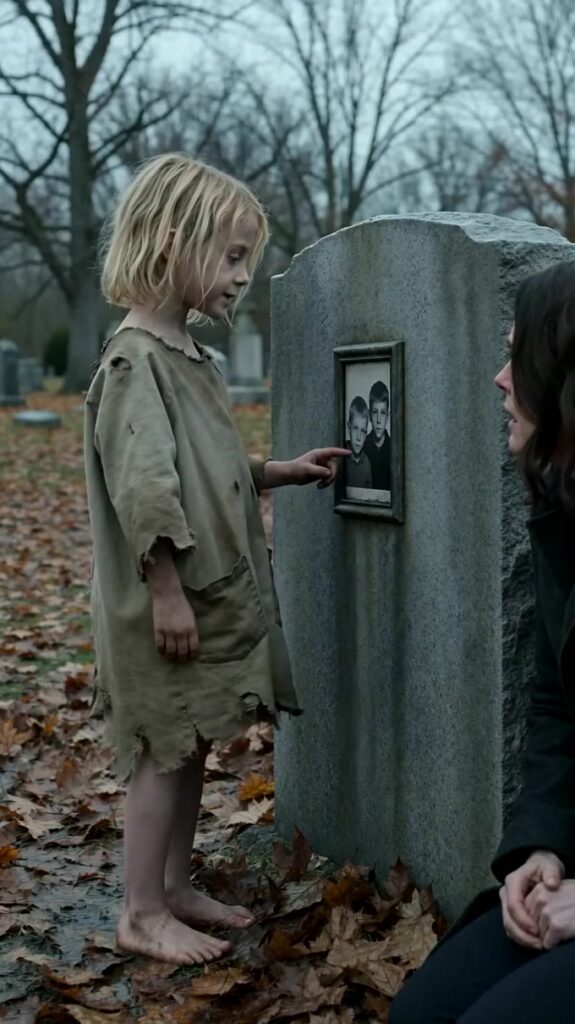
Two faces stared out from the oval photo mounted near the top: two boys, close in age, grinning with that careless confidence kids have when they believe the world is sturdy. Owen and Wyatt. Their boys. Their whole life, reduced to a picture that didn’t blink.
Mara’s fingers clawed at the soaked leaves. “I can’t—” she started, but the sentence dissolved. She pressed her forehead to her knuckles and rocked, like movement could undo time.
A wind came through the trees, thin and sharp, dragging the smell of damp dirt and distant chimney smoke. It rattled the little bouquet of grocery-store lilies they’d brought, making the petals shiver.
Then a voice cut clean through it. Small. Steady. Not scared. Not curious. Just… certain.
“They stay with me.”
Mara jerked her head up so fast her hair stuck to her cheek. Ben’s shoulders stiffened like he’d been tapped on the spine.
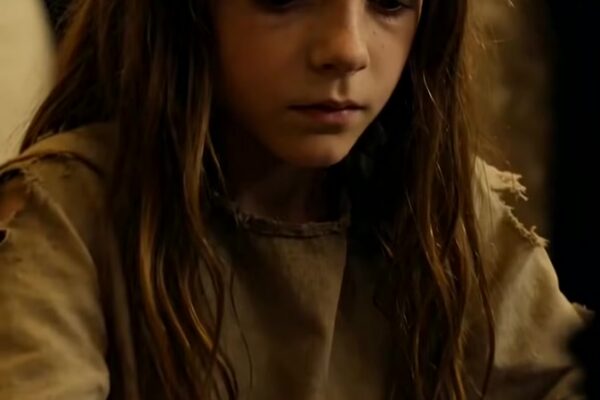
Across the grave—on the other side of the narrow strip of churned mud—stood a little girl. Barefoot. Blonde hair tangled into a wild halo. She wore a smock that might’ve been white once but now looked like it had been dragged through a ditch. Her toes were purple with cold and her knees were smudged with dirt as if she’d been crawling around the ground for fun.
She lifted one grimy finger and pointed at the photo of Owen and Wyatt, like she was identifying them in a lineup.
Ben’s voice came out hoarse. “What did you say?”
The girl didn’t flinch. Her eyes were a pale gray-blue, glossy in a way that didn’t match her age. “At the East Side orphanage,” she said softly, like it was a location everyone should know.
Mara’s face shifted. Grief didn’t leave, but it got pushed aside by something sharper. “No,” she whispered. “No, that’s—” She looked at Ben, searching his face for an explanation that could be spoken aloud.
Ben swallowed, his Adam’s apple bobbing. “Kid,” he said, forcing calm into his tone the way you do with strange dogs, “where are your shoes? Where’s your… your parents?”
“I don’t have any.” She said it like she was reporting the weather.
Mara scrambled to her feet, knees soaked through her jeans. “Sweetie, do you know where you are?”
The girl’s gaze flicked to the stone, then to Mara, then to Ben. “I know where they are,” she said. “They told me.”
Ben took one cautious step closer, stopping at the edge of the grave plot like there was an invisible line he couldn’t cross. “Who told you?”
The girl reached into the pocket of her smock. Her hand was small, knuckles pink from cold. She pulled out a toy soldier, old plastic made brittle with age, caked in mud. One arm was missing. The paint was worn down to a ghost of green.
Mara made a sound that wasn’t quite a gasp and wasn’t quite a sob. Her hands flew to her mouth so hard her fingers pressed into her lips. “That was buried with—” Her voice broke on the last word, as if saying it might summon the memory too vividly.
Ben stared at the toy like it had teeth. “That’s Wyatt’s,” he said, almost inaudible. “I put it in the casket. I… I watched it go down.”
The girl turned the soldier over in her palm, careful and gentle. “He wanted it,” she said. “But he changed his mind.”
Mara took a step back, bumping into the headstone behind her. Cold stone met warm skin through her coat. “This isn’t funny,” she said, though no one was laughing. “Who are you? Did someone send you? Are you from—” She couldn’t finish the sentence. The East Side orphanage had been a closed chapter in their life, a piece of paperwork and a set of locked memories they didn’t talk about on purpose.
Ben’s eyes narrowed, suspicion fighting with terror. “Tell us your name.”
The girl blinked slowly. “They call me Lark,” she said, and the name sounded like it had been chosen by someone who liked stories more than forms. “But I didn’t have one for a while.”
Wind brushed through her hair. She didn’t shiver. She looked like she didn’t really register weather.
“How do you have that?” Ben demanded, pointing at the toy soldier.
“It was in the dirt,” Lark said. “Where he left it. I found it when I was looking for the penny.”
Mara’s stomach dropped. “What penny?”
Lark’s mouth softened at the edges, almost like she felt sorry for them. “The one you put in Owen’s shoe. For luck.”
Mara’s knees threatened to fold. That penny—Lincoln’s profile rubbed shiny, a superstition her own father had passed down—hadn’t been mentioned to anyone. Not the funeral director, not Ben, not anyone. She’d slipped it in while everyone else was distracted, because she couldn’t stand the idea of her son going anywhere without something to help him.
Ben reached out, then stopped. His hand hovered in the air between them, undecided whether to comfort or restrain. “Okay,” he said, voice trembling. “Okay. If you know all that, then you know this isn’t right. Children don’t… come back with things from coffins.”
Lark tilted her head. “They don’t come back,” she agreed. “They just… talk where I can hear them. It’s quieter at the orphanage. Nobody listens there.”
Mara’s throat tightened. “Why would our boys be at an orphanage?” she asked, and hated herself for how the words sounded—like she was accusing the kids in that place of something.
Lark’s eyes slid to the photo again. “They said they used to be,” she murmured.
Ben went still. “Used to be what?”
“Used to be there.” Lark’s finger tapped the air as if she could touch the photograph through it. “Before they were yours.”
Mara’s face drained of color. She grabbed Ben’s sleeve, nails digging through fabric. “No,” she whispered. “We adopted them. We know. We—” She stopped because the rest of the sentence was supposed to be simple and it suddenly wasn’t. We knew everything. We had all the files. We read the reports. We asked the questions. We did it right.
Lark’s voice dropped lower, almost swallowed by the wind. “One of them said you’re not their real—”
Ben flinched as if struck. “Don’t,” he said, harsher than he meant. His eyes were wet now, the stiffness in his jaw finally cracking. “Don’t you say that like it matters.”
Lark looked at him with that unbearable calm again. “He didn’t mean it like a knife,” she said. “He meant it like a door.”
Mara stared. “A door to what?”
Lark lifted the toy soldier, and for a second Mara thought she saw the mud on it shift, like it was made of moving shadow instead of dirt. “To the part you don’t know,” Lark said. “The part they didn’t tell you at the East Side.”
Ben’s breath hitched. “Who didn’t tell us?”
Lark’s gaze flicked past them, toward the cemetery road where their car was parked. Toward the gate. Toward the world outside the fence. “The people who decided what you were allowed to read,” she said. “The people who changed names. The people who said ‘closed case’ and meant ‘keep quiet.’”
Mara felt dizzy, like the rain had soaked straight through her skull. “Why are you here?” she asked, voice thin.
Lark’s lips parted, and for the first time her calm wavered. Something like fear crossed her face, quick as a blink. “Because they asked me to find you,” she admitted. “And because if I don’t, the wrong people will.”
Ben’s eyes sharpened. “What wrong people?”
Lark looked down at the muddy soldier, then held it out across the grave toward Mara. Her arm was steady, but her fingers trembled. “Take it,” she said. “He wants you to have it back. He said it’s proof I’m not lying. And he said… you need to go to the orphanage tonight. Not tomorrow. Tonight.”
Mara didn’t move. Her brain refused to line up all the pieces into something sensible. But her body—her stupid, grieving body—reached forward as if pulled by a string. When her fingers closed around the toy, it felt colder than plastic should feel. Like it had been kept in a freezer. Like it had never been warmed by a child’s hand.
“Lark,” Mara whispered, “are you… are you alive?”
The girl blinked. Once. Twice. “Most days,” she said, and glanced toward the trees as if listening for someone else walking between them. “But I won’t be if you don’t listen.”
A gust of wind shoved through the cemetery, hard enough to shake water off branches. Mara flinched. When she looked back, the spot across the grave was empty—no barefoot girl, no smock, no pale eyes. Just wet leaves and a smear of mud where little feet had been.
Ben stared at the emptiness, then at Mara’s hand clutching the toy soldier. His voice came out like a confession. “We’re going,” he said. “Whatever this is… we’re going.”
Mara swallowed, tasting rain and panic. She looked at the boys’ faces on the headstone and tried to imagine them anywhere—anywhere—other than beneath it. “Okay,” she whispered back, because there was nothing else to say. “Okay. We’ll go.”
As they turned toward the gate, the wind shifted again, and Mara could’ve sworn she heard two boys laughing, distant and familiar, like it was coming from the wrong side of the ground.