The luxury hospital room was too quiet for what was about to happen. It had the kind of silence money buys—thick carpeting that swallowed footsteps, glass so expensive it didn’t rattle when the wind pushed at it, and machines that beeped politely, like they didn’t want to interrupt anyone important. Cool daylight slid in through the wall-sized window and made the polished floor look like a frozen pond. Two lamps glowed anyway, because the room wasn’t designed for comfort so much as for looking comfortable.
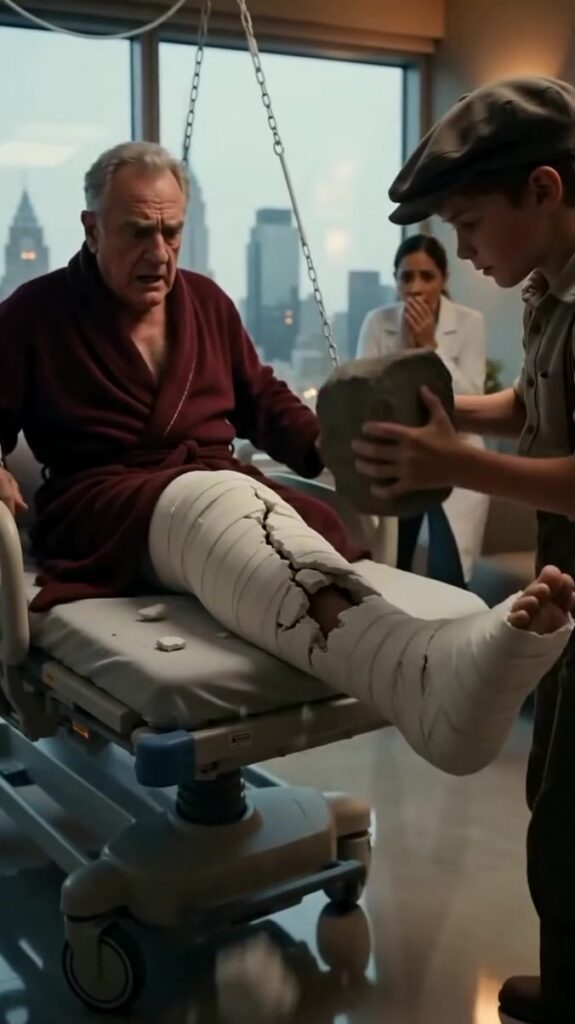
In the bed sat Vernon Lott, wrapped in a burgundy robe that probably cost more than my mom’s car. His leg—his “tragic, irreparable leg,” as he called it—hung in a sling, buried in a huge white cast. He had a remote control for the blinds, a call button the size of a coaster, and a tray with untouched fruit that looked like it had been styled by a photographer.
Near the back, two doctors hovered in that way doctors do when they’re trying to decide whether to be professional or honest. Dr. Mallory, all clean lines and calm voice, kept glancing at the door like she’d left the stove on. Dr. Finch, the one with the tired eyes, stared at Vernon’s cast with the guarded look of someone watching a magician’s sleeve.
And then there was Eli. A kid who didn’t belong in any of it.
He stood in the middle of the room in a scuffed vintage cap and suspenders that had definitely lived a whole life before him. He was thin in a way that wasn’t fashionable. His shoes were too big, his elbows sharp under his sleeves, and he held a heavy dark stone in both hands like it was the most normal thing in the world to bring to a private suite in a luxury hospital.
Vernon threw his arms wide, like he was welcoming Eli onto a stage. “All right, kid,” he said, grinning. “Heal me. Do your little miracle. I’ll give you one million.”
Dr. Finch made a small sound that could’ve been a cough or a warning. Dr. Mallory’s mouth tightened. They’d seen Vernon do this before—make a show, tease the staff, toss ridiculous promises around like confetti. Last week he’d offered a nurse a diamond bracelet if she could make the hospital mashed potatoes taste like “real food.” She’d laughed. He hadn’t meant it. Or maybe he had, but only for the fun of watching people hope.
Eli didn’t smile. Not even the polite kind people do when they’re trying to keep things from getting weird.
He stepped closer to the bed. The stone in his hands looked like something pulled from a riverbed: black, matte, a little shiny at the edges where fingers had worried it smooth. He didn’t raise it dramatically. He just lifted it like a tool.
Vernon was still laughing when Eli swung.
The crack was violent, a sound that didn’t belong in a room with silk curtains. It echoed off the glass and jolted the heart out of everyone watching. Plaster dust jumped into the air like pale smoke.
Dr. Mallory gasped. Dr. Finch took a step forward, then stopped as if he’d walked into a line of invisible electric wire.
Vernon grabbed the bedrails so hard his knuckles went bone-white. The grin slid off his face in pieces. “What did you do?!” he barked, voice pitching high with surprise.
Eli didn’t flinch. He stared at the fracture line spreading across the cast like a map of an earthquake. “It wasn’t healing,” he said, calm as if he’d pointed out a stain on a shirt.
The silence that followed was worse than the crack. It pressed into the corners of the room, into the space between the doctors’ shoulders, into Vernon’s throat as he swallowed too hard.
“Security,” Dr. Mallory said automatically, already reaching toward the wall phone, but her hand hesitated halfway. There was something about Eli’s stillness. He didn’t look angry. He looked certain.
Vernon’s eyes darted from Eli to the doctors and back. Fear arrived on his face like a curtain dropping. “You—You can’t—” he started, but Eli raised the stone again.
“Stop!” Vernon shouted, suddenly desperate in a way money couldn’t cushion. “Stop right now!”
Eli brought the stone down again.
Another brutal crack. A chunk of plaster broke loose, bounced once on the blanket, and rolled toward Vernon’s hip. Dr. Mallory clapped a hand over her mouth. Dr. Finch’s lips moved like he was doing a silent count of consequences.
Through the split, a glimpse of skin appeared—pale, compressed, with the angry red imprint of padding. Vernon stared at it as if the cast had been the only thing holding his identity together.
Eli let the stone slip from his hands. It thudded onto the carpet, and the quiet swallowed that sound too, like the room was trying to pretend none of this was happening.
Then Eli pointed—not at the cast, not at the doctors, but at Vernon’s exposed toes. “Move them,” he said.
Vernon’s face went stiff. His eyes widened, then narrowed, like he could bargain his way out of anatomy. “I can’t,” he snapped, but the words didn’t land with confidence. They landed with habit.
“Try,” Eli said.
No one breathed. Even the machines seemed to keep their beeping soft.
Vernon stared at his foot, jaw working. His toes were still for a beat… and then one twitched. Barely. Like a secret. Then another toe lifted a fraction, as if it had been waiting for permission.
Both doctors reacted at once—Dr. Mallory inhaled sharply, eyes shining with disbelief, and Dr. Finch’s head jerked forward like he’d just witnessed a door open in a wall he’d been leaning against for weeks.
Vernon’s breathing turned ragged. He looked at his own foot like it belonged to a stranger who’d walked into his room uninvited. “That’s… that’s impossible,” he whispered, but his voice had lost its theatrical boom. This was raw now.
Eli stepped closer to the bed and lifted his eyes to Vernon’s face. He wasn’t triumphant. He looked tired, the way a kid looks when adults keep doing predictable things and calling them complicated. “So why were you pretending?” he asked.
Vernon’s gaze snapped up. For the first time, he didn’t look like a man in charge of the room. He looked cornered. “I wasn’t—” he began, but the lie stumbled before it even stood up.
Dr. Finch found his voice. “Mr. Lott,” he said carefully, “you told us you had no sensation below the ankle. You told us physical therapy was ‘a waste of everyone’s time.’”
Vernon’s eyes flicked to the door again, like an exit might materialize if he stared hard enough. “You don’t understand,” he said, and there was something almost pleading in it. “When you’re… when you’re important, people stop noticing you unless something is wrong.”
“That’s not—” Dr. Mallory started, but Eli cut through gently, which was somehow more threatening than yelling.
“If your leg works,” Eli said, voice low, “then what else have you been lying about?”
Vernon’s mouth opened and closed. The room, with all its money and shine and quiet, felt suddenly cheap—like a set someone forgot to reinforce. Dr. Finch stared at Vernon as if seeing a different patient entirely. Dr. Mallory lowered her hand from her mouth, her expression shifting from shock to something like anger.
Vernon swallowed. “Who are you?” he asked, the question coming out smaller than he meant it to.
Eli glanced at the stone on the carpet and then back up. “Just somebody who’s tired of watching rich people buy excuses,” he said. Then he nodded toward the broken cast. “You wanted a miracle. That was it. Not healing. Just proof.”
Outside the window, the city kept moving, bright and indifferent. Inside, Vernon’s million-dollar promise hung in the air like a balloon losing helium. Nobody reached for it. Nobody even mentioned it. Because the quiet had finally been replaced by something else—truth, sharp and loud, cracking open everything that had been wrapped up too neatly.
And in that moment, with plaster dust still floating in the sunlight, Vernon Lott realized the scariest thing in the room wasn’t the kid with the stone.
It was the fact that the kid had been right.