The sidewalk outside Maribel’s Bakery always smelled like butter and sugar, even when the wind cut through your jacket like it had teeth. That afternoon the street was quiet in the way cities get quiet when everyone’s inside pretending winter isn’t coming. Leaves scraped along the curb like tiny brooms, and the bakery windows glowed warm and golden—people inside laughing into paper cups of coffee, arguing softly over croissants, living the kind of normal life that feels almost rude when you’re stuck outside.
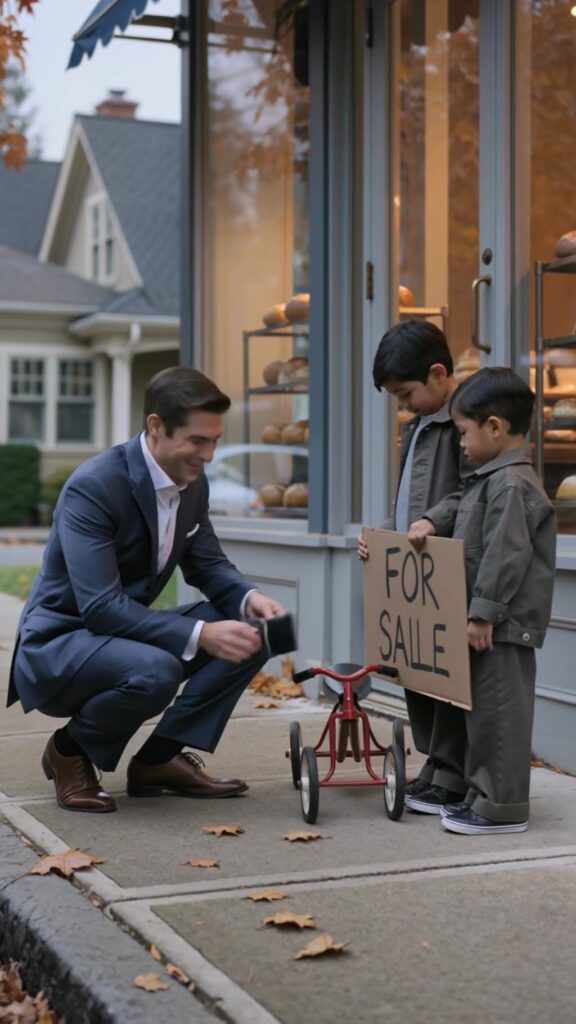
Outside, two boys stood next to a red pedal car.
It was the kind of toy you’d see in old photos: metal body, little steering wheel, chrome handle, the paint scuffed until the red looked more like a tired apple than a shiny firetruck. A cardboard sign was taped to the hood in uneven handwriting: FOR SALE.
The older boy, maybe eight, kept readjusting the sign like it might blow away. He tried to stand tall, but his shoulders kept sneaking back toward a hunch, the way they do when you’ve been cold for too long. The younger one, probably five, pressed into his side as if he could disappear through his brother’s coat. His nose was red, his eyes glossy, and he didn’t look at anyone passing by. He looked at the ground like it was safer there.
People walked past. Some slowed down, made a face like they were thinking about it, then hurried on. A woman in a wool hat glanced at the boys and then at her watch, like empathy was an appointment she was late for. Someone dropped a few coins in the gutter by accident and didn’t notice.
Then a dark car slid into the space near the curb and stopped with a soft, expensive hush. The kind of car that wasn’t just transportation but an announcement. The driver’s door opened, and a man stepped out in a sharp blue suit. He looked like he belonged in those shiny buildings downtown where the doors opened for you.
He adjusted his cuff—habit, not necessity—then his gaze snagged on the red pedal car. On the sign. On the boys.
He walked over slowly, not like someone afraid, more like someone unsure what story he was about to walk into. When he reached them, he didn’t tower. He crouched down until his eyes were level with theirs. Up close, the suit still looked expensive, but the man’s face didn’t look polished. His hair was too neat to be careless, yet his eyes had a tired softness like he’d been losing arguments with himself for years.
“Hey,” he said, voice gentle in a way that didn’t feel practiced. “Is… is this car for sale?”
The older boy nodded. His jaw tightened like he was holding something in place that wanted to spill out. “Yes, sir.”
“How much?” the man asked, glancing at the cardboard.
“It’s… it’s whatever you can,” the boy said. His eyes flicked toward the bakery window and back, as if warmth was something you had to be careful staring at too long. “We need medicine for our mom.”
The man’s expression changed so fast it was almost like a flinch. He looked at the younger boy, who stared at his shoes like the ground might swallow him if he didn’t keep an eye on it.
“You don’t have to sell it,” the man said. He reached into his wallet. “I can help you without—”
The older boy’s hands closed around the pedal car’s steering wheel. Not possessive, more like desperate. Like if he let go, something else would be taken. “No,” he said quickly, and then softer, “We have to.”
The man paused with a bill half-slid out between his fingers. “Why?”
The older boy swallowed. You could see him gathering courage like it was something heavy he had to lift. The younger one finally looked up, not at the man’s face but at the wallet, then down again, as if money itself could be scary.
“Mom said,” the older boy began, and his voice went thin. “She said to find the man who bought this car for my first birthday.” He forced himself to look the man straight in the eyes. “She said he’s our father.”
The bill slipped. It didn’t fall all the way to the sidewalk; it just sagged between the man’s fingers like his hand had forgotten how to work.
For a second everything froze—the leaves, the street noise, the warm hum behind the glass. The man’s face drained until it looked like someone had turned down the color. His eyes dropped to the red pedal car like it was suddenly a photograph from a life he’d hidden in a drawer.
His gaze landed on the front wheel. On a small scratch in the paint, right where the metal curved.
He knew that scratch.
He remembered making it. He remembered holding the little car in his arms in a cramped apartment that smelled like laundry detergent and cheap tomato sauce. He remembered laughing too loud because he was scared of being quiet. He remembered a woman—Tessa—standing in the doorway with her arms crossed, trying to look annoyed while her eyes shone like she’d swallowed sunlight. He remembered promising he’d never miss a birthday.
And then he remembered the letter from his father’s law firm. The job offer. The ultimatum hidden under fancy words. The fight. The slammed door. The months he told himself he’d go back when things calmed down, when he had money, when he had time. The years that piled up like dirty dishes because it was easier to ignore the sink than wash anything.
The younger boy watched him now, finally noticing the silence. His small hands clenched the older boy’s coat. “Owen?” he whispered, sounding like he didn’t want the answer to whatever was happening.
The older boy—Owen—didn’t look away from the man. His eyes were wet, but he didn’t let the tears fall. Like he’d decided crying was a luxury.
“She said,” Owen added, voice barely louder than the rustling leaves, “if you still loved us… you’d stop.”
The man’s throat moved. No words came out at first. He put the wallet away like it was suddenly irrelevant and set both hands on his knees to steady himself. Up close, Owen could see there were faint lines at the corners of his eyes, not from smiling but from squinting into too many bright days he hadn’t enjoyed.
“What’s your mom’s name?” he managed.
Owen blinked like he wasn’t sure he was allowed to hope. “Tessa Hart.”
The man shut his eyes for a fraction of a second, as if the name hit him physically. When he opened them again, they were glassy. “I’m… I’m Daniel,” he said. “Daniel Hart.”
Owen’s mouth fell open a little. Like he’d expected a stranger and got something else entirely. “You—you took her last name?”
Daniel gave a small, broken laugh. “I did. After I left.” He shook his head, angry at himself. “That’s not—” He took a breath. “Is she… is she sick?”
Owen nodded hard. “Really sick. She’s been trying to work, but she can’t. She said the medicine helps but it’s expensive. She’s been… she’s been sleeping a lot.”
Daniel’s eyes flicked to the bakery window, to the warm people inside. To the boys outside. To the red pedal car that should’ve been racing down a hallway, not sitting on a cold sidewalk with a sign.
“Where is she?” he asked, voice suddenly urgent.
Owen hesitated, glancing at his brother. The younger boy—Max, Daniel realized, because the face was a smaller version of his own baby photos—was trembling.
“She’s at home,” Owen said. “She didn’t want us to come alone, but—” He looked down, ashamed. “We didn’t know what else to do.”
Daniel stood up too quickly, then caught himself so he wouldn’t scare them. He ran a hand through his hair, messing it up for the first time. “Okay,” he said. “Okay. You did what you had to do. You’re not in trouble. You hear me?”
Owen nodded, but his eyes stayed cautious. The world doesn’t hand trust back easily.
Daniel crouched again and looked at the red pedal car. He touched the scratch lightly with one finger, like it might vanish if he pressed too hard. “I bought this,” he said quietly, mostly to himself. “I remember the day.”
Max finally spoke, voice thin. “Are you… are you really our dad?”
Daniel’s chest tightened. He looked at the younger boy’s small face, the shape of his nose, the stubborn set of his chin. “I am,” he said, and the word sounded both simple and impossible. “And I’ve done a terrible job of it so far.”
Max looked at Owen like Owen was the translator for scary things. Owen swallowed and asked the question that mattered most, the one hiding under all the others. “Will you come?”
Daniel didn’t even hesitate. “Yes,” he said. “Right now.”
He glanced at the pedal car again, then at the cardboard sign. He reached out and peeled the tape carefully so the sign didn’t tear. He folded the cardboard in half and handed it to Owen like it was a receipt for a debt he intended to pay.
“You can keep the car,” he said. “It was never meant to be a lifeline. It was meant to be a toy.”
Owen’s grip loosened, just a little. “But the medicine—”
“I’ve got it,” Daniel said. “And if I don’t, I’ll figure it out. I should’ve been figuring it out years ago.”
He stood and opened the back door of the dark car. “Get in,” he told them, then softened it immediately. “Please. It’s warm.”
Max climbed in first, still cautious, like warmth might be a trick. Owen hesitated long enough to haul the red pedal car toward the open door.
Daniel helped him lift it, careful with its bent chrome and worn paint like it was something sacred.
As Daniel closed the door, Owen looked up at him again, eyes shining with fear and something that might become relief if it was given enough room. “Mom said you’d recognize it,” he whispered. “The scratch.”
Daniel swallowed hard. “I did,” he said. Then, because he didn’t know how else to start becoming who he should’ve been, he added, “Thank you for stopping me.”
The street stayed cold. The bakery stayed warm. But inside the dark car, the air shifted—like the world had cracked just enough for something honest to finally get through.