The kind of café that charges extra for oat milk has a smell all its own—warm butter, citrus cleaner, money. I’d picked it on purpose. If I stayed in places that looked like magazine pages, nothing bad could reach me. That was the rule I’d been living by since last year, since the funeral, since every condolence card started to feel like a paper cut.
I was halfway through pretending to read an email when the room tilted. Not literally. The air just changed. A ripple of discomfort moved from the entrance to the barista counter to the women with glossy hair and little dogs. People turned their heads like prairie animals sensing a shadow.
He came in like a dare.
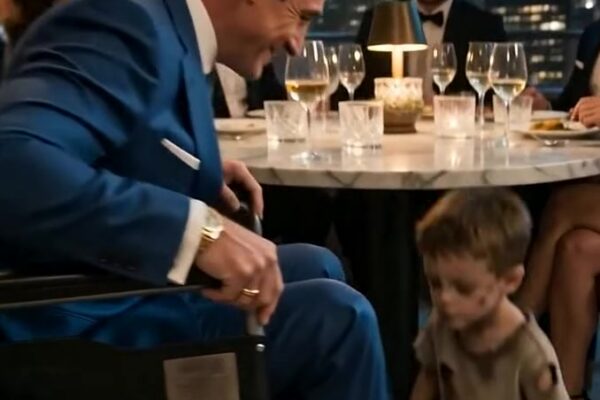
A boy—maybe eight, maybe ten—barefoot on the polished stone floor. He was all elbows and knees, dust ground into his skin, shorts too big on his hips like they belonged to someone older. His hair had the flat, stubborn shape of being slept on in bad places. He looked like hunger wearing a face.
A manager in a crisp apron started to step forward, already forming that polite, sharp smile people use before they ask you to disappear.
The boy didn’t wait.
He walked straight toward my table.
I froze, half reaching for my bag, half deciding if this was a scam. I’d seen plenty of those—someone comes up, says they know you, says they need help, says your name like it’s a key.
But the boy didn’t say my name. He reached out—slow, careful—toward my hair.
I jerked back so hard my chair legs scraped. “Hey. Don’t touch me.”
His hand stopped in the air, fingers curled like he’d meant to brush a strand out of my face. He lowered it immediately. There was no anger in him, no swagger. Just this defeated kind of sadness that made my throat tighten before I could stop it.
“She had the same hair,” he said. His voice was quiet, sandpapered by disuse.
“Who?” I heard myself ask, even though I already felt the answer creeping under my skin.
He swallowed. “My mom.”
My stomach dropped. “Your mom told you to come bother strangers at cafés?”
He shook his head like that wasn’t the point. His eyes were too old for his face. “She said I’d find you here. That you’d be by the window because you like to see the street even when you don’t look up.”
I blinked. I didn’t tell anyone that. I barely admitted it to myself. I stared out the window because I couldn’t stand having my back to a room anymore.
The boy slowly opened his fist.
Something silver lay in his palm, dulled by grime but unmistakable. A hair clip shaped like a small leaf, studded with pale stones that caught the café’s soft lighting even through the dirt. One corner was bent inward, like it had been stepped on or crushed in a door.
I knew that clip the way you know your own scar.
I’d bought it with babysitting money twelve years ago at a tiny boutique downtown, because my sister Elena had been trying to look “grown-up” for her first big school dance. She’d laughed when I gave it to her and called me dramatic, then wore it every day for a week just to make me happy. After she vanished, that clip became an object in the case file, a photograph in a folder, a rumor turned solid.
It had been found near the riverbank.
It had been called evidence.
It had been treated like a period at the end of her sentence.
My mouth went dry. “That’s… impossible.”
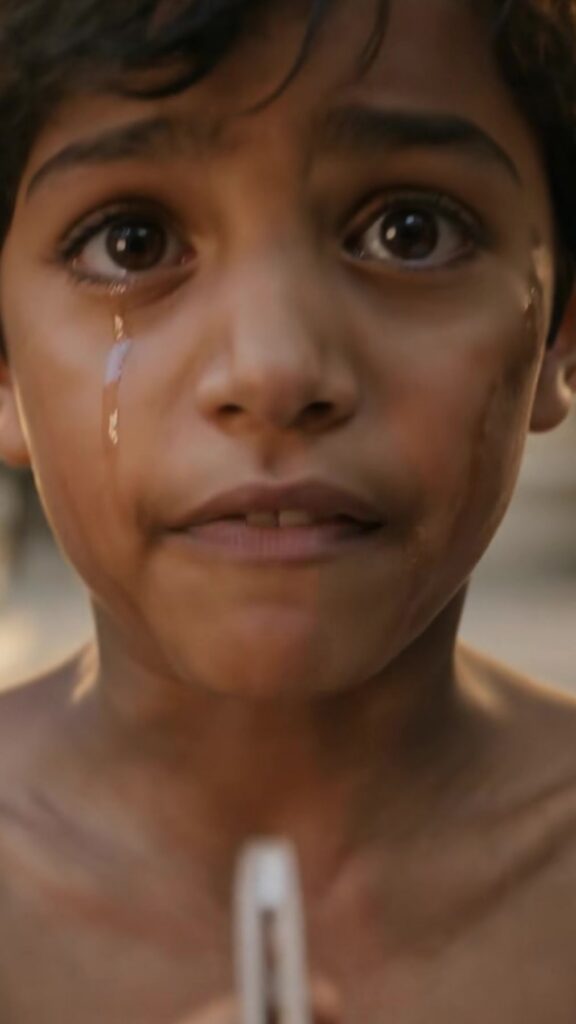
The boy’s lips trembled. A tear slid down the dirt on his cheek, leaving a clean track. “She said you’d say that.”
I leaned forward so fast my knees bumped the table. “Where did you get this?”
He looked down at the clip like it weighed more than he could hold. “She gave it to me.”
My heart banged against my ribs, painful, panicked. “When?”
He hesitated, eyes flicking to the manager now hovering a few steps away, trying to decide whether to intervene. The boy didn’t seem afraid of being thrown out. He seemed afraid of saying the next part wrong.
“Last night,” he whispered. “She said you’d listen better if I showed you something that belonged to her.”
The world went narrow. The café’s music faded. The espresso machine hissed like it was far away in another city.
I reached out and almost touched the clip, then pulled back, like it might burn me. “What’s your name?”
“Milo.” He sniffed. “She calls me ‘bug’ sometimes. Like… like a nickname.”
My sister used to call me bug when I was little. I hated it. I loved it. I hadn’t heard the word in a decade.
“Milo,” I said, forcing my voice steady, “where is she right now?”
His gaze slid past me, over my shoulder, toward the hedge-lined walkway that ran alongside the café patio. I followed it without thinking.
A woman stood half-hidden by the greenery. Beige skirt suit. Hair pinned up. One hand pressed lightly against her ribs, the way Elena did when she was nervous or lying or both. The shape of her face—the slope of the nose, the chin that always looked like it was deciding whether to be stubborn—hit me like a fist.
My lungs stopped working.
Because she was wearing my sister’s face.
And she wasn’t alone.
A man stood beside her, slightly behind, like a shadow in a tailored coat. Broad shoulders. Familiar stance. The tilt of his head when he listened. The same man whose coffin I’d watched descend into earth last year after a “car accident” so sudden the police wouldn’t answer my questions. The man whose suit I’d donated and whose phone I’d kept in a drawer because I couldn’t stop expecting it to buzz.
My husband, Ben.
My coffee cup slid from my fingers and exploded on the floor, porcelain and dark liquid everywhere. The sound snapped the café back to life—gasps, chairs scraping, the manager stepping forward with alarm in his eyes.
The woman by the hedges didn’t flinch. She just watched me, still as a statue that had been waiting for this moment.
Ben—no, not Ben, because Ben was dead—turned his head slightly and looked directly at me. His mouth moved like he was saying something I couldn’t hear through the blood pounding in my ears.
Milo’s small hand touched my wrist, light as a moth. “Don’t scream,” he whispered urgently. “Please don’t. She said they’ll run if you scream.”
“Who?” My voice came out broken. “Run where?”
He swallowed hard. “Away again.”
I stood so abruptly my chair toppled backward. The manager started to say, “Ma’am—” but I didn’t have a ma’am left in me. I stepped around the shattered cup like it was nothing. I walked toward the patio doors, my legs moving on their own, the clip burning in my memory like a brand.
Elena’s eyes—Elena’s exact eyes—met mine through the leaves. She lifted her hand, not waving. Signaling. Come here. Quiet. Now.
Ben’s hand hovered near the small of her back, protective or controlling—I couldn’t tell. My skin crawled with the wrongness of it.
As I pushed through the door, warm air turning to cooler outside breeze, Milo trotted after me on his bare feet without making a sound. The café behind us erupted in murmurs, but it all felt like the soundtrack to someone else’s life.
I stopped three steps from my sister, close enough to see the fine lines at the corners of her mouth that hadn’t been there when she disappeared. Close enough to smell her perfume—something crisp and expensive, nothing like the strawberry body spray she used to steal from my room.
“Lina?” My voice shook on her nickname.
She flinched like it hurt. “Don’t say that name,” she breathed, then immediately softened, eyes brightening with tears she didn’t let fall. “Mara.”
I couldn’t decide whether to slap her, hug her, or collapse. “You’re dead,” I said, because it was the only sentence my brain had left. “You’re—”
“I was supposed to be,” she said. Her gaze flicked to Ben. “We were.”
Ben stepped forward, and the air seemed to shrink around him. He looked the same and not the same—hair shorter, jaw tighter, eyes carrying a calm I’d never seen when we were married. Like he’d been practicing being someone else.
“Mara,” he said gently, like we were meeting for lunch. “We didn’t want you involved.”
I laughed, a sharp ugly sound. “Involved? In what? In the fact that I buried you?”
Milo pressed the hair clip into my palm. His fingers were cold. “She said you’d need proof,” he whispered.
Elena watched me clutch it, her face crumpling for a second. “I’m sorry,” she said, and the words seemed too small for the canyon between us. “I’m so sorry. We didn’t mean for it to go this far.”
“How far?” I demanded. “Twelve years? A fake body? A fake accident?” My voice rose despite Milo’s warning. “You let Mom die thinking—”
Elena’s breath hitched. Ben’s eyes flicked toward the walkway, scanning like he was expecting someone to appear. That’s when I noticed the earpiece tucked behind his ear, nearly invisible. The kind you see on security guards and people who don’t want to be followed.
My terror shifted shape, becoming something sharper, more specific.
“Who are you running from?” I asked, quieter now, because suddenly I believed the running part.
Elena looked past me to the café’s glass façade, to the people staring, to the manager on the phone. Her voice dropped to a whisper. “The same people who made it easy for the police to call me a runaway. The same people who signed Ben’s death certificate without asking for dental records.”
Milo tugged my sleeve. “We have to go,” he said. “She said once you saw, you’d either come with us or… or you’d never see her again.”
Ben held out his hand—not to me, but to Milo. Protective. Practiced. “Decision time,” he said softly.
I stared at Elena—at my sister alive, my husband resurrected, and a barefoot boy holding my whole world together with a dirty palm and a bent piece of jewelry. My pulse roared in my ears as if my body was trying to warn me of something my mind still couldn’t name.
Then, through the hedges, I saw a black sedan glide to the curb, too smooth, too deliberate. Two men inside, silhouettes that didn’t belong to tourists.
Elena’s hand tightened against her ribs. Ben’s calm cracked for the first time. Milo’s grip on my sleeve turned desperate.
I forgot how to breathe—not from shock this time, but from the sudden understanding that whatever story I thought I’d lived was just the safe, edited version.
And the uncut version had finally found me at a luxury café.
“Mara,” Elena whispered, eyes pleading. “If you ever loved me at all—if you ever loved him—come now.”
I looked back at the café, at the life I’d been performing. Then at the sedan, the men inside, the way Ben’s shoulders squared like he was ready to fight or flee.
My fingers closed around the jeweled clip until the stones bit into my skin.
“Okay,” I said, and my voice surprised me with how steady it sounded. “Tell me everything. But you’re not disappearing again.”
Elena’s eyes flashed with something like relief and terror mixed together. Ben nodded once, sharp. Milo exhaled like he’d been holding his breath for hours.
And as we moved into the hedges, slipping out of view, the café behind us kept sparkling like nothing in the world had changed—while mine broke open completely.