By the time the city learned to dress itself in spring again, Elliot Harper had trained his face into something that didn’t invite conversation. He kept his eyes forward, his hands on the push handles, and his voice clipped to the bare minimum required to buy groceries or pay a bill. He’d learned, the hard way, that people loved to sprinkle “maybe” over tragedy like it was salt. Maybe she’ll improve. Maybe a new program. Maybe a clinical trial in another state. Maybe, maybe, maybe. Elliot didn’t collect maybes anymore.
Mara didn’t either, not really. She just wore them better. At sixteen she’d mastered the kind of smile that made adults feel less guilty for staring at her chair. She was all sharp eyebrows and patient jokes, her dark hair pulled into a messy bun, her backpack hanging off one handle like it belonged there. Sometimes, when Elliot caught her looking at a group of girls in sneakers and short skirts, her smile slid away for a second. That was when he felt his throat tighten and his hatred for false hope turn into something almost physical.
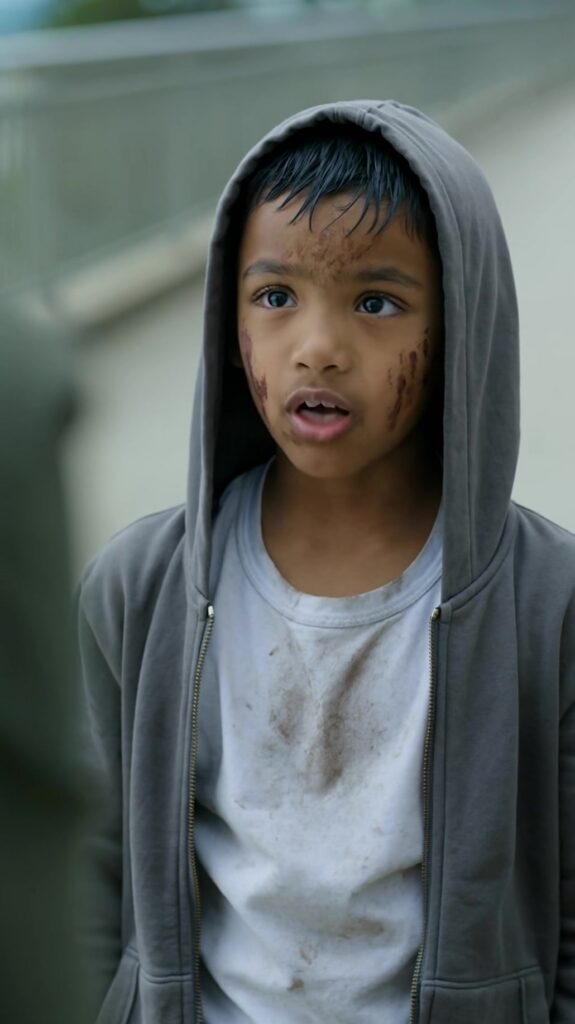
They were on the pedestrian path behind the library, a shortcut home Elliot took because it avoided the steep sidewalk where the front wheel always snagged. The air smelled like wet mulch and someone’s latte. Mara was telling him about a podcast she liked—something about lost ships and conspiracies—when a boy stepped out from behind the little stone planter near the bench. He wasn’t much older than Mara, maybe seventeen or eighteen. Torn hoodie, grime on his cheeks, shoes held together by faith and duct tape. The kind of kid Elliot usually pretended not to see, the kind everyone else pretended not to see.
“Hey,” the boy said, like he’d been waiting all morning. “I can help her.”
Elliot’s whole body tightened. Instinct shoved him between the chair and the stranger, hands up, chest forward. “Nope. Don’t. Whatever you’re selling, we’re not buying.” His voice came out rougher than he meant, but he didn’t soften it. Softness invited stories. Stories invited hope. Hope invited the crash afterward.
The boy didn’t flinch. He didn’t laugh, didn’t get defensive, didn’t do the usual thing where a scammer tries to sound offended. He just stood there, too calm, eyes flicking past Elliot to Mara. Mara had stopped mid-sentence. Her fingers were clenched around the armrests, knuckles pale. Elliot turned his head, confused by the sudden silence, and saw her face change in a way that made his stomach drop. It wasn’t fear. It was something like… seeing a familiar street sign in the wrong city.
“Doctors couldn’t fix it,” Elliot snapped, trying to drag Mara back into the present with anger. “Physical therapy, surgeries, specialists—you name it. You think you’re better than all of them?”
The boy swallowed. For the first time he looked his age, like he was holding something heavy inside his ribs. “I’m not better,” he said. “I’m just… I promised. Your mom told me I’d find you.”
Everything went quiet, like the world decided to stop making background noise. Elliot felt his heart stumble. “Don’t,” he said, low and dangerous. “Don’t talk about her.”
Mara made a sound that wasn’t quite a sob, wasn’t quite a laugh. Tears filled her eyes fast, like someone had flipped a switch. “Dad,” she whispered. “Wait.”
The boy reached into the front pocket of his hoodie and pulled out a small silver charm on a broken chain. It caught the watery sunlight and flashed. Elliot knew it before his brain could say the words. A tiny music note, worn smooth at the edges from years of nervous thumb-rubbing. His wife, Rachel, had worn it on a bracelet since college. He’d teased her about it—said it looked like a prize from a vending machine. She’d rolled her eyes and told him it reminded her to keep singing even when life was noisy.
Elliot’s legs went weak in an embarrassing, teenager-in-gym-class way. “Where did you get that?” he managed.
“From my mom,” the boy said. “She—she died last year. She kept it in a tin with letters.” He held the charm out like it might burn him. “Her name was Janice. She worked at St. Mary’s. She was on shift the night of… your accident.”
Elliot’s mouth went dry. That night was a messy blur of headlights and sirens, Mara’s scream, the smell of deployed airbags. Rachel had been gone before Elliot even understood she was gone. He remembered a nurse with tired eyes, someone pressing paperwork into his hands, someone else whispering that Mara’s spine had been injured. He remembered a bracelet on Rachel’s wrist in the hospital, and then not.
“Janice cleaned out the trauma bay,” the boy continued, words tripping over each other now that he’d started. “She found the charm under the gurney. She didn’t know whose it was at first. Then she saw your wife’s name on a form. She—” He wiped his face with the heel of his hand, smearing dirt. “She couldn’t bring herself to hand it in. She said it felt like stealing from grief. So she kept it until she could figure out how to return it. She tried to reach you, but—” He looked past them, embarrassed. “Life happens. Then she got sick. And before she went, she gave me the tin and told me to do the thing she never did.”
Mara was openly crying now, shoulders shaking. Elliot hated that, hated this stranger for cracking open a part of their life they’d glued shut. And yet, underneath the anger, something else trembled: a thread pulled tight for three years and suddenly tugged.
“She said,” the boy went on carefully, “that if I ever found you, I had to ask what you keep under the seat. She said it matters. She said you’d know.”
Elliot’s eyes snapped to Mara’s chair like it had grown teeth. Under the seat was a thin fabric pouch, strapped to the frame. He’d put it there himself. It held boring things—an extra phone charger, a pack of wipes, a folded poncho, a tiny screwdriver for when the footrest loosened. Practical. Normal. Safe.
“Dad,” Mara said, voice watery. “I… I remember Mom tucking something in there. After the accident. When I was in rehab.” She sniffed hard. “She said it was a ‘just in case.’ I thought it was, like, candy.”
Elliot’s hands shook as he crouched. He undid the Velcro with clumsy fingers and pulled the pouch down. His brain shouted at him to stop. This was exactly how false hope got in—through tiny doors you didn’t even notice you’d left unlocked. He opened the pouch anyway.
Inside, tucked behind the wipes and the poncho, was an envelope. Not fresh. Old, corners softened, sealed with clear tape that had yellowed. Rachel’s handwriting slanted across the front: For Elliot and Mara. Not for today. For when you’re ready to be mad at me.
Elliot’s breath hitched, sharp as glass. He could almost hear her voice saying it, half-apologetic, half-annoyingly right. He looked up at Mara. She was watching him like the envelope was a live animal.
“Open it,” she said, barely audible. “Please.”
Elliot tore the tape. A second smaller chain slid out first, coiled like a sleepy snake. Attached to it was a key. Cheap brass, no label. Under it was a letter and a folded map of their neighborhood with a circle drawn around a storage unit place near the highway.
Rachel’s letter was short, because Rachel never believed in dragging a point out when it hurt. She’d written that she’d been scared Elliot would drown in plans to fix what couldn’t be fixed. She’d written that she didn’t want Mara’s life to become a waiting room. She’d also written, in ink that pressed hard into the paper: If you find this, it means I’m not there to nag you. So let me nag you one last time. Use the key. Go to the unit. Take what’s inside. It isn’t a cure. It’s a door.
Elliot stared at the word door until the letters blurred. “This is ridiculous,” he muttered, more to himself than anyone else. “This is—” He stopped, because Mara had reached out and covered his hand with hers. Warm, steady, real.
“Not a cure,” Mara repeated, wiping her cheek with her sleeve. “I can handle that. Can you?”
Elliot swallowed a laugh that sounded too close to a sob. He looked at the boy, who was standing awkwardly to the side like he didn’t know what to do with his arms. “What’s your name?” Elliot asked, because suddenly he needed this to be human and not a ghost story.
“Noah,” the boy said. “My mom said you might hate me.”
“I don’t hate you,” Elliot said, surprised to find it was true. What he hated was the glittery cruelty of strangers who offered miracles like party favors. Noah wasn’t doing that. Noah looked like someone who’d carried a promise through his own mess and showed up anyway.
Elliot stood, the key cold in his palm, the charm glinting between Noah’s fingers. “Okay,” he said, voice hoarse. “We’ll go.”
“Now?” Mara asked, a tremor of something like excitement sneaking into her grief.
Elliot hesitated, because three years of survival had taught him to say not yet to anything that might break them. Then he remembered Rachel’s handwriting: Not for today. For when you’re ready. He looked at Mara’s face—wet, brave, tired of waiting rooms—and realized readiness wasn’t a feeling. It was a decision.
“Yeah,” he said, and for the first time in a long time, he let a new word sit in his chest without flinching. Not hope. Not miracles. Just motion. “Now.”