The market was doing what it always did—being too loud to think inside your own head. Fruit sellers hollered like they were auditioning for a street opera. A fishmonger slapped a slab of ice with a scoop like it had insulted his mother. Someone argued over the weight of potatoes as if it were a matter of national security. It was the kind of noise that made you forget you were a person and not just another body being carried along by the crowd.
Mara noticed the girl before the crowd did. Mara always noticed kids. Not because she was sentimental—she’d spent enough years behind a produce stall to burn through most forms of softness—but because kids moved differently. They didn’t stride with purpose or shove like adults. They hovered at the edges, testing the world like it might bite.
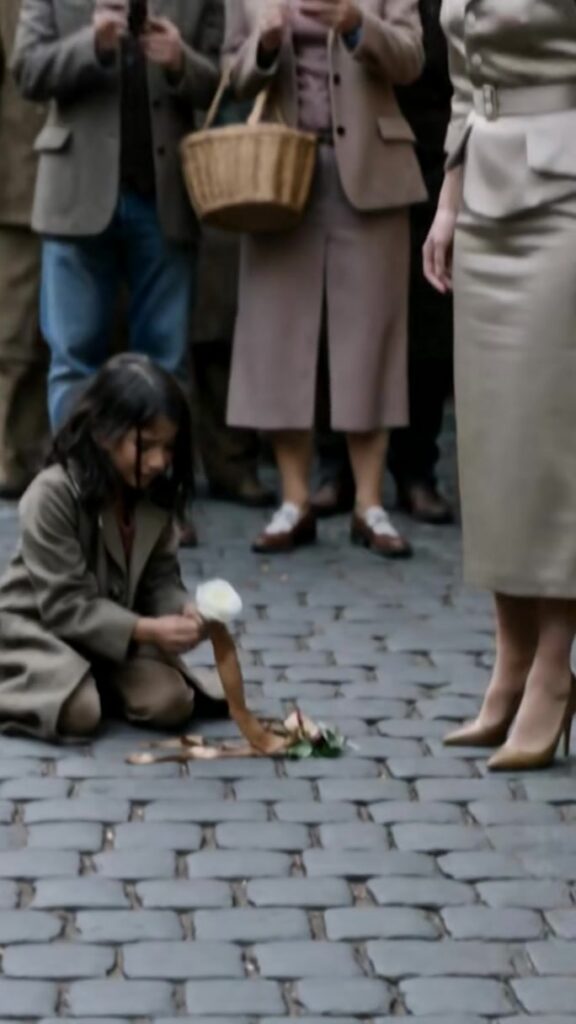
The girl looked about eight or nine. Her coat was too thin for the weather and too big for her, the sleeves swallowing her wrists. She held something with both hands, carefully, like it was delicate or sacred. A white flower—some kind of daisy or a garden bloom that had no business surviving the grime of this place—was tied with a faded ribbon. The ribbon wasn’t pretty anymore, but it had once been. A pale blue maybe, now sun-washed to the color of old sky.
“Flower for a coin,” the girl said softly. She wasn’t yelling. She wasn’t even really asking. Just offering, like she’d been taught manners by someone who used to have time for them.
People brushed past her. A couple of shoppers glanced down and then away, the way you look at a sad headline you don’t want to click. Mara saw the girl’s fingers tighten around the stem as bodies bumped her from both sides. Still, she kept the flower steady. She kept the ribbon clean, tucked between her knuckles.
Then the elegant woman arrived like a sharp perfume. You could tell she didn’t belong in the market by how she walked—like the wet stone underfoot was personally offensive. Her coat was tailored. Her hair was the kind of perfect that took either money or a stylist with magical powers. She was holding a basket as if she’d seen a movie once about “shopping like a local” and decided to try it as a hobby.
Her heel came down before anyone understood what was happening. Not a stumble. Not an accident. A cold, deliberate step.
The flower flattened with a tiny, cruel sound. A soft snap and a wet smear of white petals on stone.
“Go beg somewhere else,” the woman said. Her voice cut through the market noise like a knife through fruit. “Before you ruin this place with your… drama.”
The girl gasped, a tiny wounded sound like air being stolen from her. She dropped down immediately, knees hitting the damp stone, hands scrambling for the crushed stem. Her fingers shook as if the cold had gotten into her bones. She tried to lift what was left of the flower, but it fell apart, petals sticking to her skin.
A phone rose above a pile of melons. Then another. The market had its own rules—people argued and pushed and cursed daily—but there was a line, and everyone knew it had been crossed. Even the loudest vendors seemed to lose their voices at once, like the sound had been switched off.
The girl was crying hard enough that her breath hiccuped. She fumbled at the ribbon, pulling it free from the broken stem as if the ribbon mattered more than the flower. Maybe it did.
“My mother said…” she tried, voice breaking. “She said the man who gave her this ribbon would know me. He’d know me as soon as he saw it.”
The elegant woman let out a laugh that didn’t match the scene at all. It was light, almost bored. “Oh, lovely. A story too. What’s next, a lost princess?”
Mara’s eyes slid to Old Jovan’s stall across the aisle. Jovan had been in this market longer than most of the paving stones. He was the kind of man who could tell the weather by the way apples smelled. He usually moved slow, like time had agreed to wait for him.
But now he wasn’t moving at all.
His hands were out over his crates, mid-sort, and they were shaking so badly an apple rolled from his palm and thumped to the ground. He didn’t even look at it. He was staring at the ribbon in the girl’s hands like he was seeing a ghost, or maybe like the ribbon was seeing him.
Jovan stepped out from behind the stall, and for a second the crowd made space without meaning to, the way water parts around a stone. He walked toward the girl, slow but unstoppable, eyes fixed on that strip of faded fabric.
His mouth moved, but the first words were so thin they barely made it to the air. “I tied that ribbon.”
It was like someone had grabbed the whole market by the throat. Even the cart wheel that had been squealing a moment ago went quiet. People leaned in without realizing it, drawn by something heavier than curiosity.
The elegant woman’s foot eased back from where it still hovered near the crushed petals. Her posture, so proud a second earlier, faltered. She looked around like she expected someone to tell her this was a prank.
Jovan crouched as well, lowering himself with the stiffness of age, eyes glossy. He didn’t touch the girl at first. He just looked—at her face, at the ribbon, at her face again, like he was trying to solve a puzzle he’d been carrying for years.
“I tied it around my daughter’s baby,” he whispered. The words scraped out of him. “The night she… the night she disappeared.”
A ripple went through the crowd. Someone inhaled sharply. A woman near the spice stall pressed a hand to her mouth. Mara felt her own chest tighten, because she remembered. Everyone who worked this market remembered that night.
Years ago, there had been shouting between the stalls. A young woman running, hair loose, face panicked. People had assumed it was a lovers’ fight or a thief. The market swallowed scenes like that all the time. And then later Jovan had been walking the aisles with red eyes, asking if anyone had seen his daughter, if anyone had seen a baby wrapped in a blanket.
There had been posters. Then fewer posters. Then none.
The girl froze mid-sob. Her fingers tightened around the ribbon like it might fly away. She stared at Jovan with raw, frightened hope. “My mama said her father sold fruit,” she said, the words tumbling out between breaths. “She said he would have kind hands. She said if I ever got lost, I should come to the big market and show the ribbon.”
Jovan made a sound that wasn’t quite a cry and wasn’t quite a laugh. It was what grief does when it suddenly changes shape. He reached out carefully, palms open, as if approaching a skittish animal. “What’s your name, little one?”
“Lina,” she whispered. “Mama called me Lina.”
Jovan’s shoulders buckled. He pressed his knuckles to his mouth like he could hold himself together that way. “Alina,” he said, tasting the syllables like they were both a memory and a miracle. “My daughter named her baby Alina. She told me once, before… before everything.”
The elegant woman’s face had drained to the color of paper. She opened her mouth, maybe to defend herself, maybe to pretend it was all a misunderstanding, but no sound came out. Her eyes kept darting to the crushed petals on the stone as if she’d only just realized what she’d done wasn’t just rude—it was recorded, witnessed, and now attached to a moment that had turned sacred.
Mara stepped forward. She didn’t know why, exactly, except that the girl’s knees were on wet stone and her hands were trembling and the world had gone too quiet. Mara shrugged off her scarf and draped it over Lina’s shoulders. Lina flinched at first, then melted into the warmth like she hadn’t felt it in a long time.
“Easy,” Mara murmured. “You’re okay.”
Jovan looked up at Mara, eyes overflowing. “Where did you come from?” he asked the girl, voice rough.
Lina swallowed. “We moved a lot. Mama did cleaning sometimes. Then she got sick. She said… she said she had to go away for a while.” Lina’s gaze dropped to the ribbon. “She gave me this. She said it was my map.”
On the edge of the crowd, someone whispered, “Call someone.” Another person answered, “I already did.” A man in a delivery vest pushed through, holding out his phone like a lifeline. There were murmurs about social workers, about hospitals, about the police. But the market itself stayed strangely still, as if it didn’t want to interrupt the reunion with practical details.
Jovan held his hands out again, waiting for permission the way you wait at a doorway when you’re not sure you belong. Lina stared at him a long moment, then leaned forward and placed the ribbon into his palm like she was handing him proof she had been real all along.
His fingers closed around it, gentle and certain. “I remember every knot,” he said, and his voice cracked. “I sat up all night because I was scared to sleep with the baby in the house. I tied it so I’d know which blanket was hers.”
Lina’s lower lip trembled. “Do you… do you know my mama?”
Jovan’s face twisted with sorrow. “I knew her,” he said softly. “And if she’s out there, we’ll find her. I promise you. But right now…” He looked at Lina like he was afraid she’d vanish if he blinked. “Right now you’re not alone.”
Behind them, the elegant woman finally found her voice. “This is ridiculous,” she tried, but it came out weak, almost pleading. She looked around at the phones, at the faces, at the sudden wall of judgment that money couldn’t buy her out of.
Mara didn’t even have to speak. The market answered for her. A vendor near the citrus crates stepped forward and blocked the aisle with his cart. Another woman turned her body sideways, cutting the elegant woman off from the center like she was being quietly evicted from the moment. Someone said, not loudly but clearly, “You should go.”
The woman hesitated, then retreated, heels clicking faster than they had before. The sound was swallowed by the hush. Nobody moved to stop her. They didn’t need to. She had already been recorded stepping on a child’s only treasure. The market would remember her face the way it remembered prices and seasons and loss.
Then, slowly, the noise returned. Not the old noise—something softer, more careful. A seller offered Lina a warm bun. Someone else pressed coins into Mara’s palm “for the kid.” A man in a thick jacket took off his gloves and handed them over without a word. The market, which could be cruel by habit, was trying to correct itself in real time.
Jovan lifted Lina, awkwardly at first, like his arms had forgotten how to hold someone small. Lina clung to him, her scarf slipping, her fingers still gripping the ribbon’s end as if she didn’t trust the world not to steal it back.
“We’ll go home,” Jovan said, voice steadier now that he’d said it out loud. “You’ll eat. You’ll sleep in a real bed. And tomorrow, we start looking for your mother. We start asking questions the right way.”
Lina nodded against his shoulder, a tiny motion that carried years of waiting.
Mara looked down at the crushed flower on the stone. It was ruined, yes. But the ribbon was safe, wrapped around Jovan’s hand like a promise that had finally found the person it was meant for. In the middle of a market that never stopped, one strip of faded fabric had forced the whole world to pause—and remember what mattered.