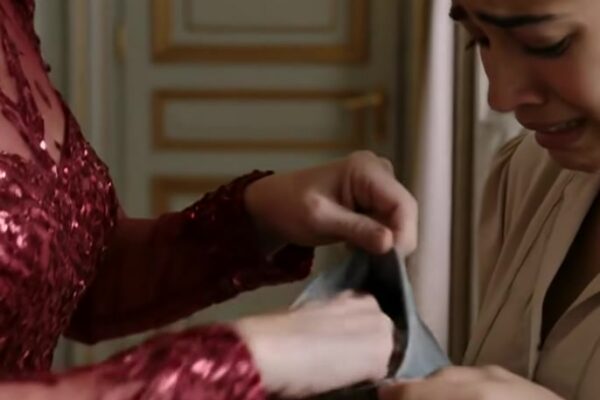
The lobby of the Maribel Grand was doing that thing expensive places do—trying to make you forget you’re a person with pores. Marble floors polished to a mirror, a chandelier that looked like it could fund a small country, and a string quartet tucked beside a fountain like they were part of the décor.
Mara stood near the reception desk, half-hidden behind a column and a brochure stand, because hiding was what she’d been doing for the last ten minutes. Her coat was still dripping. Rainwater ran off the hem and made a tiny puddle that the lobby’s heat couldn’t evaporate fast enough. The front of her hair had gone limp, and her hands wouldn’t stop shaking.
She didn’t come here to crash a party. She didn’t come here for drama. She came because a promise from a dead woman had weight, and it was pulling her like a hook in the ribs.
In her fist was an old brass key—heavy, warm from being squeezed too hard, and ugly in a way modern keys weren’t allowed to be anymore. It still had a paper tag tied to it with a fraying bit of string. The tag was so faded it looked like it had survived a war.
At the center of the lobby, under the chandelier, the engagement celebration was in full shimmer. Crystal glasses clinked. People with perfect hair laughed like they were sponsored. On a cocktail table, a five-tier cake waited like it knew it would be photographed more than it would be eaten.
And then Mara saw him.
Gavin Holt—tall, clean-cut, the kind of man who made older relatives say things like “such a good match” without knowing a single fact. He had his arm around his fiancée, Celeste Wren, who looked like she’d been assembled out of pearls and confidence. Gavin was smiling. Not a nervous smile. A comfortable one.
Mara swallowed hard and stepped closer, because if she turned around now she would be doing what she’d always done: letting other people’s stories end without the truth.
She made it three steps before Celeste’s eyes found her.
It was like watching a spotlight snap on.
Celeste’s smile didn’t fade; it sharpened. She excused herself from a circle of guests and glided across the lobby like she owned every molecule of air. The quartet’s music kept playing, but somehow it sounded wrong the closer Celeste got, like it was accompanying the wrong scene.
“You,” Celeste said, loud enough that the nearest guests turned their heads. “I knew you’d show up eventually.”
Mara opened her mouth. The words were there—practiced, rehearsed in the car, whispered to the windshield while she sat in the rain. But her throat had other plans. It tightened. The hotel seemed to swell around her, all that marble and money pressing in.
Celeste stepped in close, close enough that Mara could smell her perfume and see the perfect line of her eyeliner. “How many times do I have to pay you to stay away from him?” she snapped, the sentence slicing through the lobby like a dropped glass.
The air changed instantly.
People pivoted. Phones rose like reflexes. The bartender stopped mid-pour. Even the receptionist froze with her hand hovering over a keyboard, as if typing could suddenly become illegal.
Mara flinched as if Celeste had slapped her. “I didn’t—” she started.
Celeste didn’t let her finish. “Tell them,” Celeste said, turning slightly so her voice carried. “Tell them why you’re here. Go on. Since you love making scenes.”
Mara’s chest hitched. Rainwater slid from her hair onto her cheek, mixing with tears she hated herself for. She forced herself to breathe. She looked past Celeste at Gavin.
Gavin’s smile had gone stiff. His eyes, though, were locked on Mara’s hand.
On the key.
Mara raised her fist a little, like it had its own gravity. “He said,” she managed, voice thin, “if he ever… if he ever hurt her too, I had to bring this back.”
The word too landed on the marble with an echo nobody could ignore.
Gavin went pale so fast it looked like someone had drained him. His hand tightened on Celeste’s waist—not protective, not loving. Possessive. Panicked.
“Mara,” he said, and just hearing her name in his mouth made her stomach turn. “This isn’t the place.”
Celeste blinked. “What is that?”
Mara didn’t answer. She didn’t have to. The key was doing the talking now.
The concierge, an older man with silver hair and a posture like a letter opener, had been watching from behind his station. He leaned forward, eyes narrowing, and for a second Mara thought he was just curious.
Then he saw the engraving.
His face lost color in layers, like someone turning down a dimmer switch. He took one careful step around the desk, as if the wrong movement might set off an alarm.
“Miss,” he said softly to Mara, not to Celeste, “may I… may I see that?”
Mara hesitated, then loosened her fingers. The key dropped into his palm with a dull, historic weight. He turned it over. The number was scratched in near the base. Not a neat hotel font. A gouge, like it had been done in desperation.
“No,” the concierge breathed. It wasn’t dramatic. It was the kind of no people say at accidents. “That room…”
The quartet faltered. A violin squeaked. The music stopped like it had been unplugged.
Celeste’s voice rose, sharp with impatience. “What room?”
The concierge’s eyes flicked to Gavin, and in that glance Mara saw recognition settle like dust. “That room was sealed,” he said, voice dropping lower but somehow carrying anyway, “after his first fiancée vanished.”
Sound left the lobby in a rush. It was like the whole building inhaled and forgot to exhale.
“Excuse me?” someone whispered. “First fiancée?”
“Gavin never said—” another voice started.
Celeste slowly turned toward Gavin. Her expression stayed composed, but her eyes did something new—measured him, like she’d just discovered she’d been shaking hands with a stranger. “What is he talking about?” she asked, and for the first time her tone wobbled.
Gavin’s jaw worked. He looked like he was trying to swallow a stone. “It was years ago,” he said. “It was a misunderstanding. She—she left.”
Mara found her voice again, and it came out steadier than it had any right to. “Then tell them,” she said, stepping forward, “why my mother signed in under your surname.”
A murmur rolled through the guests like wind through leaves.
Celeste’s hand lifted to her chest as if checking whether her necklace was still there. “Your mother?”
Mara nodded once. The lobby lights made everyone look too polished, too unreal, but her memories weren’t polished. They were blunt. “She didn’t come home,” Mara said, and the words tasted like rust. “She told me if anything ever happened—if she ever stopped answering—there would be a key. That I’d know where to go.”
Gavin took a step forward, palms raised. “Mara, don’t do this,” he pleaded, and the plea sounded practiced, like something he’d used before. “We can talk privately.”
“Privately is where people disappear,” Mara shot back. She reached for the concierge’s hand. “Give it back.”
The concierge hesitated, then placed the key in her palm like he was returning evidence.
Mara flipped the tag over. Up close, you could see the faint ink lines, the ghost of a logo, and a scribble at the bottom that had been written hard enough to dent the paper. She held it up so Celeste, so the guests, so every camera in the lobby could see it wasn’t just a key. It was a message that had survived time and fear.
“There’s more,” Mara said, voice shaking but loud. “There’s a note.”
Gavin’s face tightened. “Stop.”
Mara looked straight at Celeste, because Celeste deserved the truth even if she’d been cruel. “He wants you to believe he’s never had a before,” Mara said. “He wants you to believe he’s clean. But my mom didn’t check out. She didn’t even make it downstairs.”
The concierge cleared his throat, as if forcing himself to be professional while his world tilted. “Room 814,” he said quietly, to no one and everyone. “We… we boarded it. We were instructed—” He stopped, eyes flicking to Gavin again, and you could almost see the shape of old fear in his posture.
Celeste stared at Gavin like she was memorizing his face in case she needed to describe it to someone later. “Gavin,” she said, each syllable controlled, “tell me you didn’t.”
Gavin’s mouth opened. Closed. Opened again. No sound came out, just breath.
Mara’s fingers tightened on the tag. The ink, though faded, was still there. And whether or not Gavin spoke, the paper was about to.
“Or,” Mara said, lifting the tag higher, “should I read what she wrote on the checkout note the morning she never came downstairs?”
In the silence that followed, Gavin’s eyes darted toward the elevators—toward the hall that led to rooms the party guests would never see. And for the first time since Mara had walked in soaked and shaking, everybody in that lobby looked at him the same way.
Not like a groom.
Like a man with a locked door and a history.
Mara took a breath, and started to read.