The elevator lobby on the thirty-second floor always smelled like expensive soap and anxiety. The marble was so glossy you could see your future in it, if your future involved unpaid overtime and pretending you loved “fast-paced environments.”
At 8:12 a.m., the place was unusually quiet—just the soft hum of the building and the squeak of a mop that sounded like it had been alive since the nineties. An older man, thin in that way people get when they’ve spent decades lifting other people’s messes, guided the mop in careful lines. Beside him sat a yellow bucket with a “CAUTION” label peeling at the corners.
Mara Vance stepped out of the glass corridor like she owned the floor. In a way, she did. She wasn’t the CEO, but she was the CEO’s executive assistant, which in this building functioned like royalty by proxy. Her hair was slicked into a bun that looked like it could cut paper. Her heels clicked the marble with a rhythm that said, Make room, or become furniture.
She glanced at the cleaner and then at her watch as if time itself had offended her. “Seriously?” she said, voice low but sharp. “Why is this wet? We have clients coming.”
The cleaner’s shoulders tensed. “I’m almost finished, ma’am,” he said, and his accent softened the words into something humble.
Mara reached for her phone, already halfway to composing a complaint. She took a step, her heel skidded slightly, and her face tightened as if the marble had personally insulted her. “Unbelievable,” she muttered.
The cleaner moved quickly to steady the bucket. “I’m sorry,” he said again, because apologies were clearly part of his job description.
Mara’s eyes flashed toward the elevator. The doors were open, waiting, and she could hear the distant ping of someone else calling it from another floor. She didn’t have time for dampness and inconvenience and someone else’s life happening in her way.
“Move,” she snapped.
The cleaner tried to shift the bucket, but his hands—gloved, trembling a little—caught the handle wrong. The bucket tipped. A fan of soapy water spilled out like a slow-motion wave, spreading across the marble with a gleam that looked beautiful if you didn’t know it was about to ruin someone’s day.
The cleaner’s mop clattered. He reached for the wall, palm flat against the polished stone, trying to keep his balance. His face tightened, pain and embarrassment pinching his features into something that wasn’t old so much as tired.
Mara’s jaw clenched. “Clean your mess,” she said, as if she hadn’t just witnessed the mess in the act of being made.
“I’m sorry,” the cleaner repeated, eyes lowered like he’d been trained not to make eye contact with people who paid more for coffee than he probably made in an hour.
A young woman in a navy blazer rushed in from the corridor, her ID badge flipping like a nervous metronome. Lila—new intern, eager, still believing that competence would protect you. She crouched, grabbing the mop and righting the bucket with careful hands.
“Here,” Lila said to the cleaner, voice gentle. “I’ve got it.”
The cleaner looked startled, like he wasn’t used to people helping without a catch. “Thank you,” he whispered.
Lila glanced up at Mara, and for a second her face hardened with a kind of simple fairness that doesn’t survive corporate training. “You pushed him,” she said.
It wasn’t loud. It wasn’t dramatic. But it cut through the lobby like a dropped glass.
Mara turned so fast her bun didn’t even move. Her expression shifted into that practiced calm people use when they’re about to do something cruel with a smile. “Excuse me?”
“I saw you,” Lila said. “He almost fell.”
Mara’s gaze swept over Lila’s cheap badge, her sensible shoes, the slight tremble in her hands. She dismissed her with the same ease she dismissed unimportant emails. “You’re fired too,” Mara said, like she was tossing a napkin into a trash bin.
Lila blinked. “I’m… I’m an intern.”
“Not anymore,” Mara replied. “I’ll call HR right now.” She lifted her phone, thumb hovering like an executioner’s blade.
Lila’s eyes flicked upward, toward the small black dome camera mounted above the elevator doors. It was easy to forget it was there. It blended into the ceiling like a tiny mole. “The camera saw it,” Lila said.
Mara let out a short laugh that sounded more like a cough. “Nobody checks those,” she said. “Not unless something big happens.”
The cleaner kept his gaze on the spill, kneeling now, hands moving carefully to wring out a cloth as if he could wring out shame too. Water crawled toward the elevator threshold in thin rivulets.
Then the screen beside the elevators—the one that usually looped company announcements and motivational slogans—flickered. The corporate logo vanished. The display went black for half a beat.
And the replay started playing.
No sound, just crisp footage from above: Mara’s hand extending, a sharp shove into the cleaner’s shoulder. The cleaner stumbling. The bucket tipping. Water blooming across marble. The mop falling like a surrender flag. Mara’s lips forming words that, even without audio, looked unmistakably like “Clean your mess.”
Mara’s face drained. Her smile died mid-breath.
Lila stood frozen, mouth slightly open, as if she’d accidentally summoned a ghost by saying the word “camera.”
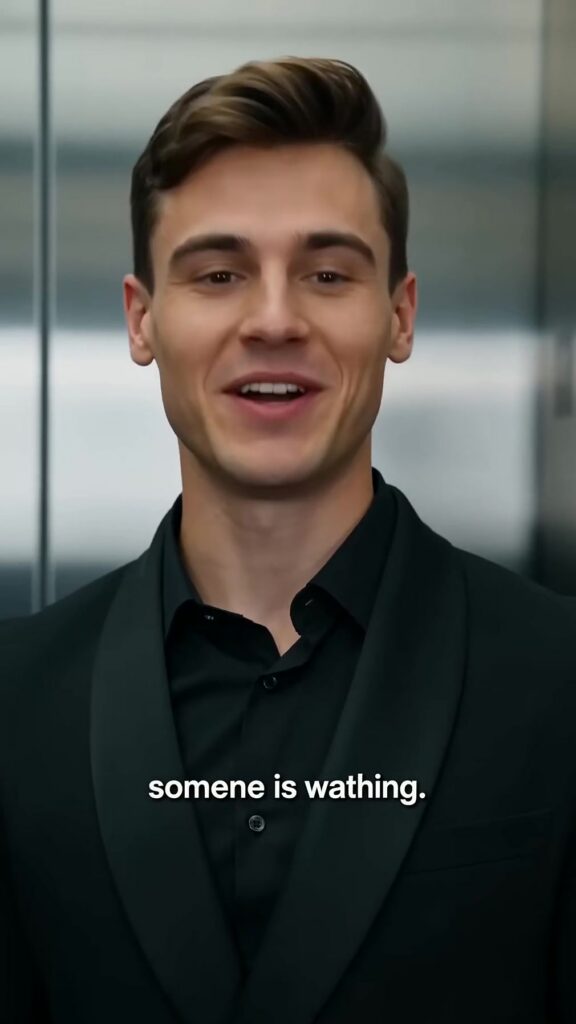
The cleaner looked up at the screen. For the first time, his eyes weren’t lowered. They were wide, wet, and bright with something between fear and relief. “Someone is watching,” he said quietly, not a question so much as a realization.
Mara’s throat worked. Her voice came out thinner than before. “Who?”
The elevator doors slid open with a soft chime that sounded suddenly like a judge’s gavel. Inside stood Rowan Kade, CEO, founder, and the reason everyone wore their stress like cologne. He held his phone in one hand, thumb paused on a video timeline. He didn’t look angry at first. He looked focused, like he’d been watching a problem and already found the solution.
He stepped out of the elevator without rushing, wearing a charcoal suit that probably cost more than Lila’s rent. Behind him, the elevator’s mirrored wall reflected the screen, doubling the scene like a punishment that insisted on being seen twice.
Mara’s lips parted. “Mr. Kade—”
Rowan raised a finger, not for silence exactly, but for patience. He glanced at the screen, then at the cleaner, then at Mara. His gaze felt like cold water in a different kind of bucket—one that didn’t spill, one that just poured.
“Mara,” he said, voice calm enough to be terrifying. “Do you know what the security system does when it detects a sudden impact near an elevator?”
Mara swallowed. “I… I’m not sure—”
“It flags the clip,” Rowan continued, as if explaining a feature to someone who’d skipped the manual. “Sends it to the building’s safety dashboard. Which,” he added, lifting his phone slightly, “I happen to have on my screen this morning because we’ve been reviewing incident reports after the slip-and-fall lawsuit last quarter.”
Mara’s face tried to rearrange itself into something believable. “It was an accident,” she said quickly. “He—he spilled water, and I—”
Rowan’s eyes flicked to the cleaner’s hands, red at the knuckles, and to the cloth he was using like he was trying to erase himself from the floor. “Funny,” Rowan said, still calm. “The video looks like your hand made the first move.”
Lila’s heart hammered so loud she wondered if the camera could pick up sound. She looked at the cleaner. He wasn’t crying dramatically. He was just… existing in a moment where someone important had finally seen the way he was treated.
Rowan turned to Lila. “What’s your name?”
Lila blinked, stunned he was speaking to her like she mattered. “Lila Chen,” she said, voice small. “I’m in the internship program. Marketing.”
Rowan nodded once. “Good instincts,” he said. “And for the record, Mara doesn’t have the authority to fire anyone.”
Mara’s breath hitched. “I’m your assistant,” she said, as if that explained everything. “I manage your calendar. I—”
“You managed it poorly,” Rowan replied. The words weren’t loud, but they landed heavy. “Because now my calendar includes a meeting with HR.”
Mara’s eyes widened. “Rowan, please—”
He didn’t flinch at the first-name plea. He just angled his phone so she could see the paused frame: her hand against the cleaner’s shoulder, frozen mid-shove, undeniable. “You’re done,” Rowan said. “Badge, laptop, and you can leave through the lobby. Not the executive elevators.”
Mara looked around as if someone would rescue her, but the lobby had become a roomful of witnesses. A couple of early employees had gathered near the corridor, pretending they weren’t watching while absolutely watching.
The cleaner began to rise, slow, careful. Rowan held out a hand—not to pull him up, but in a simple gesture of respect. “Sir,” Rowan said, “are you hurt?”
The cleaner hesitated, then shook his head. “Just… startled,” he murmured. “I’m fine.”
Rowan’s expression tightened at that, like he understood the difference between being fine and being forced to say you were. “What’s your name?” he asked.
“Hector,” the cleaner said. “Hector Alvarez.”
Rowan nodded. “Hector,” he said, and the name sounded like an apology for not knowing it sooner. “Take the rest of the morning off. Go to the clinic downstairs anyway, get checked. The company covers it.”
Hector’s eyes flicked to the spill and the mop, habit pulling him toward finishing the job. Rowan seemed to read it. “We’ll handle this,” he said, looking briefly at Lila. “If you’re willing.”
Lila nodded, still dazed. “Of course.”
Mara stood stiffly, cheeks blotched. For a moment, she looked like she might argue. But the screen behind her looped the clip again, like the building itself refused to let her rewrite the story.
She reached up, unclipped her badge with shaky fingers, and set it on the marble. The sound was small, but it echoed anyway.
Rowan watched her go, then looked up at the camera dome. “By the way,” he said to no one in particular, “we do check those.”
And then, as if the building exhaled, the lobby felt different—not magically fixed, not suddenly fair, but cracked open enough for something new to get in. Lila picked up the mop. Hector steadied the bucket. Rowan crouched, not caring about his suit, and grabbed a wad of paper towels from a dispenser along the wall.
“Let’s keep the marble as spotless as your conscience,” Rowan said, casual, almost dry.
Lila let out a surprised laugh—small, relieved, disbelieving. Hector’s shoulders loosened, just a fraction. And on the screen beside the elevator, the replay finally blinked away, replaced by the company logo as if trying to pretend it had never shown the truth at all.
But everyone in that lobby had seen it. And more importantly—someone upstairs had been watching the whole time.