The garden was quiet, almost too quiet, when the little girl in the worn yellow dress stepped onto the stone path.
It was the kind of quiet that felt expensive. Not just “no birds” quiet—more like everything living had been trained to behave. The hedges stood like guards with perfect haircuts, the fountain kept its voice low, and even the roses looked like they’d signed an agreement not to drop a single petal without permission.
She walked anyway, sandals slapping softly on the warm stones. Her dress had a frayed hem and a tiny stitched patch on the side where somebody had tried to rescue it from a tear. It wasn’t the right outfit for a place like this, and she knew it. That was kind of the point.
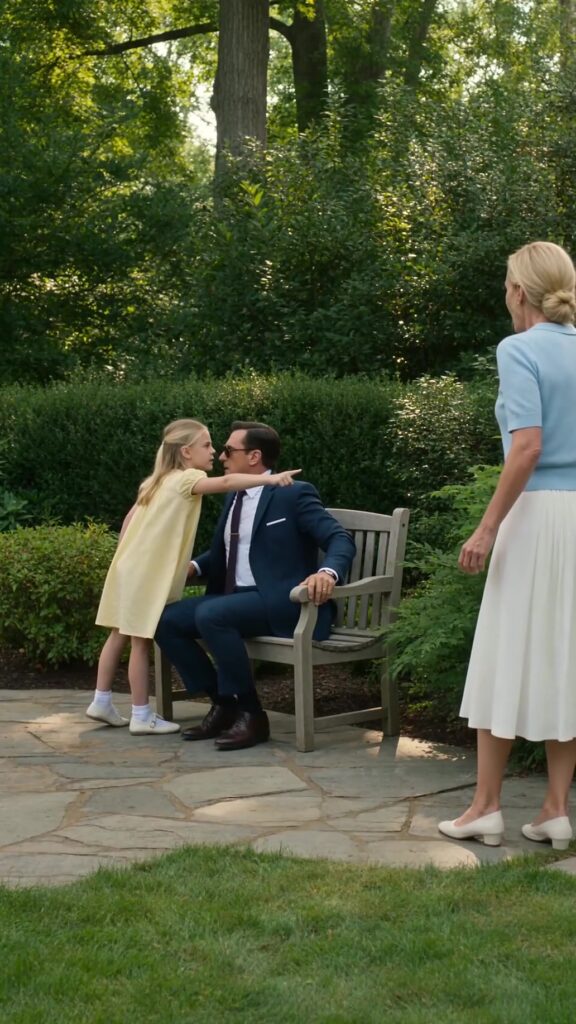
At the end of the path, a man sat on a wooden bench as if it belonged to him and nobody would argue. Navy suit. Clean lines. Not a speck of dirt on the cuffs even though the bench had old paint flaking off like sunburn. Dark sunglasses covered his eyes. He held a porcelain cup with both hands, like he needed it to anchor him to the world.
Behind him, the estate glowed in late afternoon light, all windows and white columns, the kind of house that made you whisper even if you weren’t sure why. It looked peaceful from a distance. People always said that about this place: peaceful, private, secure.
The girl stopped two feet from the bench. She stared at him, chest rising too fast for a walk that short. Her hands were balled into fists so tight her knuckles shone.
The man’s head tilted slightly, like he’d sensed the shadow she cast over his light. “Can I help you?” he asked. His voice was smooth, practiced, the sort of voice that had signed papers and ended arguments without raising a volume.
She didn’t answer. She stepped forward and slapped her small palm onto his forehead.
It wasn’t hard. It didn’t need to be. The contact was enough.
He jerked back like she’d touched a bruise he’d forgotten he had. The porcelain cup wobbled; tea rippled up to the rim. “Hey—what are you doing?”
She leaned in, close enough that her breath hit his cheek. It shook like she was trying not to sob. Her eyes were glossy, furious, older than her face.
“You’re not blind,” she said.
The man froze. The muscles along his jaw tightened so suddenly it looked like a switch had flipped under his skin. “What did you say?”
He tried to angle away, but she didn’t move. She stood there like a dare. Like somebody had pushed her onto a stage and told her not to leave until the truth came out.
Across the lawn, near the edge of the greenhouse, a blonde woman stood holding pruning shears she wasn’t using. She had been arranging a basket of clipped lavender. Now she had gone perfectly still, as if motion itself might set off an alarm.
The girl’s hand shot out. She grabbed the sunglasses off the man’s face and yanked them away.
His eyes—sharp, clear, an icy gray—blinked in the open air. They were not the empty stare of someone who lived in darkness. They tracked her immediately, focused, annoyed, frightened in a way he hadn’t rehearsed.
For one second, nobody breathed. Even the fountain seemed to pause mid-splash.
The man’s mouth opened, then closed. “Who are you?”
The girl didn’t answer him. She didn’t need his questions. She lifted her arm and pointed past him, straight across the sunlit lawn.
“It’s your wife.”
The man turned sharply. The blonde woman’s face drained so fast it was like watching a candle go out. Her lips parted, but her throat didn’t produce anything useful.
The garden went dead silent, not even pretending anymore.
“What are you talking about?” the man demanded, but the confidence in his voice had cracks now. A tremor of something else—recognition? dread?—slipped through.
The girl’s lower lip trembled. She swallowed, and when she spoke again her voice stayed steady like she’d practiced it on the bus ride here. “She puts it in your food.”
The blonde woman made a sharp sound—half gasp, half laugh, like a person trying to turn a mistake into a joke and failing. “That’s ridiculous,” she managed. “Daniel—”
Daniel. The name landed heavy on the air. The man—Daniel—rose halfway from the bench, one hand still hovering near the teacup. His breathing had turned uneven, as if he’d started running without moving.
The girl stepped closer, holding the sunglasses tightly in one fist. They looked too big in her hand, like a stolen trophy. “Ask her what she put in your tea,” she said.
Daniel’s gaze dropped to the cup, then lifted again toward his wife. His face had gone pale in a way the sunlight couldn’t explain. “What did you put in my tea?” he asked, low and cold, each word pushed out like it hurt.
The blonde woman took one step back. Then another. The pruning shears dangled from her fingers, forgotten. “Daniel, honey, this is—this is some kid. She doesn’t know what she’s saying.”
“She knows enough to walk through security,” Daniel said. He didn’t look away from her. “And enough to pull my glasses off like she’s done it before.”
His wife’s eyes flicked toward the gate, toward the guards who were suddenly far too late, toward the cameras that should have prevented this scene. Her gaze came back to Daniel with a thin smile that didn’t reach her cheeks. “You’re not thinking clearly. You’ve been… stressed.”
“Stressed,” Daniel echoed, like the word was a flavor he was tasting and finding unfamiliar. He looked back at the girl. “Why do you know?”
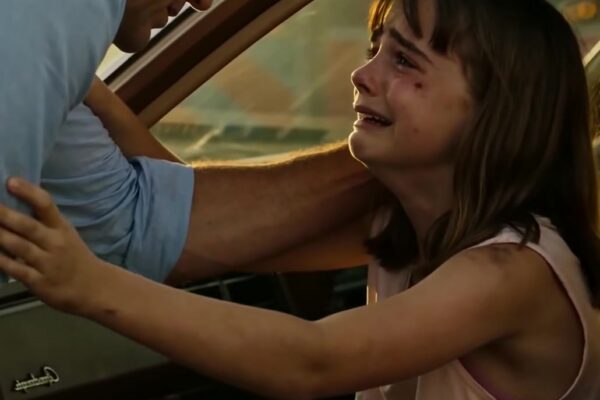
The girl’s throat worked. She blinked hard, and a tear finally escaped, cutting a line down her cheek. She looked like she hated herself for it. “Because my mother died trying to warn you,” she said.
Daniel went still. The way a door goes still right before it slams.
“Your mother,” he repeated, and the garden felt suddenly smaller, like the hedges had crept in to listen. “What was her name?”
The girl’s fingers tightened around the sunglasses. “Marisol Vega.”
The blonde woman’s breath hitched like she’d been punched. “No,” she whispered, but it wasn’t denial. It was recognition with nowhere to go.
Daniel stared at the girl as if she’d become a photograph he hadn’t looked at in years. His face changed in slow, awful increments—confusion breaking into memory, memory bleeding into guilt.
“Marisol,” he said again, quieter now. “She… she worked here.”
“She worked everywhere,” the girl snapped, anger flaring hot enough to dry the tear on her cheek. “She cleaned your wife’s jewelry. She brought your wife her vitamins. She poured your tea when the staff was ‘busy.’ She heard things you didn’t.”
Daniel’s eyes flicked to his wife. “Vitamins?” he asked.
“Doctor-approved supplements,” the blonde woman said fast, almost eager. “For the migraines. For your eyes. We’ve talked about this.”
“My eyes,” Daniel repeated. His hand rose unconsciously to his face, to the space where the sunglasses had been. Without them, he looked exposed, younger, more human than the man on the bench had seemed a minute ago.
The girl took a shaky breath. “My mom said you used to read to the gardeners’ kids on Sundays. She said you could see. She said you started wearing those glasses after you married her.” She jabbed her chin toward the blonde woman. “And then you stopped recognizing people. You stopped leaving the house alone. You started believing you were… broken.”
Daniel swallowed. “I went to specialists,” he said, but even as he said it, the excuse sounded like something he’d been handed. “They said the damage was irreversible.”
“Did you ever see them without her in the room?” the girl asked.
That landed like a stone. Daniel’s face tightened again, but this time it wasn’t anger—it was the horrible realization of how easy it is to be guided when you think you can’t trust your own senses.
His wife’s voice turned honey-sweet and dangerously calm. “Daniel, this child is trying to manipulate you. She’s upset. She’s making up stories because—”
“Because my mom is dead?” the girl cut in. Her voice cracked on the word dead, but she refused to soften it. “She collapsed in the kitchen after your wife made her drink a ‘special tea’ because she ‘looked tired.’ We didn’t have money for lawyers. We didn’t have money for a second autopsy. We had a funeral and a landlord who didn’t care.”
Daniel’s jaw worked. He stared at his wife like he was trying to see her for the first time, without the story he’d been living inside. “Did you do it?” he asked.
The blonde woman’s eyes shone with tears—real or staged, it was impossible to tell. “Of course not,” she said. “You think I’d risk everything we have?”
“Yes,” the girl whispered, stepping forward again. She held out the sunglasses like evidence. “Because you already have. You just didn’t think anyone small enough would matter.”
Daniel’s gaze dropped to the tea in his cup. The surface had gone still again, reflecting the sky, the hedges, and a man who had been pretending for so long he wasn’t sure which parts were lie and which parts were fear.
He set the cup down carefully on the bench, like it might explode. “Go inside,” he told his wife, voice flat.
She didn’t move. “Daniel—”
“Go inside,” he repeated, louder. “And do not touch anything in the kitchen. Don’t throw anything away. Don’t wash any cups. Do you understand me?”
The blonde woman’s mouth tightened. For a split second, the mask slipped, and something sharp looked out through her eyes. Then she forced her face back into softness. “You’re overreacting,” she said, but she started walking, heels pressing into the grass like punctuation marks.
Daniel watched her go. Then he crouched in front of the girl, lowering himself so his face was level with hers. Up close, he looked tired in a way money didn’t fix.
“Why come here?” he asked softly. “Why now?”
The girl’s shoulders rose and fell. “Because she’s going to finish it,” she said, voice small for the first time. “My mom said she would. She said your wife doesn’t like loose ends.”
Daniel’s throat bobbed. He reached out like he might touch the girl’s shoulder, then thought better of it and let his hand hover in the air instead. “What’s your name?” he asked.
She hesitated, as if names were dangerous things. “Luna,” she said finally.
Daniel nodded once, like he was saving it somewhere. “Luna,” he repeated, and there was pain in it. “I’m going to need you to tell me everything you know.”
Luna stared at him, still trembling, still fierce. “I didn’t come here to tell,” she said. “I came here to make you look.”
He looked at the sunglasses in her hand. Then at the estate. Then at the path she had walked alone. Something in his expression shifted, not into certainty, but into a decision.
“Okay,” he said, and his voice had lost its polish. It sounded like a real person now. “I’m looking.”
In the distance, the fountain started up again, as if it had been holding its breath the whole time. The garden stayed quiet—but it wasn’t peaceful anymore. It was listening, waiting, like a secret that had finally realized it was about to be said out loud.