People only noticed when Madeline fell to her knees. Not when her hands started shaking. Not when her breathing turned shallow and panicky like she’d swallowed a mouthful of smoke. Not even when she stopped dead in the middle of the sidewalk and stared at nothing with the kind of blank focus you only see on people right before they faint.
They noticed the kneel because it was dramatic, because her beige designer suit looked too expensive to meet city pavement, because her handbag—some structured leather thing with a tiny gold clasp—hit the ground with a soft thud that sounded louder than it should have.
Madeline didn’t seem to hear it. She was facing a man slumped against the brick wall outside a closed bakery, sitting on flattened cardboard like it was a throne he’d been banished to. His beard was scruffy and uneven. His jacket had lost a war with weather and time. His eyes, though—his eyes were the kind that made you look away quickly, like you’d just caught a stranger reading your mind.
Madeline brought up a small velvet ring box, already open. The diamond caught the weak winter sun and scattered it into tiny, insulting sparks.
“Marry me,” she said. Her voice didn’t carry far, but the word itself seemed to yank the whole street into silence. “Please.”
Someone nearby made a small, choked laugh, then stopped when they realized she wasn’t joking. Phones started to appear, half-hidden behind coffee cups and scarves, because nothing makes people brave like having a screen between themselves and a moment that isn’t theirs.
The man pushed himself upright, slow and cautious. He didn’t reach for the ring. He stared at it like it might be a trick that would bite his fingers. “Why me?” he asked. His voice was rough, not loud—more like it had been unused for a while.
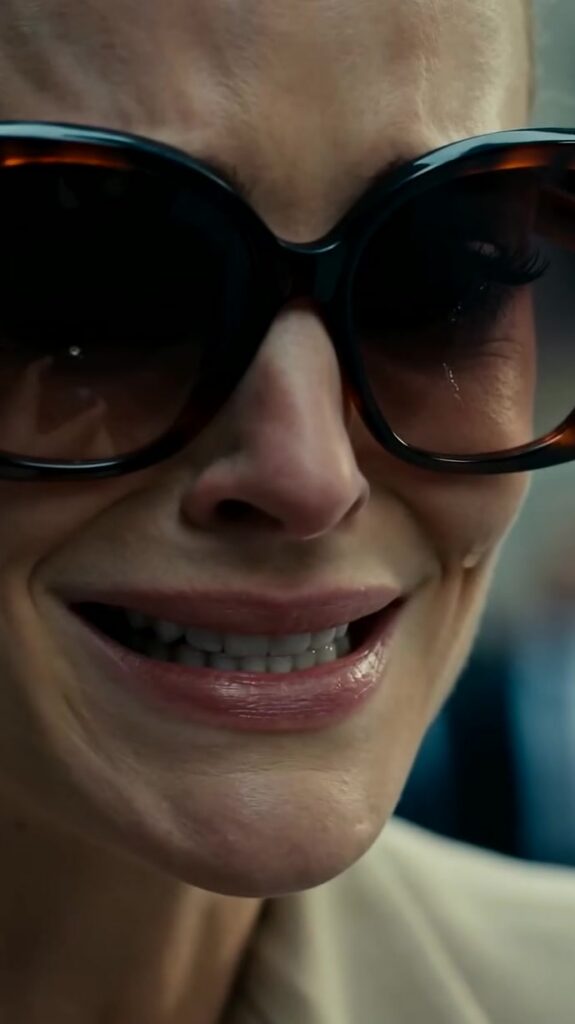
Madeline’s lips trembled. She had sunglasses on, big ones, but tears still found a way. They slid down her cheeks and disappeared into her scarf. “Because it’s you,” she said, like that explained everything.
He flinched. Not dramatic. Just a tiny step back, a recoil that made the onlookers shift uncomfortably. Like her words had landed in a tender place.
Madeline lifted the ring box higher, offering it like an altar. “Please,” she whispered. “Please remember me.”
The man frowned. His gaze flicked from the diamond to her face, then to the ring again. The diamond was too clean for this sidewalk, too perfect for his cracked knuckles. But it wasn’t the stone that held his attention in the end. It was the inside of the band. Something engraved there, small and deliberate.
His dirty fingers hovered, hesitating, and Madeline’s whole body went still like she was holding her breath for him.
Then the roar of an engine cut through the hush.
A black SUV swung to the curb so sharply it made a cyclist swear and swerve. The back window slid down, and an older man leaned out. He wore a suit that screamed money, a tie knotted perfectly, hair silvered at the temples. His face, though, wasn’t polished. It was raw with fear.
“Madeline!” he shouted. “Stop!”
Madeline didn’t turn her head. “Don’t,” she said quietly, but the word carried anyway, as if the street wanted to listen to her more than it wanted to listen to him.
The older man’s eyes darted to the homeless man’s hands. “Don’t let him touch it,” he barked. “Don’t let him remember!”
That sentence landed like ice water. People blinked, confused, and the phones rose higher.
The homeless man’s fingertips brushed the ring at last. The moment his skin made contact, his breath hitched. He stared at the engraving as if the letters were moving.
“This name…” he murmured, and his voice cracked on the edge of something. He looked at Madeline, and for the first time the emptiness in his eyes shifted. A ripple of recognition passed through him, faint but undeniable. “Mads?”
Madeline made a sound that wasn’t quite a sob and wasn’t quite a laugh. “Yes,” she said. “Yes. It’s me.”
The older man in the SUV slammed his palm against the door. “Madeline, I swear to God—” His throat worked like he was swallowing panic. “Get in the car. Now.”
Madeline finally looked over her shoulder. The movement was slow, deliberate, like she wanted him to see her face. “You can’t keep doing this,” she said, her voice steady now. “You can’t keep erasing people and pretending it’s mercy.”
The older man’s jaw tightened. “It was necessary,” he snapped. “You don’t know what you’re inviting back.”
“I know exactly what I’m inviting back,” Madeline said. “I lived it. You made sure I lived it alone.”
The homeless man blinked hard, his gaze unfocusing. His fingers tightened around the ring, and the air around him felt charged, like the moment before a storm. “Erase…” he repeated, tasting the word. “You said… you said it would stop hurting.”
Madeline turned fully toward him again. She was still kneeling, but it didn’t look like surrender. It looked like insistence. “They told you that you could trade your memories for quiet,” she said. “They didn’t tell you the quiet would eat everything else too.”
He stared at the ring, then at his own hands, like he didn’t trust them. “I remember a door,” he said slowly. “White paint. A chain lock.” He lifted his free hand to his temple, pressing two fingers there. “And your laugh. It was—” He swallowed. “It was loud. Like you didn’t care who heard.”
Madeline’s smile broke through her tears. “I didn’t,” she said. “Not back then.”
The older man’s voice sharpened, desperate. “Madeline, you’re going to destroy everything your mother built. Everything we built. That man is a liability.”
“He’s not a liability,” Madeline shot back. “He’s a person.”
The homeless man flinched at the word person, like it was unfamiliar praise. His eyes squeezed shut. His shoulders rose as he took a breath that shuddered through his whole body. When he opened his eyes again, they were clearer. Not clean—life doesn’t clean itself up that fast—but present.
“My name,” he said. It wasn’t a question. It was a demand for the missing piece.
Madeline held the ring box out again, but this time she angled it so he could read the inside. “Elliot,” she said softly. “Elliot Harrow. It’s engraved because you used to lose everything. Keys, wallets, entire weeks. So I got it engraved and told you it was so you could never forget you belonged somewhere.”
The older man made a strangled sound. “Madeline—”
“You took him,” Madeline said, louder now. People were openly staring, no longer pretending. “Your company took him. Your ‘program’ took him. You promised him relief, and then you dumped him right back on the street when his mind didn’t hold the edits the way you wanted.”
The older man’s face went pale. “Watch your mouth,” he warned, but his voice lacked conviction. He sounded like someone who’d been caught in a lie that had gotten too big to manage.
Elliot’s hand trembled as he traced the engraving. “M. W.” he read. “What’s that?”
Madeline swallowed hard. “Madeline West,” she said. “Before I had to become my father’s daughter in public.” She glanced at the SUV, at the man leaning out like a furious ghost. “Before I learned how to smile like nothing was wrong.”
Elliot looked at her as if she’d just reached into him and pulled out a piece he didn’t know was missing. “You…” He shook his head, trying to steady himself. “You didn’t forget.”
“I tried,” she admitted. “I tried so hard. I thought if I kept moving—new job, new apartment, new hair, new everything—I could outrun what they did.” She held the ring up, the diamond flashing. “But then I saw you last week by the subway. And I realized they didn’t just take your memories. They took your life. And they were going to get away with it because nobody looks up unless someone falls.”
Behind them, the older man was speaking into a phone now, his hand shaking as he covered the receiver. “Get security,” he hissed. “Now. She’s with him.”
Madeline heard anyway. She snapped the ring box closed around the diamond and pressed it into Elliot’s palm like she was placing something dangerous there. “Listen to me,” she said, fast now. “If they come, you don’t let them separate you from that ring. It’s not just a ring. It’s a key.”
Elliot’s brows knit. “A key to what?”
Madeline’s smile turned fierce. “To everything they stole,” she said. “It’s coded. The engraving isn’t just our names. It’s coordinates. A deposit box. Proof.” She nodded toward the SUV. “The kind of proof my father can’t shout away.”
Elliot’s grip tightened. For a second he looked like a man waking up in the wrong life. Then his shoulders squared, like something old and stubborn had returned to him. “You planned this,” he said.
Madeline stood up from her knees, brushing grit off her suit. People had to step back to make room for her; it was like the sidewalk itself remembered how to be a stage. She took off her sunglasses. Her eyes were red, but clear.
“I had to,” she said. “Nobody listened when I wrote letters. Nobody cared when I filed reports. Nobody even looked at you when you were right here. So I made them look.” She met Elliot’s gaze. “Marry me isn’t the point. Remembering is.”
Elliot stared at her, at the raw truth in her face, at the ring in his hand like it had weight beyond metal. Somewhere down the block, footsteps were running—too organized, too heavy to be normal pedestrians.
Madeline reached out and took Elliot’s hand, not delicate about it, not afraid of the dirt. “Come on,” she said. “Before they get here.”
Elliot nodded once, sharp and certain, and for the first time his eyes held something that looked like direction. Together they stepped away from the wall, away from the cardboard, away from the spot where the whole city had finally noticed a woman on her knees.
Behind them, the older man shouted her name again, furious and terrified. Madeline didn’t look back. She and Elliot pushed into the crowd, hand in hand, carrying a ring that wasn’t a promise of happily ever after—just a promise that the truth, once remembered, would not be erased so easily.