The bikers were laughing in the heat when the little boy ran into the middle of the yard, like he’d been launched out of a slingshot. The gravel lot behind the old feed store shimmered with August glare, the kind that makes everything look slightly unreal—chrome too bright, shadows too sharp. A half-circle of motorcycles sat idling and ticking, black and loud and proud, lined up like beasts being shown off.
Someone had dragged a cooler into the only slice of shade, and the men were telling the kind of stories that get funnier the longer you’ve been baking in the sun. A burst of laughter rolled across the yard, and then it hit a wall the instant the kid appeared.
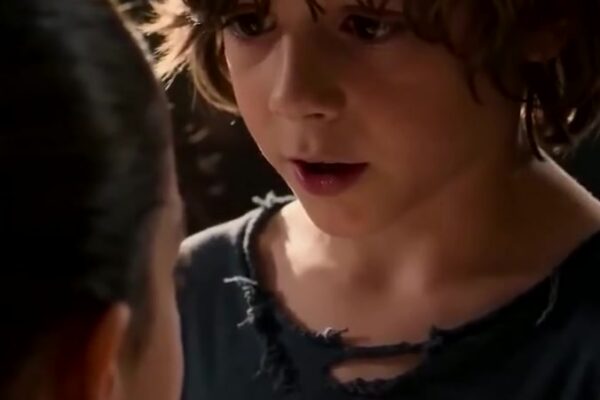
He was maybe seven, maybe eight, too skinny for his big T-shirt. His face was filthy, dust stuck to sweat and tears. He was crying so hard he couldn’t get air, and when he tried to speak it came out as a strangled hiccup. He ran straight into the open space between the bikes like it was the only safe place on earth, then dropped to his knees so hard dust jumped up around him.
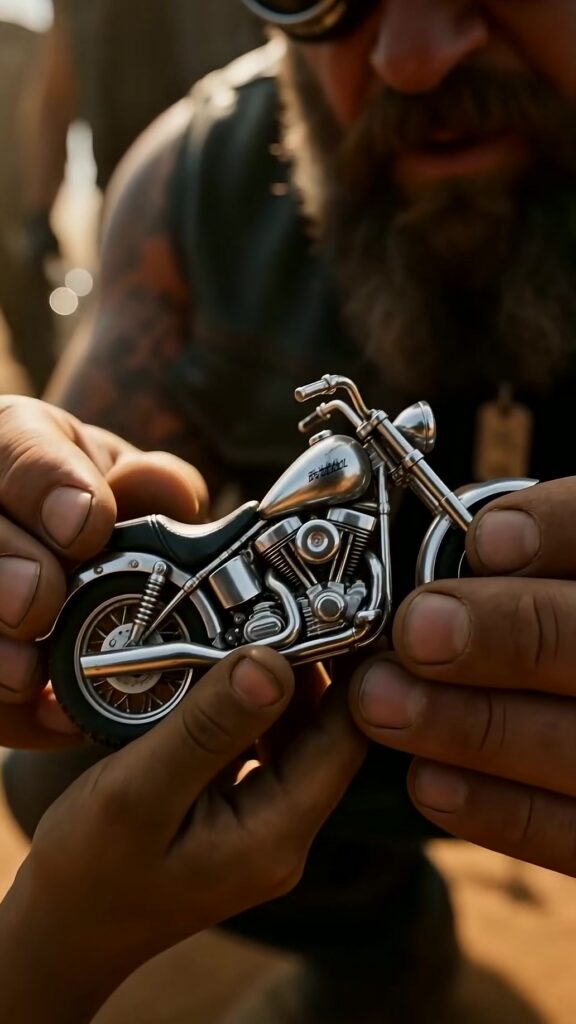
Both of his hands were lifted like an offering. In them he held something tiny, silver, and trembling—because his hands were shaking, not because it was alive. A miniature motorcycle, no bigger than a sandwich, with a little curved tank and wire-thin handlebars. It looked too perfect to be a toy.
“Please,” he rasped. “Please buy it.”
The laughter died so fast it felt like someone had yanked the power. Even the cicadas seemed to pause to listen.
The main biker—everyone called him Hawk, even though his real name was Joel—stepped forward. Heavy boots crunched the dirt. He had a beard like steel wool and a face that rarely relaxed all the way. He was the kind of man strangers moved aside for without thinking about it.
But the boy stayed right there, knees in gravel, shoulders jerking with each breath, holding the tiny motorcycle out like it was the only thing keeping him upright.
Hawk squinted at the object. “What is that, kid?”
The boy swallowed hard, as if it physically hurt. For a second he pulled the little bike toward his chest, like a reflex, like his fingers didn’t want to let it go. Then he pushed it out again.
“My dad made it,” he said. His voice cracked on the word dad.
Hawk reached. He didn’t snatch. He didn’t soften either. He just took it the way you take a fragile thing you’re not sure you deserve. At first his expression stayed the same—hard lines, sunburnt nose, eyes narrowed from years of squinting at open roads.
Then the sunlight hit the frame near the tiny engine block, and something small flashed. A mark. An engraving. A few letters inside a little symbol.
Everything in Hawk’s face went still. The lines didn’t change shape so much as freeze in place, like a mask had been lowered over him.
“Let me see that,” he said, quieter now.
The boy hesitated, then slowly released the model bike into Hawk’s hands. Behind Hawk, the other men shifted. One of them killed his engine. The lot got even quieter, filled with ticking metal and distant highway noise.
Hawk crouched in the dirt so he was eye-level with the kid. Carefully, like he was handling evidence or a relic, he turned the little motorcycle over and stared at the engraving again. His thumb brushed it once, not wiping, just touching—confirming it was real.
“Why are you selling it?” he asked.
The boy tried to answer and failed. His mouth opened and nothing came, just a sound that wasn’t a word. He wiped his nose with the back of his wrist and left a streak of grime across his cheek.
Then it spilled out fast, the way kids do when they’ve been holding it in too long. “My dad… he won’t wake up.”
Hawk’s breath stopped in his chest. For a second he looked past the kid, past the bikes, like he was staring at a different year entirely.
“Where’s your mom?” Hawk asked, voice hoarse.
The boy shook his head. “It’s just me. She left.”
That landed in the yard like a dropped wrench. One of the bikers—Polo, the guy with a tattoo of a rose climbing up his neck—muttered something under his breath that sounded like a curse aimed at the universe.
The boy pointed at the tiny motorcycle with one shaking finger, then up at Hawk. “My dad said… you’d know.”
Hawk looked at the boy’s face, really looked. Same dark eyes as the man he hadn’t thought about in years. Same stubborn set to the chin even through the crying. It hit him like a tire blowout at speed.
“What’s your name?” Hawk asked.
“Mason.” The boy sniffed. “Mason Kline.”
Hawk’s jaw tightened. He didn’t move for a long second. Then he stood and turned slightly, as if he needed to steal one breath where no one could see him take it.
“Kline,” he repeated. The name came out careful, like it was sharp.
One of the other bikers, a wiry guy with mirrored sunglasses, leaned forward. “You okay, Hawk?”
Hawk didn’t answer him. He looked down at the miniature motorcycle again. It was gorgeous—hand-cut metal pieces, tiny bolts, a chain made from linked rings no bigger than grains of rice. Whoever made it had loved motorcycles the way some people love religion.
Hawk’s thumb traced the engraving. It wasn’t just initials. It was an old club mark, from a time before this group had a name anyone knew. A small wing with a lightning bolt through it. Hawk had that same symbol on his shoulder, faded and half-covered by newer ink.
He swallowed. “Your dad… your dad make bikes?”
Mason nodded hard. “He fixes ’em. And he makes stuff. He made this for you. He said… he said if anything happened, I should find the guys at the feed store lot. The laughing guys. And show it to the big one.” He blinked, trying to focus through tears. “That’s you.”
Hawk exhaled slowly, like he was letting out years. “Where do you live, Mason?”
The kid pointed toward the far edge of town. “The trailer by the canal. The one with the broken fence.”
Hawk nodded once. Then he did something that made every man behind him straighten: he took his wallet out and put it away without opening it.
“I’m not buying it,” Hawk said.
Mason’s face crumpled in panic. “But we need—”
“Listen to me,” Hawk cut in, but his voice wasn’t harsh now, just firm in the way grown-ups get when they’re trying not to fall apart. He held the tiny bike out flat on his palm so Mason could see it safe. “This isn’t something you sell in a parking lot.”
Mason’s lips trembled. “I don’t know what else to do.”
Hawk crouched again, slower this time, like his knees hurt more than they used to. “You did exactly what you were supposed to,” he said. “You found me.”
The kid stared at him as if he didn’t understand how that helped.
Hawk nodded toward the other bikes. “Polo, grab your truck keys.” Then to the wiry guy: “Dane, call Mercy Clinic. Tell ’em we’re coming in with a patient.” He looked back at Mason. “We’re going to your dad.”
Mason’s eyes widened. “He’s at home. He’s on the couch. He’s… he’s cold.”
Hawk’s throat worked. “Then we don’t waste time.” He set the miniature motorcycle gently into Mason’s hands again, but he closed the boy’s fingers around it. “Hold onto it. It’s proof you came to the right place.”
Mason clutched it like a lifeline. “Will you help him?”
Hawk’s gaze flicked down to the engraving once more, and something like guilt moved behind his eyes. “Your dad helped me once,” he said. “I didn’t earn it. But he did it anyway.”
The kid took a shaky breath. “He said you’d know.”
Hawk stood and looked at his crew. They weren’t laughing now. They weren’t even pretending to be tough. They were just men in heat and dust, suddenly given a job that mattered.
Hawk extended his hand to Mason, palm open. “Come on, kid,” he said. “Let’s go wake your dad up.”
Mason put his small, dirty hand in Hawk’s, and Hawk felt how light he was, how easy it would be for a boy like that to disappear in the cracks of the world. Hawk tightened his grip, not crushing—just promising, with skin and bone, that he wasn’t letting go.
They moved fast then, boots and tires and keys, the yard turning from a lazy hangout into a launch point. As Mason climbed into the passenger seat of Hawk’s battered pickup, he set the tiny silver motorcycle carefully on his lap like it was a sleeping bird.
Hawk started the engine and glanced over. “Your dad’s name,” he said. “It’s Ray, right?”
Mason nodded, eyes huge. “Ray Kline.”
Hawk’s hands tightened on the steering wheel. “Yeah,” he murmured, more to himself than to the kid. “I know.”
And as they rolled out of the shimmering lot, dust swirling behind them, the laughter was gone for good—replaced by the sound of engines doing what they were made to do: carry you, fast, toward the people you can’t afford to lose.