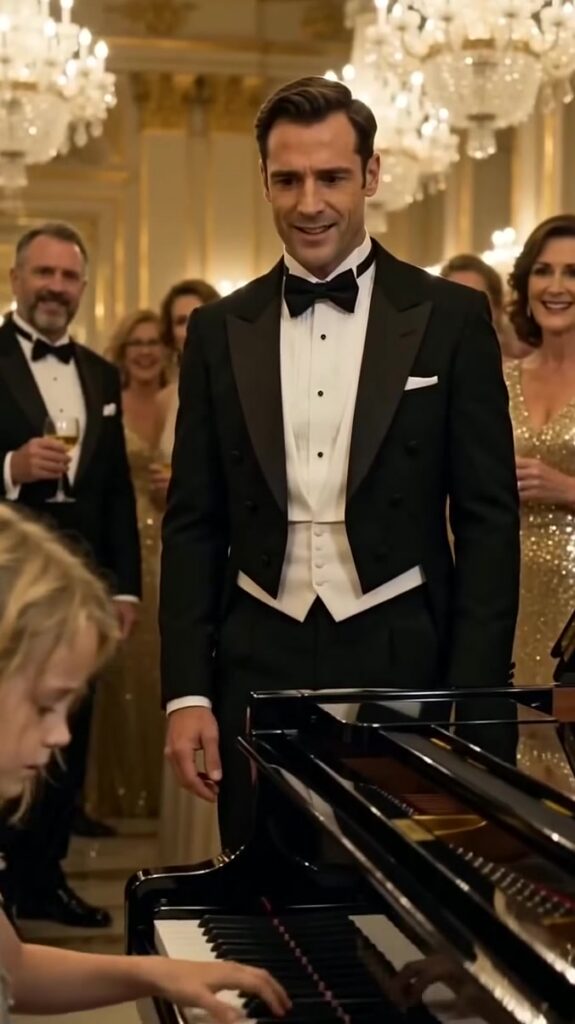
The ballroom glittered like a place where hunger was not supposed to exist. Everything about it screamed abundance—crystal chandeliers with enough dangling prisms to catch a lifetime of sunsets, marble floors polished to the point you could see your own smile and decide whether it was expensive enough, walls brushed with gold leaf that looked like it had never known dust.
People floated through the space the way swans moved across a pond: slow, graceful, and absolutely certain nothing unpleasant could reach them. Champagne traveled from hand to hand in tall, thin flutes. Laughter came in soft bursts—polite, filtered, trained. Even the music was supposed to be tidy: a hired trio in the corner doing something cheerful and forgettable.
That’s why the sound of one brutal piano chord felt like someone had thrown a brick through a stained-glass window.
It wasn’t part of the program. It wasn’t gentle. It was sharp enough to cut through silk conversation and expensive perfume. Heads snapped toward the grand piano at the far end of the room, like they were pulled by a single invisible string.
A girl sat there, barefoot, her toes curled on the glossy floor as if the cold had climbed through the marble and into her bones. Her dress had once been white, maybe for a recital or a church day, but now it was torn at the hem and greyed with travel. Dirt smudged her arms. Her hair was tied back with something that looked like a shoelace. Hunger sat on her face the way exhaustion does—an honest, unavoidable thing that no amount of pretending could cover.
She looked at the crowd and asked, carefully, with a voice that tried not to shake, “Can I play for a plate of food?”
For a second, the entire ballroom went still. Not because they were moved. Because they didn’t know what the correct response was in a room designed to never need one.
Then the laughter started, at first like a hiccup—one woman behind a glass, a man with a hand over his mouth. It spread quickly, easier than kindness. A few guests leaned closer to each other, enjoying the novelty of a problem they didn’t have to solve.
A man in a black tuxedo—sharp jaw, tidy hair, the kind of smile people wore when they thought cruelty was elegance—stepped forward as if he owned the air itself. He didn’t shout. He didn’t have to. His voice had been trained in places where rooms listened.
“This isn’t a shelter,” he said, lightly, as if he were correcting a waiter’s mistake.
The laughter got louder. A couple of people glanced around to see who else was laughing, the way you do when you’re making sure your morality matches the group’s.
The girl’s face fell, not from surprise, but from recognition. Like she’d heard this exact tone before and knew how it landed—heavy, humiliating, sticky. But she didn’t stand. She didn’t scramble away. She just swallowed, blinked hard once, and set her hands on the keys.
“Okay,” she said, to no one in particular.
Then she played.
Not flashy. Not the kind of thing that made people clap because it sounded expensive. Just a simple melody, delicate as a thread, pulled through the room with steady fingers.
The laughter died the way a fire dies when you cut off its oxygen—little by little, then all at once. Conversation snapped off mid-sentence. A woman in a gold gown lowered her glass and forgot to lift it again. A man near the back stopped chewing whatever canapé he’d been criticising and turned fully toward the piano, his brow tightening as if he’d been struck by something that didn’t leave a bruise.
Even the tuxedoed man lost his smile. It didn’t fade. It was removed, like someone had reached into his face and taken it away.
Because he knew that melody.
Not in the vague way you know a song you’ve heard in passing. He knew it like a secret. Like a name you didn’t say out loud. Like a scent that could drag you backward through time without asking permission.
He took one step closer, and something in his posture changed. It wasn’t confidence anymore. It was caution.
“Who taught you that?” he asked.
The girl kept playing for another bar, then let the notes hang in the air until they thinned into silence. Her fingers hovered above the keys, trembling just a little. She looked up at him, eyes wide but steady.
“My mother,” she said.
A ripple moved through the room, that sound people make when they all inhale at the same time. Someone whispered a name and then swallowed it, like they’d tasted poison.
The man went pale. Up close, his face wasn’t as flawless as it had looked from a distance. There were tiny cracks of old stress at the corners of his eyes. For the first time, he looked like a person who’d been awake at night.
“No,” he said, too quickly. Then, softer, “That’s… that’s impossible.”
The girl tilted her head. “She said she played it here,” she said, her voice lower now, more devastating for its calm. “A long time ago.”
Somewhere by the buffet, silverware clinked against a plate and no one laughed. The chandeliers suddenly seemed too bright, as if they were interrogating the room.
The tuxedoed man’s eyes darted over her—her torn dress, her bare feet, the small bones of her wrists. His gaze snagged on the chain around her neck. Until then it had been hidden under the collar of her dress, but as she shifted, it slid forward into the chandelier light.
A silver key, worn smooth at the edges, hung from a thin chain. Not costume jewelry. Not a charm. It had weight, history, meaning.
Every muscle in the man’s face tightened.
“Where did you get that?” he asked.
The girl’s fingers closed around it instinctively, like she was protecting the one thing no one could take. “From her,” she said. “She said to never lose it.”
The man’s throat worked. He glanced around as if the walls might suddenly start talking. A woman near him—pearls, stiff posture—went white and turned her head away, like looking at the key might make her complicit.
“What was her name?” the man demanded, and it wasn’t polite anymore. It was desperate.
The girl breathed in. Her mouth opened.
“Elara,” she said.
The name landed in the ballroom like another piano chord—clean, undeniable, cracking something that had been carefully sealed. A few older guests flinched. A man near the back muttered, “That’s not possible,” as if saying it could build a wall against the past.
The tuxedoed man stared at the girl like she’d become a ghost. His hands, so steady a moment ago, had started to shake.
“Elara Valen?” he whispered, barely audible.
The girl nodded once. “She told me not everyone here was bad,” she said. “She said there was one person who would remember.” She lifted her chin, and despite the dirt and the hunger, she suddenly looked older than her years. “She told me to find the man who locked the music away.”
A hush swallowed the room. Even the trio in the corner had stopped playing, their bows suspended. The air felt thick, like everyone was holding their breath to keep the truth from spreading.
The man’s eyes flicked to the key again, and then to the grand piano itself—an antique thing with carved legs and a lid that gleamed like black water. He looked like he wanted to step back, to disappear into the safety of money and polite rules. Instead, he stepped closer to the bench, close enough now that only the girl could hear him.
“Do you know what that key opens?” he asked.
She tightened her grip on it. “No,” she said. “But she told me it would matter. She told me if I played the song, the right person would get scared.”
His face twitched, a broken attempt at a smile. “Smart woman,” he murmured, and there was something like grief in it.
The girl studied him. “Are you going to call someone to throw me out?” she asked, and her voice wobbled for the first time since she’d started playing. “Because I really am hungry.”
The man exhaled slowly, like he was surrendering to something he’d avoided for years. He looked up at the chandeliers, at the gold walls, at the laughing people who weren’t laughing anymore. Then he looked back at the girl.
“No,” he said. “You’re not leaving.”
A murmur raced through the guests. A few looked offended, as if kindness were a breach of dress code. Someone in the back whispered, “Is he serious?”
The man ignored them. He reached into his jacket, not for a phone, not for a wallet, but for a small black notebook. The kind with pages that didn’t forgive mistakes. He flipped it open with hands that were trying to be steady.
“Elara was the best pianist this room ever had,” he said, louder now, so the room could hear whether it wanted to or not. “She didn’t vanish. She was pushed.”
The woman in pearls made a sound like she was choking.
The girl’s eyes widened. “She said the winter got her,” she whispered, confused. “She said the city was… colder than she expected.”
The man’s jaw clenched. “That’s what people say when they don’t want to say what really happened.” He looked down at her, and his voice softened. “What’s your name?”
She hesitated, like names were dangerous things to offer. “Mara,” she said finally.
He nodded once, as if sealing a decision. “Mara,” he repeated. “You’re going to eat tonight. And then…” He tapped the notebook with a finger. “Then we’re going to open what that key opens. In front of everyone.”
In the chandelier light, the silver key glinted, small and ordinary and somehow terrifying. The girl sat up straighter, as if the promise of food was only part of what she’d come for.
Somewhere in the ballroom, the first brave person started to clap—slowly, uncertainly. It wasn’t applause for entertainment. It was the sound of a room realizing it might have to pay attention.
Mara turned back to the piano, placed the key against her chest like a heartbeat, and set her hands on the keys again. This time, when she played, it didn’t sound like begging.
It sounded like a door unlocking.