The ballroom was built for spectacle, and it delivered on the promise like it was a law of physics. Every surface was trying to show off: chandeliers dripping crystal like frozen rain, walls dressed in mirrors that made the room feel twice as expensive, and a marble floor so polished it looked like it could swallow your reflection if you stood still too long.
I was there because I was hired to be there—coat, white gloves, tray, neutral expression. That was the deal. Be invisible, keep the champagne moving, don’t stare at the rich people like they’re zoo animals. Which, to be fair, is hard when the zoo animals wear diamonds the size of peppermint candies and laugh like they invented air.
They’d arranged themselves in a loose ring around the center like it was a stage. The band was warming up, playing something soft and floaty that sounded like it belonged in a movie where nobody ever spills a drink. Everyone kept glancing toward the middle, waiting for the next polished moment: a toast, an announcement, maybe one of those surprise charitable donations people make while cameras blink.
In the center sat the girl.
Not a little kid—late teens, maybe. She wore a blue gown that caught light and threw it back like it had opinions. A sash crossed her shoulder with the charity’s name embroidered in silver thread. Her hands rested on the arms of her wheelchair, fingers relaxed in a way that looked practiced, like she’d learned how to be still for other people.
Her father stood behind her, tall and glossy and tense, the kind of man who could smile while making you feel like you’d accidentally insulted his entire bloodline. When people leaned in to say things like, “You must be so proud,” he nodded, thanked them, and kept one hand on the chair handles like she might roll away if he blinked.
I’d seen her earlier by the side entrance while I was bringing in ice. She’d been watching the guests arrive, faces pressed into perfect shapes. When she caught me looking, she smiled—small, real—and said, “Does it always smell like roses in here?” like she hadn’t been raised in a place where roses were standard.
Before I could answer, someone called her name and she was wheeled away, leaving the question hanging in the air with the scent.
The band shifted into a new tune. Everyone in the ring leaned subtly closer, like a tide.
Then the doors opened.
Not the grand doors, the ones that were meant for entrances. The side ones. The service doors.
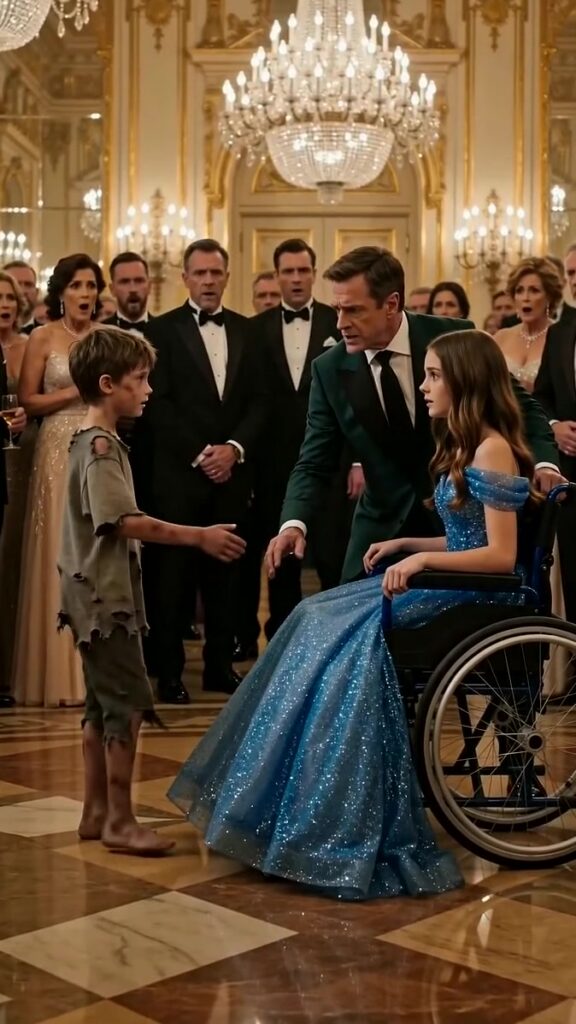
I saw him first because I was closest. A boy stepped in barefoot like he’d forgotten what shoes were. His clothes looked like they’d been in a fight with a fence and lost. Dust smeared his knees. One sleeve was ripped clean off. He didn’t hesitate, didn’t check the room to see if he belonged. He just walked straight across the marble like it didn’t matter how cold it was.
Behind him, one of the kitchen runners mouthed, “Oh no,” like a prayer.
The wealthy guests noticed in stages. First the nearest ones frowned, then the frown traveled outward as people turned their heads. Whispers rose, then dropped as if someone had pressed a mute button. Even the band slowed, like the musicians weren’t sure whether they were allowed to keep playing during a disaster.
The boy didn’t look at the diamonds or the champagne or the judges in their expensive suits. He looked at the girl in the center, and it was so focused it made the room feel suddenly less shiny.
He stopped a few feet away from her chair.
Her father moved with the speed of a man used to controlling a room. He stepped between them, one arm out, palm open like a stop sign. “This is a private event,” he said, not loud, but with the kind of authority that expects the world to apologize and back away.
The boy’s voice was calm. Not polite exactly. More…certain. “I’m not here for the event.”
“Then leave,” the father snapped.
The boy tilted his head, like he’d heard the command but didn’t find it relevant. His gaze stayed on the girl. “I’m here for her.”
That got a ripple through the circle. People love a scene as long as they’re not the villain in it.
The girl’s eyes went wide, not with fear—something sharper, like recognition. Her mouth parted slightly, as if she was searching for a name and couldn’t find it.
Her father’s jaw worked. “Do you even know who she is?”
The boy didn’t answer him. He addressed the girl, like the rest of us were furniture. “You wanna dance, right?”
Silence. The kind that makes you hear the chandelier crystals settle.
Her father laughed once, short and mean. “She can’t.”
The boy’s expression didn’t change. “She can. Not the way you think.”
I should’ve been looking for security. That was my job. But my feet stayed planted, tray heavy in my hands, because something about the boy’s certainty pulled the whole room toward him. Like he’d brought his own gravity.
The father lowered his voice, trying to keep control without making a scene—too late. “You don’t get to come in here and—”
“Let me,” the boy said, finally glancing at the father for half a second. It wasn’t defiance so much as…permission request from someone who already decided the answer. “Just one song.”
Someone near me murmured, “Is this a stunt?” Another whispered, “Call the board.” The word “press” floated through the ring like perfume.
The girl’s fingers tightened around the chair arms. Her shoulders lifted with a breath she’d been saving. “Dad,” she said softly.
He turned to her, his face pulled tight with fear disguised as anger. “No,” he said, like he was stopping her from stepping off a cliff.
The boy took a step closer, careful, like he was approaching a skittish animal. He held out his hand toward her, palm up. His hand was scraped, knuckles rough, nails dirty. It looked like a hand that had actually done things.
“I can help you stand,” he said, not to the crowd, not to the father. Just to her. Like it was a simple offer. Like it wasn’t a bomb.
The ring of guests tightened. I saw a woman clutch her pearls, literally, like the universe was about to steal them. A man raised his phone and then hesitated, caught between outrage and the need to document it.
The father went still. “What did you say?”
“Dance with me,” the boy said again, gentler now. “If you want. Not for them. For you.”
The band, sensing a cue or maybe just desperate to fill the silence, started a slow waltz. It was shaky at first, then steadied, as if the musicians decided to commit to whatever was happening.
The girl stared at the boy’s hand. Her throat bobbed. Her eyes shone with something dangerous, the kind of hope that ruins carefully arranged lives.
“What’s your name?” she asked.
“Eli,” he said.
Her lips moved like she was tasting it. “Eli,” she repeated, and it sounded like a memory she’d misplaced and just found under a couch cushion.
Her father’s hand clamped on the chair handle. “This is insane. You can’t just—”
“Dad,” she said, louder now. The room flinched at her voice. “Please.”
He looked down at her, and for a second all the glossy control slipped, and he was just a man terrified of watching his daughter get hurt in front of an audience hungry for cracks.
Eli’s hand stayed there, steady. Waiting.
The girl lifted her own hand, slowly, like she was reaching toward fire to see if it was real. Her fingers hovered over his. The whole room leaned with her, even the people pretending not to care. Even me, with my tray and my job and my rules.
Her father whispered, “If this is a trick—”
“It’s not,” Eli said, and there was no showmanship in it. No wink. No grin. Just that same impossible certainty.
The girl let her fingers settle into his palm.
Her father’s grip tightened, then loosened, like he couldn’t decide whether to pull her back or let her go. In the end, he did neither. He just watched, breath held hostage.
Eli stepped closer, braced his feet on the slick marble like he’d been taught how not to slip. He shifted his stance and placed his other hand near her elbow without touching, waiting for consent with a patience that felt oddly respectful in a room full of entitled people.
“Ready?” he asked her.
She swallowed. “I don’t know.”
“That’s fine,” he said. “We’ll find out.”
The music carried on, soft and insistent. The chandeliers threw gold across her blue gown, across his torn sleeve, across the father’s pale knuckles.
And then, with the boy’s hand steadying hers, the girl leaned forward out of the wheelchair—like she was stepping into a story she’d been told was impossible, like she was about to prove whether the ballroom was built for spectacle…or for something real.