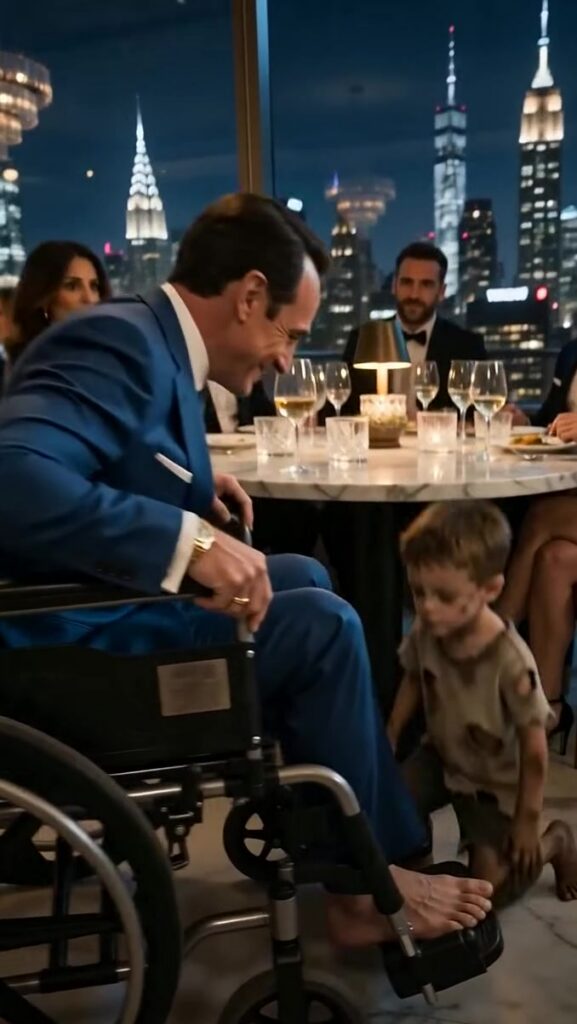
The rooftop restaurant floated above Manhattan like it had signed a contract with gravity and negotiated better terms. The kind of place where the elevators smelled like citrus and the menus didn’t have prices, just vibes. Warm light poured over white tablecloths, and the skyline beyond the glass looked like someone had spilled a jar of LEDs across the dark.
At the center of it all—because of course he had the center—sat Graham Kessler. Blue suit, silver watch, a smile that belonged on the cover of a magazine called People Who Don’t Wait in Lines. His wheelchair was sleek enough to be mistaken for modern art, all carbon fiber curves and quiet wheels. He held a wine glass like it was part of his hand.
People laughed around him the way people do when they’ve decided laughter is a kind of membership card. They nodded at his stories, tossed in comments that made him look funnier, smarter, more human. Graham didn’t mind. He liked an audience. He liked knowing he could stop speaking and they’d still watch him.
That’s when the boy stepped out of nowhere and stopped directly in front of the wheelchair.
At first, nobody clocked him. This place was trained to ignore certain kinds of people—busboys, coat-check attendants, anyone without a reservation. The boy was small, face smudged with city grime, hair too long and uneven like it had met scissors once in a rush. His hoodie was thin enough that the night breeze could probably read his ribs.
But he didn’t look lost. He didn’t look scared. He looked like he’d been walking toward this moment for miles.
“Sir,” he said.
The conversation at Graham’s table hiccuped. A couple of nearby guests leaned subtly in their chairs, like they were adjusting for a better angle. The boy’s voice wasn’t loud, but it carried the way certainty carries.
Graham’s eyes traveled over him and landed back on his face with a half-smile that wasn’t warm. More like a cat noticing a toy.
“You talking to me?” Graham asked, amused. Like the whole city was full of tiny surprises and this was today’s.
The boy nodded once. “I can fix your leg.”
A laugh popped out of someone at the next table. Another followed. Not cruel, exactly. Just the automatic laughter people use when they’re sure the punchline isn’t them.
Graham raised his eyebrows and looked around as if the restaurant had hired entertainment without telling him. “That so?” he said. “What are you, a doctor?”
“No,” the boy said. “I’m me.”
That got a few more chuckles, and Graham—still smiling—set his wine glass down carefully on the marble table. His attention sharpened, the way it did whenever he scented a risk-free game.
“Alright,” he said, leaning forward. “How long’s this miracle going to take?”
“A few seconds,” the boy answered, no pause, no performative thinking.
Graham’s grin widened. “I’ll give you a million dollars if you do it.”
This time the laughter was bigger, bouncing off crystal and glass. A million was a number Graham threw around to remind people it existed in his world. The manager hovered at a polite distance, clearly wrestling with whether to intervene or watch this play out like everyone else.
The boy didn’t react to the number at all. He just dropped to his knees beside the wheelchair like he’d been waiting for permission.
That shift—someone kneeling—changed the energy. Even the people who’d been laughing quieted a little. The way crowds do when the thing they thought was a joke starts developing teeth.
Graham’s right foot rested on the footplate, bare because he’d kicked off his expensive loafer under the table. His ankle looked normal. Everything about him looked normal, which was part of the unfairness. The injury was old, the story polished. Accident. Surgery. Complications. A hundred specialists. Bad luck. Good lawyers.
The boy reached out and placed two fingers against the inside of Graham’s ankle, almost gentle. Like checking a pulse.
Graham laughed under his breath. “This is—”
The boy pressed.
Not hard in a violent way. Hard in a precise way, like he’d found a button.
Graham’s whole body jerked. His hand slammed onto the tabletop, rattling cutlery. The chair squeaked. For a second his face was pure reflex—shock without permission.
“Count,” the boy said, eyes on the ankle, voice flat and calm.
Graham tried to shake it off, tried to reassemble the version of himself that didn’t get startled. “This is ridiculous,” he started, but it came out thin.
The boy pressed again, slightly different angle.
“One.”
Graham stared down at his foot. His toes—his actual toes—had moved. Just a twitch, almost insultingly small. But it was real. He knew what nothing felt like. He’d lived with nothing for years. This wasn’t nothing.
Someone at the table next to them whispered, “Did you see that?”
“Two,” the boy said, and pressed.
Another toe lifted. Then another. A tiny, involuntary dance. Graham’s mouth opened like he was about to laugh, but the sound never found the door. His eyes darted up, scanning faces, as if he needed someone to confirm he wasn’t imagining it.
The restaurant had gone almost silent. Even the music—some soft jazz—felt like it had stepped back to watch.
Graham’s wine glass trembled where it sat. His fingers reached for it without thinking, the way people grab for comfort, and the stem slipped. The glass tipped, struck the marble, shattered. A sharp, clean sound. Nobody flinched. They were too busy staring at his foot.
“Three,” the boy said.
Graham’s foot flexed. Not much. But enough that his calf tightened. Enough that his knee responded like it remembered a language he’d stopped speaking.
Graham swallowed. His voice came out rough. “What are you doing?”
The boy finally looked up. His eyes were dark and steady, like he’d been carrying a message too big for his small body. “Fixing it,” he said, as if that should’ve been obvious.
He moved his fingers once more, a quick press-and-release, and then he pulled his hand away like he’d finished tying a knot.
He stood, wiping his palms on his torn hoodie, and said the words that made the air in the room feel suddenly heavier.
“Stand up.”
Graham stared at him. He looked around again, searching for the punchline, the hidden camera, the manager ready to shout ‘Surprise!’ But there was only the crowd—wealthy, curious, hungry for a story they could retell. And beneath that, there was something else. A quiet fear that this might actually be real.
His hands gripped the edge of the table. His knuckles went pale. He shifted forward in the chair and felt his legs respond. Weakly. Unsteadily. But respond.
A woman a few tables away brought a hand to her mouth. Someone else whispered, “No way.”
Graham leaned forward, weight over his feet. He could feel the floor through the soles of his socks. He hadn’t felt the floor like this—honestly felt it—in so long that it seemed like the world was switching back on one circuit at a time.
He pushed.
The wheelchair rolled back an inch.
Graham rose.
Not smoothly. Not like an athlete. Like a man waking up from a long sleep and finding out his body had been waiting for him. His knees trembled, his jaw clenched, and his eyes went wide with something dangerously close to panic.
The boy stepped closer, just enough that his voice could belong only to Graham.
“My mom told me you’d walk the day you saw me again,” he whispered.
Graham froze mid-breath. The color drained from his face, leaving him suddenly older, suddenly less polished. The name that flashed across his mind wasn’t a name he said out loud anymore. It was one he’d buried under settlements and silence.
“That’s not possible,” Graham murmured, barely moving his lips.
The boy tilted his head, watching him the way someone watches a door they know is about to open. “It is,” he said softly. “Because she sent me.”
Graham’s legs shook. His hands hovered, unsure whether to reach for the table, the chair, or the boy. Around them, the restaurant held its breath, waiting for the next part of the spectacle.
But the boy wasn’t looking at the crowd. He was looking only at Graham, like the whole city was just background noise.
“You promised her,” the boy added, casual as if he were reminding him about a missed appointment. “And she doesn’t like broken promises.”
Graham’s mouth opened. No words came. Somewhere in the room a phone began recording. Somewhere else, someone whispered the word “miracle.”
The boy took one small step back and nodded toward the elevator doors. “We should talk,” he said. “Somewhere without an audience.”
Graham stood there on unsteady legs, the millionaire who’d just been forced to feel the ground again, and for the first time all night he didn’t look entertained.
He looked caught.