The café terrace was full of golden light and expensive calm, the kind you could practically taste—citrus in the spritzes, butter in the pastries, money in the way nobody rushed. A plane-tree canopy sifted the sunlight into coins that landed on marble tabletops. Everything clicked and murmured softly, like a room full of people pretending the outside world wasn’t real.
Clara liked it that way. She’d picked this place because it made her feel untouchable. Black dress, neat bun, sunglasses that cost more than her first rent. She’d ordered an espresso she didn’t even want because she needed her hands to look occupied while she decided if she was brave enough to open the envelope in her bag.
The envelope had been mailed to her office with no return address. Inside: one line on creamy paper—MEET ME WHERE WE USED TO BUY CANNOLI—and a time. That was all. She’d tried to laugh it off, tried to tell herself it was a weird prank, but her fingers had gone cold anyway. There was only one “we” that fit that sentence. Her sister, Iris. The sister who’d disappeared ten years ago like a door shutting mid-sentence.
Clara had been stirring the foam into her coffee when she felt it—something small and warm grazing the back of her head, a careful tug at a loose strand. She flinched so hard the chair legs shrieked on stone. Her cup tilted, a brown wave threatening her dress, and she caught it on instinct.
“Hey,” she snapped, turning fast, the word sharper than she meant. “Don’t touch me.”
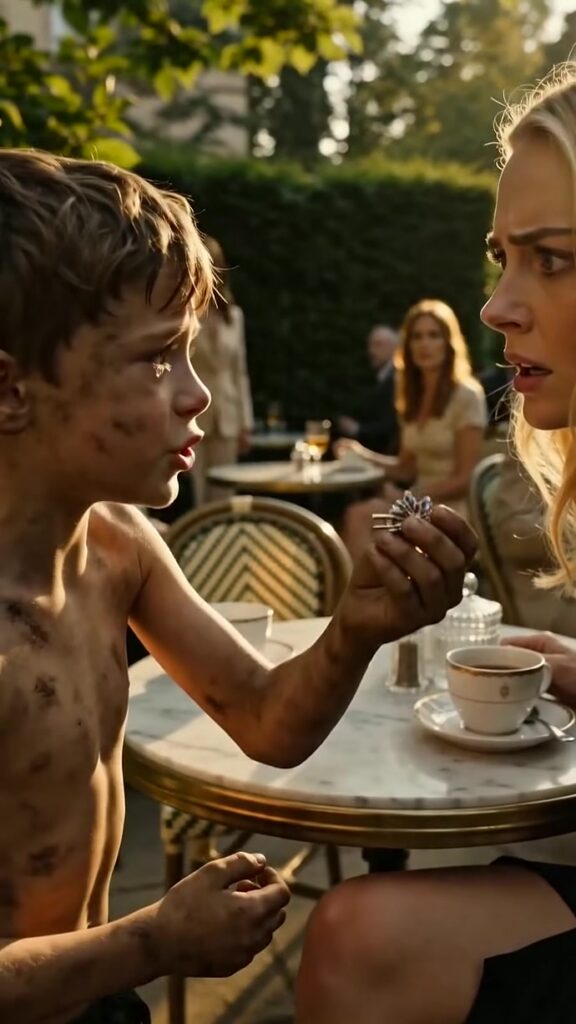
A boy stood beside her table like he’d materialized out of the heat. Shirtless. Bare feet gray with dust. Hair hacked short, as if someone had cut it with a kitchen knife. His chest rose and fell too quickly. He pulled his hand back, not defensive—more like he’d touched something holy by accident and didn’t know what to do with his fingers now.
Nearby conversations thinned. A couple at the next table paused with forks halfway to their mouths. Clara felt the eyes on her, waiting to see what kind of person she was going to be about this.
“What do you want?” she asked, trying to lower her voice into something firm and adult and in control. She hated that her heart was thudding. She hated that the boy’s stare wasn’t scanning her jewelry like a little hustler’s would. He was looking at her face. At her hair. Like he was matching her against an image he’d carried for a long time.
His voice came out small and wobbly. “She has the same hair.”
Clara frowned. “Who does?”
The boy swallowed, blinking hard. “My mom.” He said it like those two words were heavier than the whole terrace. Then, as if that wasn’t enough, he added, “She said I’d find you here.”
Clara let out a quick, disbelieving breath. People lied all the time. Kids got coached all the time. She’d seen it at charity events, seen parents send children forward with rehearsed sob stories. But something inside her reacted before her mind finished building its wall. A prickling at the base of her skull. A memory of Iris’s laugh on this same street, powdered sugar on her lip, swearing she’d never leave Clara behind.
“Your mom,” Clara repeated, softer now, and hated how shaky it sounded. “What’s your mom’s name?”
The boy didn’t answer. Instead he opened his fist slowly, like he’d been afraid to reveal what was inside because it would make everything real. Nestled in his palm was a hair clip—metalwork shaped like ivy, stones set like dew. Not flashy-new, but intricate and old-fashioned, the kind of thing you couldn’t buy at the airport. The gems caught the late sun and flashed a greenish gold.
Clara’s throat tightened. She knew that clip. She’d watched Iris pin it into her hair for school dances and job interviews and nights out when she wanted to feel like someone in a film. Clara had held it once, careful not to drop it, while Iris curled her hair in the bathroom mirror. The clip had been an heirloom, passed down from their grandmother, and Iris had promised—half teasing, half serious—that she’d give it to Clara “when you stop acting like a miniature lawyer.”
Clara’s hands went numb around her cup. “That can’t be,” she whispered, because her brain refused to let her mouth say Iris’s name. “Where did you get that?”
The boy’s face crumpled like paper in rain. Tears slid down, cutting clean tracks through the dirt. “She told me to hold it. She said if I got scared, to keep it closed in my fist and think about the sparkles.” He tried to smile and failed. “She said you’d say it wasn’t possible. But she said you’d know.”
Clara leaned forward without deciding to. The terrace suddenly felt too open, too bright. Like the light was an interrogation lamp. “Where is she?” Clara asked, and heard the edge in her own voice. Not anger. Fear. Fear with teeth.
The boy didn’t speak. He just turned his head, slow and deliberate, and looked past the line of tables toward the hedge that divided the café from the walkway. Clara followed his gaze, because her body was already doing what it always did when Iris was involved: chasing.
At the edge of the greenery stood a woman in a beige suit. Not the harmless, office-neutral beige of normal people. This beige was tailored, expensive, the color of sand after a storm. Her hair was sleek, her posture straight, her face calm in a way that made Clara’s stomach drop. The woman’s eyes were on them—on the boy, on Clara—as if she were checking that everything went according to plan.
Clara knew her the way you know a smell that once meant danger. Ten years ago, the night Iris vanished, there had been a woman who came to the apartment in a beige suit. She’d spoken to their mother in a soothing voice, had called Iris “a bright young lady with a lot of options.” She’d offered “help,” “opportunities,” “a program,” words that sounded like scholarships until you realized none of the details ever landed. Iris had argued with their mother. Clara had listened from the hall, small and furious and powerless. Then Iris had walked out with a duffel bag and a promise to be back by morning.
Morning came. Iris didn’t.
Clara’s breath hitched. The beige-suited woman lifted a finger, placed it gently against her own lips, and smiled as if they were sharing a private joke. The terrace noise returned in a rush—cups clinking, a waiter calling an order, a scooter whining in the distance—but now it sounded wrong, like music playing during a fire.
Clara set her coffee down with a care that felt absurd. She took off her sunglasses. Her hands were steadier than her insides. She looked at the boy again, really looked, and the shape of his cheekbones made her think of Iris at twelve, pouting because Clara wouldn’t let her borrow a sweater.
“What’s your name?” Clara asked.
The boy sniffed. “Milo.” He said it quickly, like he’d been told to. Then he added, quieter, “She said you’d help me. She said you’d be mad, but you’d help.”
Clara stood. Her chair scraped again, loud enough that a few people startled. She didn’t care. She reached for the boy’s dusty hand, and he flinched, then let her take it. His fingers were small and hot, and his fist still clutched the jeweled clip like it was the only proof he existed.
Across the hedge, the beige-suited woman’s smile didn’t change. She didn’t run. She didn’t wave. She simply waited, sure of herself, like she’d already bought the ending and was only watching the scene catch up.
Clara felt something old and sharp click into place inside her, the same feeling she’d had as a kid when Iris dared her to jump off the pier: fear, yes, but also a furious kind of clarity. She squeezed Milo’s hand once. “Okay,” she said, more to herself than to him. “We’re not doing this her way.”
Then she stepped away from the expensive calm, pulling the boy with her, and walked straight toward the hedge and the woman in beige—because sometimes the only way out of a trap is to walk right up to it and start pulling the wires.