The carnival looked like joy from the sidewalk, like someone had taken all the good parts of summer and stitched them into one loud, spinning place. The gate was wrapped in streamers that shivered in the breeze. Light bulbs blinked even though the sun was still up, as if they couldn’t wait to be useful. Somewhere inside, a ride whooshed and squealed and the sound floated out over the parking lot like an invitation.
June stood across the street with her chin tilted up, letting herself pretend for ten seconds that she was just another kid in line, sticky from lemonade, clutching her mom’s hand. The pretend part fell apart fast. She didn’t have a hand to hold anymore, and her clothes were a few sizes too big because they’d been someone else’s before they were hers. She’d rolled the sleeves twice, but they still swallowed her wrists. Her feet were bare because the flip-flops she’d started with had snapped a week ago.
The air smelled like dust and sugar and something fried. It made her stomach do a hopeful little twist, which she hated, because hope was the kind of feeling that could make you do dumb things. She did it anyway. She crossed the street when the light changed and the cars stopped, then walked right up to the entrance like she belonged there.
She had a ticket. Not a new one, not one of those glossy wristbands everyone else had, but a faded paper stub with a rip along the edge and a date printed so lightly it looked like it was trying to disappear. She’d kept it folded in her pocket through rain and sweat and a night she slept on a bus bench with her arms wrapped around herself. It was the one thing she didn’t let go of.
When she reached the front, the security guard barely looked at her face. He looked at the ticket, like it was a bug that had landed on his counter.
“Where’d you get this?” he asked, already making a face.
“It was my mom’s,” June said. Her voice came out smaller than she meant it to. “She said—”
He didn’t let her finish. He flicked the ticket out of her hand with two fingers. Not angry, not even dramatic. Just… casual. Like swatting lint off a jacket.
The stub fluttered and landed in the dirt by the gate.
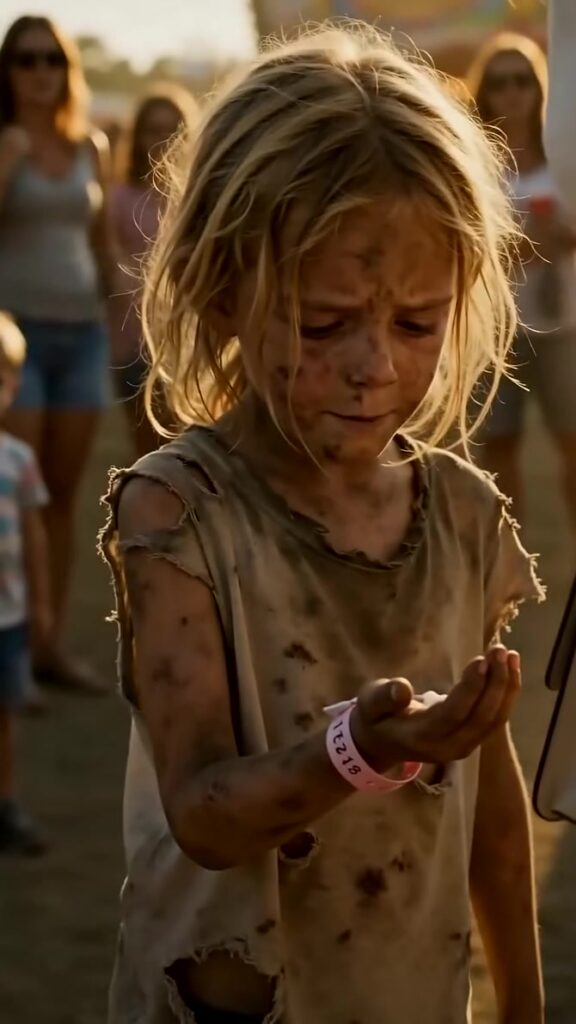
For a second June froze, like her body hadn’t decided whether she was allowed to move. Then she dropped to her knees without thinking. The gravel bit into her skin. Her clothes bunched weirdly around her and she hated how she looked, hated that she was a whole scene now. She scrabbled for the ticket with her fingertips, the dust clinging to her nails.
A couple standing nearby snorted. Not a big laugh. Just that small, sharp sound people make when they think they’re better than you but don’t want to commit to it.
June found the stub and curled her hand around it like it might run away. When she stood up, her knees were dirty and her throat felt thick. She wasn’t crying, but her eyes had that hot, watery sting that meant the tears were waiting right behind the door.
“You can’t come in,” the guard said. “We don’t accept—whatever that is.”
June wiped her palm on her pants, leaving a darker smear of dirt. “I’m not here for rides,” she said. “I’m here to find someone.”
That was when the woman showed up, sliding into the space beside the gate like the carnival had opened just for her. She wore a white dress that looked too clean for dust, sunglasses that hid her eyes, and sandals that probably cost more than June had seen in her whole life. Even the way she stood was tidy.
June recognized her, not because she’d ever met her, but because she’d memorized her. There’d been a photo once. A magazine clipping her mom had kept folded in a Bible, the edges soft from being touched too many times. The headline had called her a “philanthropist.” In the photo she’d smiled like a person who knew exactly how much her smile was worth.
The woman glanced down at June like she’d stepped in something. “She doesn’t belong in here,” she said, her voice smooth and bored, as if she were commenting on bad music.
The guard straightened immediately, eager for backup. “Ma’am, yeah, I’m handling it.”
June’s fingers tightened around the ticket until the paper bent. She could taste metal in her mouth. Every part of her wanted to turn around and run. That would be easier. That would be safer. But her mom’s voice pushed through the panic, clear as if she were right behind her.
Find her first.
June lifted her chin. “I’m not leaving,” she said. It came out shaky, but it was still words.
The woman’s head tilted a fraction. “Excuse me?”
June swallowed. She didn’t look at the guard. She didn’t look at the laughing couple. She looked at the woman’s mouth, the sharp line of lipstick, because the sunglasses made the rest of her unreadable.
“My mom said I had to find you first,” June said.
That made the woman pause. Not much. Just enough that June noticed it, like a crack in glass catching light.
“Your mom,” the woman repeated, like she was testing whether the words were even real.
June opened her other hand. She’d been sweating so hard it had stuck to her skin, but it was still there. A thin pink hospital bracelet, faded and wrinkled, the plastic cloudy from age. The printed numbers were barely readable, but the pattern was. A code meant to match another code, two halves that belonged together.
The woman’s entire posture changed. The smoothness drained out of her like someone had pulled a plug. Her shoulders stiffened, and her hand jerked toward her purse in a movement so automatic it looked like a reflex.
June didn’t miss it. The purse was open just a little, and inside, tucked into a side pocket like a secret, was the corner of another bracelet. Same color. Same cheap hospital plastic.
The woman’s breath came out in a whisper she didn’t seem to control. “No.”
Even the carnival noise seemed to dip for a second, as if the music had turned its head to listen. The people nearby stopped laughing. The guard’s mouth hung half open, his earlier confidence suddenly useless.
June’s lips trembled, but she held her palm steady. “This is mine,” she said. “My mom tied it on me before she—” She stopped. Saying the word died made her feel like she was dropping something fragile. “Before she was gone.”
The woman leaned closer, and for the first time her voice wasn’t bored. It was tight. “Where did you get that?”
“She saved it,” June said. “She said it mattered.”
“What did she say?” the woman asked, and the question sounded like it hurt.
June blinked hard. Her eyes finally spilled, a couple of tears tracking through dust on her cheeks. She hated that she was crying in front of all these people, but she couldn’t stop. She could only keep going.
“She said you took my sister home,” June said, each word heavy like she was lifting it up with both hands, “and left me at the hospital.”
The woman’s fingers went slack. The bracelet corner slipped out of her purse and dropped against the fabric with a soft tap. She stared at June like she was looking at a ghost that had learned to talk.
Behind them, the carousel kept spinning. Kids kept laughing. Music kept drifting through warm air full of dust and sugar, like joy was still the whole point of this place.
June stood there with dirty knees and a bent ticket stub and a bracelet that felt like proof and a weapon all at once. Her voice came out quiet, not brave, just honest. “I didn’t come here for a ride,” she said. “I came here because my mom said you’d recognize me.”
The woman’s mouth opened, then closed again. For a second she looked like she might faint, like all the neat parts of her life were trying to slide off her shoulders. She took off her sunglasses with a shaky hand.
Her eyes were red already, like they’d been that way for years and she’d just been hiding it better than most people.
“What’s your name?” she asked.
June’s throat tightened. “June.”
The woman repeated it like a prayer she’d forgotten how to say. Then she looked past June, at the gate, at the guard, at the people watching. Her voice steadied, but it wasn’t the old smooth voice. It was something rawer.
“Open the gate,” she said.
The guard fumbled with the latch like his hands didn’t belong to him anymore.
June didn’t move right away. She watched the woman’s face, trying to read it. Disgust was gone. So was the practiced distance. What was left looked like fear, and something else—something like regret, but bigger.
The gate clicked open.
The carnival still looked like joy. Up close, June could see the grime on the painted rides, the faded posters, the cracked asphalt under the glitter. It wasn’t perfect. It was just loud and bright enough to distract you.
June stepped forward anyway, still holding the bracelet, because she’d come this far and she wasn’t about to let go now.
“Where is she?” June asked, her voice small again, but steady. “Where’s my sister?”
The woman swallowed hard, and for the first time, she didn’t have an answer ready. She just reached out, not to grab June, not to pull her close, but to touch the edge of the pink bracelet like she needed to confirm it was real.
“I…” she started, and the word broke.
The music swelled, the rides flashed, and the sunlight poured over them like a spotlight.
Joy, from the outside, could look a lot like a cover story.
And June was done being fooled by pretty lights.