The wedding planner kept saying the word “timeless,” like she was trying to cast a spell over the whole day. Timeless candles. Timeless orchids. Timeless string quartet that cost more than my first car. Even the sunlight looked rented—golden and soft, pouring through the tall windows of the old hotel ballroom like it had a contract.
Daniel Mercer stood at the front of it all, shoulders squared, tux pressed within an inch of its life. He smiled in the way people smile when they know everyone is looking. The kind of smile that makes investors relax and mothers cry and photographers whisper, “Hold that.”
I was there because I was the best man, which mostly meant I was responsible for keeping Daniel from doing anything stupid. He’d been on his best behavior for months—no late nights, no tabloid nonsense, no disappearing acts. The Daniel who used to blow up his own life for sport had been replaced by this polished, composed version, and I wanted to believe it was real.
The bride—Sloane—was walking down the aisle on her father’s arm. She looked unreal. Not in a creepy mannequin way, but like someone had edited her in real time: soft veil, calm smile, eyes bright with the kind of certainty you can’t buy. She met Daniel’s gaze, and his expression softened. For a second he looked like a guy who actually deserved a happy ending.
The officiant cleared his throat. The quartet slid into the next song. A few people dabbed at their eyes. Everything was moving according to plan.
Then the doors at the back of the ballroom slammed open so hard the sound slapped the air.
The music tripped and died. A champagne flute shivered on a tray. You could feel the whole room inhale and freeze.
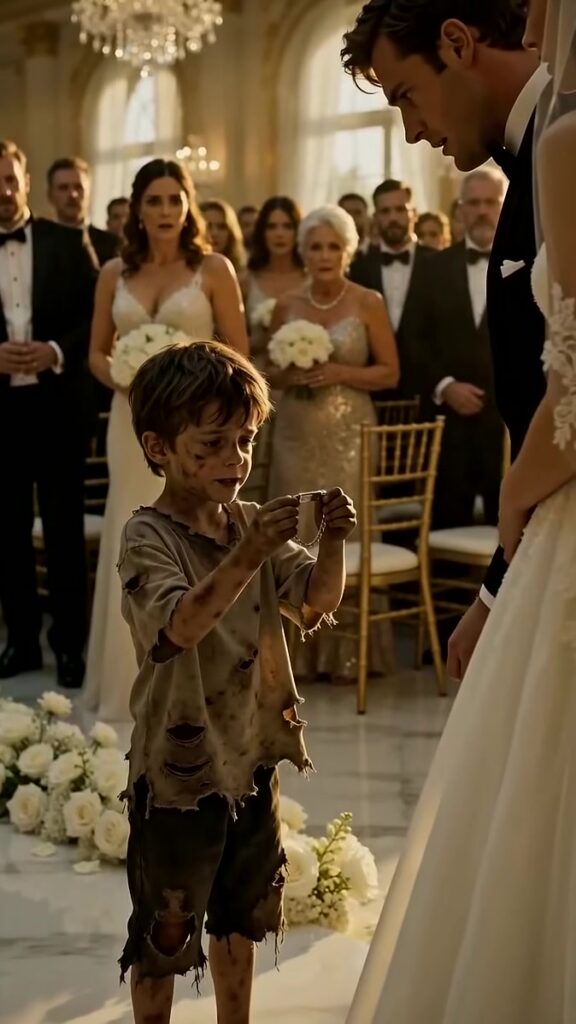
A kid stood in the doorway like he’d been fired out of a cannon. Bare feet on marble. Shirt too big and torn at the shoulder. Hair messy in the way that didn’t come from styling products, but from sleeping wherever you can. His cheeks were smudged with city dirt, and his eyes were wide and frantic, scanning the crowd until they locked onto the altar.
People didn’t move at first. The security guards—because of course there were security guards—started forward with the lazy confidence of men who assumed they were about to escort out an inconvenience.
But the boy didn’t hesitate. He bolted down the aisle.
Gasps rippled like a wave. Someone actually said, out loud, “Is this part of it?” as if Daniel had hired a dramatic child as entertainment between vows.
I stepped down from my spot, instinct taking over, ready to intercept. Daniel’s face tightened, jaw clenching, eyes narrowing with a flash of anger so fast it almost looked practiced.
The boy reached the front steps and stopped short, panting like his lungs were too small for what he needed to say. He clutched something in his fist—something silver that caught the late-afternoon light.
Daniel took one step forward. “What is this?” he snapped, voice sharp enough to cut through the silence.
Sloane’s fingers found Daniel’s sleeve, like she could anchor him in place. Her eyes moved from the kid’s bare feet to his shaking hands to his face, confusion starting to wrinkle into worry.
The boy swallowed. His lower lip trembled, but he lifted his hand anyway. “I need to show you something,” he said, voice small but stubborn, like he’d rehearsed it a hundred times and refused to forget it now.
He opened his fist.
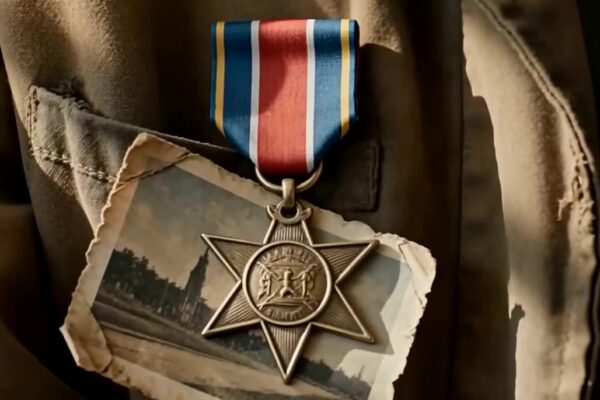
In his palm lay a tiny baby bracelet. The kind you get at a hospital. Worn thin, scratched up, the clasp bent like it had been pulled too hard at some point. But it was still bright enough to shine under the chandeliers.
Even from where I stood, I could see letters engraved along the metal. Faded, but readable.
For my son — Daniel.
The room didn’t just go quiet. It went weightless.
Daniel’s expression flickered—anger draining out like someone pulled a plug. Color left his face. His mouth opened slightly, but no sound came out. He stared at that bracelet like it was a snake, or a mirror, or both.
“No,” he breathed, and it wasn’t denial so much as a word that fell out of him on accident.
Sloane let go of his sleeve. Her hand dropped slowly to her side, like she didn’t trust herself to touch anything anymore.
The boy’s eyes shone with tears he refused to let fall. “My mom kept it,” he said. “She said it was the only thing she had that proved… that proved I wasn’t making it up.”
Daniel’s throat worked. “Where did you get that?”
“From her,” the boy said. He wiped his nose with the back of his wrist, leaving a dark smear. “Before she died.”
It hit the guests like a second door slam. Someone near the front made a choking sound. I heard a woman whisper, “Oh my God,” like she’d just spotted a ghost.
Daniel’s knees bent slightly, like the floor had turned soft. He lowered himself a fraction, trying to see the kid’s face up close, like proximity could change the math. “What was your mother’s name?” he asked, and his voice cracked in a way I’d never heard from him—not even in the rough years.
The boy hesitated. You could see him fighting himself: wanting to be brave, wanting to be angry, wanting to run. Then he lifted his chin.
“Mara,” he said. “Mara Reyes.”
Daniel’s breath left him in a harsh exhale. His eyes shut for one second, like his brain had to reboot. When he opened them, they were wet.
Sloane’s face had gone pale, her lips parted. She looked at Daniel like she’d been handed a version of him she’d never agreed to marry.
Daniel whispered, “Mara…?” like he was tasting the name, like it had been buried under years of expensive distractions. His gaze dropped back to the bracelet. “That’s…” He stopped. Swallowed hard. “That’s not possible.”
The boy’s voice came out rougher now. “She said you left us the day I was born.”
Every eye in the room darted to Daniel. Even the officiant looked like he was about to faint.
Daniel stood completely still, like if he didn’t move, the moment might pass him by. His hands started shaking, small tremors that betrayed him. He reached out, slowly, like approaching a skittish animal. “What’s your name?”
“Leo,” the boy said. “Leo Reyes.”
Daniel flinched, and I saw it then—not a man caught in a lie, but a man getting hit by something he’d tried to outrun for a long time. “How old are you?” he asked.
“Ten,” Leo said. He sniffed and blinked hard. “Almost eleven.”
Daniel’s eyes turned distant, counting backward without meaning to. His mouth tightened with memory. A decade ago, he’d been a different person: wilder, reckless, convinced consequences were something that happened to other people.
“Why are you here?” Sloane asked, and her voice wasn’t angry. It was thin, like she was holding herself together by thread.
Leo looked at her, then back at Daniel. “Because I don’t have anybody,” he said. “And she made me promise. She said if anything happened to her, I had to find you. She said you’d know what to do.”
Daniel laughed once, a sharp little sound with no humor in it. “I don’t even know what I’m doing right now,” he whispered.
I took a step closer, not sure who I was supporting—my best friend, the bride, or the kid who’d just detonated an entire ballroom. The security guards hovered, uncertain now, because what do you do when the “problem” is a barefoot child holding a piece of someone’s past?
Daniel finally reached out and took the bracelet. His fingers curled around it like it was fragile. Like it might disappear if he held it too loosely. He stared at the engraving again, and I watched his face shift through disbelief, regret, panic, and something that looked a lot like grief.
Sloane’s eyes flicked to me, silently asking if I knew. I shook my head, because I honestly didn’t. Daniel had never mentioned a Mara, never mentioned a child, never even hinted at anything this huge. He’d always talked about his past like it was a closed chapter.
Turns out he’d just ripped the pages out.
Leo’s voice dropped to a whisper. “Are you… are you my dad?”
Daniel looked up, and for the first time since the doors flew open, he seemed to actually see the kid: the bones too sharp under his skin, the way he held his shoulders like he expected to be shoved away, the brave face cracking at the edges.
Daniel’s eyes filled, and he blinked hard, like he was offended by his own tears. “I don’t know,” he said honestly. Then he swallowed, and his voice steadied. “But… if there’s even a chance…”
He glanced at Sloane, and the whole room waited for her reaction like it was the final verdict. Sloane’s throat moved as she swallowed. Her gaze slid from the tuxes and flowers and crystal to the boy’s bare feet.
“Daniel,” she said quietly. “What are you going to do?”
Daniel’s shoulders sagged, the polished version of him slipping like a jacket falling off. He looked back at Leo. “I’m going to figure this out,” he said. “Right now. Not later.”
He turned to the officiant, to the guests, to the whole perfect setup that suddenly felt like a stage built on the wrong story. “I’m sorry,” he said, voice carrying. “I can’t… I can’t do this today.”
A collective murmur rose, confusion mixing with outrage, but it didn’t matter. Daniel stepped down from the altar.
He held out his hand to Leo.
Leo stared at it like it might burn him. Then, slowly, he placed his small, dirty hand into Daniel’s trembling one.
And just like that, the wedding stopped being the main event.
Daniel walked down the aisle with a barefoot kid at his side, leaving behind the string quartet, the white flowers, the “timeless” everything. I followed, because that’s what best men do, even when the script catches fire.
Behind us, Sloane stood at the altar alone, veil glowing in the late light. She didn’t cry. She didn’t chase. She just watched them go, and in her eyes was the kind of stunned bravery you see when someone’s life reroutes without asking permission.
Outside the ballroom, the hallway felt colder, more real. Daniel crouched in front of Leo, still holding the bracelet. “Where have you been staying?” he asked.
Leo shrugged, trying to look tough. “Wherever.”
Daniel’s jaw tightened. He looked up at me like he’d forgotten how to ask for help, then remembered I was there. “Call someone,” he said, voice raw. “A doctor. A lawyer. I don’t care. Call everybody.”
I pulled out my phone, hands suddenly clumsy. “Yeah,” I said. “Okay.”
Leo glanced back toward the ballroom like he expected someone to drag him out. “Am I in trouble?” he asked.
Daniel shook his head quickly. “No. You’re…” He paused, like the next words were too big to say in a hallway full of wedding guests and spilled secrets. Then he exhaled. “You’re safe. That’s the only thing I know for sure right now.”
Leo’s face crumpled for half a second, relief breaking through. He blinked hard and looked away, embarrassed by his own emotions.
Daniel stood, still holding the kid’s hand, the baby bracelet pressed between his fingers like a tiny anchor. He looked down the corridor toward the elevator and whatever came next.
The perfect wedding had been designed to look flawless.
But a barefoot boy with a silver bracelet had shown up and proved something Daniel couldn’t buy, plan, or polish away: the past doesn’t care about orchids.
And sometimes the most important vows are the ones you never saw coming.