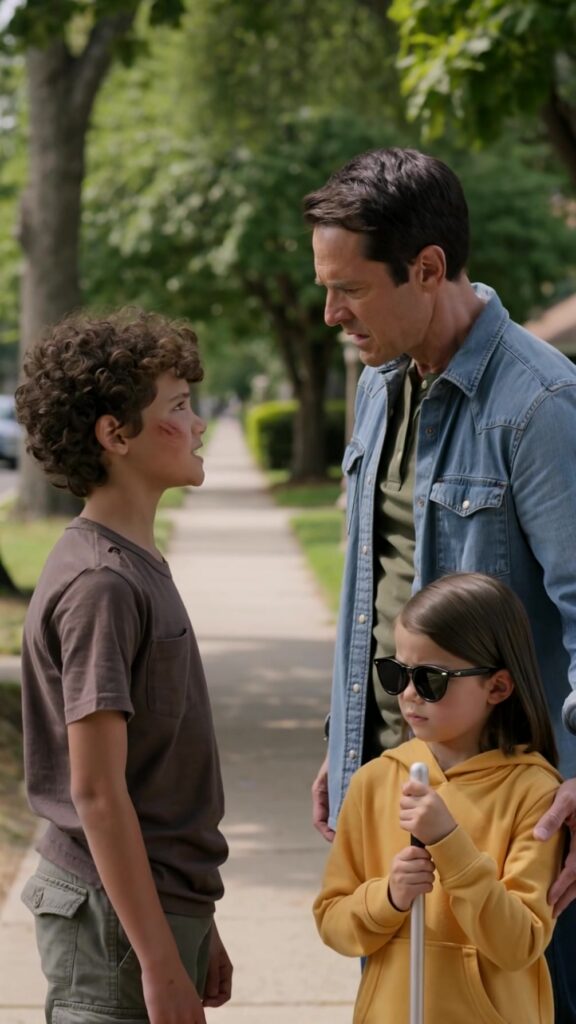
The kid looked like he’d crawled out from under a storm drain and decided to stay there. Mud up his calves, a rip in one knee, hair stuck together in greasy ropes. He stepped off the strip of grass between sidewalk and street like he’d been waiting for us specifically, blocking the path with the confidence of someone who didn’t know what fear cost.
I almost kept walking. Suburban reflex: don’t make eye contact, don’t engage, pretend you didn’t notice anything weird in a neighborhood designed to be aggressively normal. But Lily’s cane tapped his shoe and she stopped, shoulders tightening under her yellow hoodie. Her sunglasses reflected the sky, blank and glossy, like she had no reason to look anywhere at all.
“Excuse us,” I said, reaching out to guide her around him.
“She isn’t blind,” the boy said, like he was reading a fact off the side of a cereal box. He didn’t even look at me when he said it. He looked at Lily. “She just doesn’t want to see you.”
Heat flooded my neck so fast I felt dizzy. My hand curled into a fist before I knew it. “What did you say?” I snapped. “Move.”
The kid didn’t budge. His face was too calm for how filthy he was—like the dirt had gotten on him, but panic hadn’t. “Ask your wife,” he said.
That hit in a different place. Not anger. Not even confusion. Something colder, like stepping onto ice you didn’t realize was there.
Lily’s grip whitened around the cane. I saw it because I had become the kind of person who noticed everything about my daughter: the way she tilted her head toward sound, the careful steps, the way her mouth went tight whenever my phone buzzed with a text from home. Doctors had a name for it—trauma-induced blindness. The specialists said sometimes the brain just… shuts a door. My wife, Mara, cried in the hospital parking lot and told me Lily hadn’t looked at anything since the crash.
I believed her because believing her let me keep standing upright.
“Who are you?” I demanded. “Where are your parents?”
The boy’s eyes flicked over my shoulder, toward the houses with trimmed hedges and porch swings no one sat on. “Doesn’t matter,” he said. Then, softer, to Lily: “You can stop pretending now. He wasn’t the one driving.”
A sound came out of Lily—small, strangled, like she’d swallowed a squeak. Her chin tucked toward her chest. The cane trembled.
My stomach dropped. “Lily?” I said. I tried to keep my voice normal, gentle, like the word itself could steady her. “Honey, what is he talking about?”
The boy stepped closer. Up close he smelled like wet leaves and metal, like pennies rubbed between fingers. There were scrapes on his knees and a fading bruise on his temple. The kind of marks you got when you fell and no one helped you up right away.
“She saw it,” he said. “That’s why your wife covered her eyes before the police came.”
The accident wasn’t supposed to have layers. It was supposed to be simple: rain, slick road, a stupid curve, my brother Jonah dead before the paramedics even finished unrolling their gear. Mara said Jonah was driving. Mara said she’d begged him to slow down. Mara said she couldn’t remember details because everything went white and loud. Lily was in the back seat in her booster, buckled, miraculously alive.
Afterward, Lily wouldn’t meet my gaze. At first I thought it was grief, shock, the way kids process disaster. Then she started wearing sunglasses indoors. Then she reached out with her hands like the air had become a map she had to read. “I can’t see,” she whispered one morning, and my world turned into appointments, diagnoses, and the soft, careful voice I used around her.
Now a dirty stranger was standing on a sunny sidewalk in a neighborhood with bird feeders and chalk drawings, saying the story was wrong.
“That’s impossible,” I said, but it came out thin.
The boy reached into his cargo shorts and pulled out something small and pink. He held it on his palm like an offering. A plastic hair clip shaped like a butterfly, one wing chipped, glitter dulled by grime.
My throat closed. I knew that clip. I’d bought it at a grocery store checkout aisle the week before the crash because Lily had begged, and I’d said yes because it was two dollars and I wanted to be the kind of dad who said yes sometimes.
“Where did you get that?” I whispered.
Lily’s breathing hitched. Her head turned—not toward the boy’s voice, but toward the clip. Toward the exact point where it hovered between us. It was tiny, almost nothing, and yet her face oriented to it with a precision that made my skin prickle.
The boy’s voice dropped like he didn’t want the street to hear. “She dropped it under the seat when she saw your wife switch places.”
I stared at Lily. My mind tried to shove the thought away, like it was a hot pan. Mara switching places. Jonah taking the blame. Lily watching. Mara “covering her eyes.”
“No,” I said again, louder, like volume could make reality behave. “My wife wouldn’t—”
Lily made another sound, and this time I understood it. It was a wordless plea. Don’t. Not here. Not like this.
The boy watched her with something like pity. “She didn’t want you to hate her,” he said. “So she made you look somewhere else.”
My chest hurt. My brother’s laugh flashed in my head—Jonah tossing Lily in the air at a barbecue, Jonah calling Mara “Mare-bear,” Jonah offering to drive because he was “better in the rain.”
Had he offered? Or had Mara asked?
I crouched down in front of Lily, careful not to touch her too fast. “Lily,” I said, my voice cracking in spite of myself. “Sweetheart… can you see?”
Her lips pressed together. Behind the sunglasses, her eyes were a secret I thought I’d accepted. Her fingers found the edge of the frames, hesitated, then let go like they burned. “I can see,” she whispered. “Sometimes.”
My heart lurched. “Since when?”
“I never… lost it all the way,” she said, voice tiny. “It was easier to not look. If I didn’t look at you, you didn’t ask questions. If I didn’t look, Mom didn’t cry so much.”
The sidewalk blurred. I blinked hard, staring at a crack in the concrete like it could hold me up. “Did she switch places?” I asked, and hated myself for asking my child that question out loud.
Lily didn’t answer right away. Then she gave one small nod. “She told me to close my eyes,” she said. “She reached back and put her hand over my face and said, ‘Don’t look, baby.’ But I looked anyway. I saw Jonah—he was… he was slumped. Mom climbed over him. She said she had to help. Then she was in his seat.”
The boy held the butterfly clip closer, and Lily’s hand—steady, sure—reached out and took it. No groping. No searching. She held it like it belonged to her because it did.
I sat back on my heels, staring at my daughter holding proof in her palm. My brain tried to hurry ahead, to logistics: police reports, insurance, my wife’s voice when she called me from the roadside sobbing Jonah’s name. The way she’d stared at her own hands afterward like they were strangers. The way she’d flinched every time a car slowed too suddenly.
“Why now?” I asked the boy, because I needed somewhere to put my fear. “Why tell us this?”
He shrugged, but his mouth twisted like shrugging hurt. “Because you keep walking around like you’re supposed to forgive the wrong person,” he said. “And because she”—he nodded at Lily—“is carrying something too heavy for her backpack.”
Lily’s chin lifted, and for the first time in a year she aimed her face toward mine. Her sunglasses were still there, but the gesture alone hit me like sunlight. “Dad,” she said, voice trembling, “I didn’t know how to tell you without breaking everything.”
I wanted to tell her none of it was her fault, that secrets grown-ups plant in kids become weeds, not flowers. But my mouth wouldn’t cooperate yet.
The boy stepped back, already slipping away from the moment like he’d delivered a package and didn’t want a signature. “Ask your wife,” he repeated, less like a threat now and more like instructions.
“Wait,” I said, standing too fast. “Your name—”
He paused at the edge of the lawn, looking suddenly younger, just a kid with scraped knees and too much knowledge. “Names don’t help,” he said. “Truth does.”
Then he turned and walked between two houses, vanishing into a gap of shadow and privacy fences like the neighborhood swallowed him.
Lily clutched the butterfly clip in one hand and her cane in the other. She didn’t move until I reached out—not to steer her, not to control her—but to offer my arm like I used to before all of this. She took it.
As we headed home, the street looked the same as it had fifteen minutes earlier: sprinklers ticking, a dog barking behind a gate, the smell of cut grass. But every step felt like walking toward a door I didn’t know how to open.
At the end of the block, Lily leaned closer and whispered, “I’m sorry,” like she’d been holding that word between her teeth for a year.
“Me too,” I said, because I finally understood that sorry wasn’t a confession. Sometimes it was just what you said when the world changed shape and you were still standing in it.
And behind the sunglasses, my daughter kept her face turned toward mine, seeing me whether I deserved it yet or not.