The boy did not walk into the bank to ask for money, which was probably the first reason nobody took him seriously. Kids wandered into places all the time—trailing parents, chasing a dropped mitten, staring at the shiny floor like it was a skating rink. This kid walked in alone, like he’d missed a memo about how eight-year-olds are supposed to move through the world.
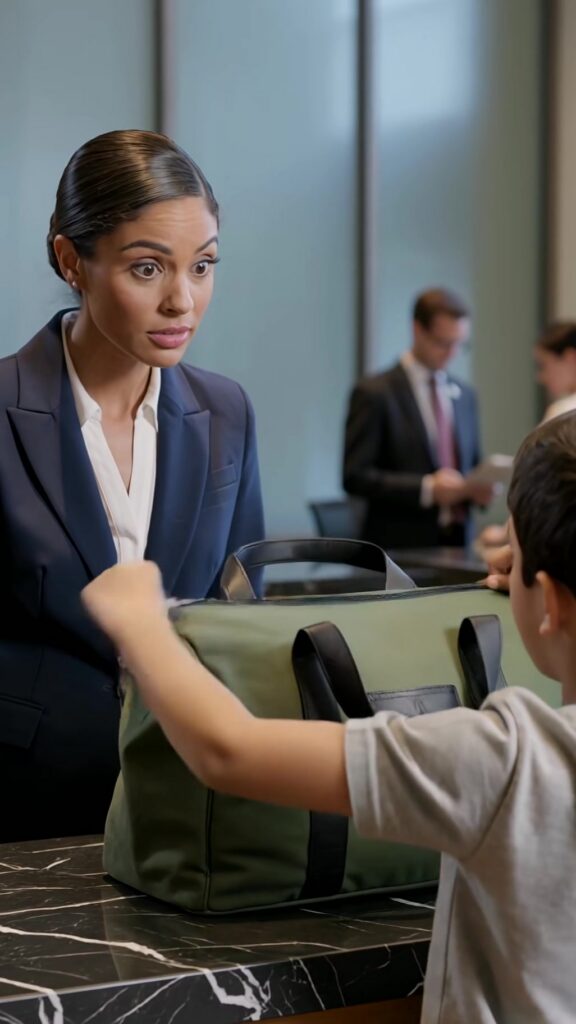
He wore a plain gray T-shirt and sneakers with one untied lace. He had that too-old expression that makes adults do a double take and then look away because it feels rude to stare. In his right hand he held a green duffel bag that looked almost as heavy as he was, the strap biting into his fingers.
The lobby was busy in that clean, quiet way banks are busy. People in stiff jackets and polished shoes stood in line, tapping phones, checking watches. A guy in a suit was murmuring into earbuds like he was negotiating peace talks. A couple argued about interest rates in whispers sharp enough to cut paper.
The boy waited until a teller waved him forward, smiling with the kind of automatic friendliness reserved for customers and small dogs.
“Hey there,” the teller said. She had a neat bun and a name tag that read LANA. “Are you… looking for your parent?”
The boy shook his head once, slow and sure. “No, ma’am. I need to open a savings account.”
Lana’s smile stayed, but it wobbled a little at the edges. “Okay. That’s… responsible. Do you have an adult with you who—”
He lifted the duffel bag onto the marble counter. It landed with a thump that made the pen in Lana’s hand jump. A couple of people turned their heads. One man frowned like he’d been personally offended by the noise.
Lana blinked. “What’s in there, honey? Sports stuff?”
The boy reached for the zipper. His hands were small, but he moved carefully, like he’d practiced. The bag opened with a soft rasp.
And the bank changed temperature.
Inside were stacks of hundred-dollar bills, packed tight, bound in crisp paper bands. Not a messy heap, not a handful of crumpled notes from a birthday card. It was organized. Dense. Heavy. The kind of money you see in movies when someone’s about to betray someone else.
Lana’s smile vanished so fast it was like it had never been there. Her shoulders went stiff, and for a second she just stared, like her brain was trying to reboot.
“Oh,” she said, which did not come close to covering it. Her voice dropped automatically. “Where did you get this?”
The boy looked into the bag with a weird mix of familiarity and confusion, like it belonged to him and also didn’t. “My mom hid it,” he said. “She told me if she didn’t come back by Friday, I had to bring it here and open an account where my uncle can’t touch it.”
Friday. The word landed between them, heavy as the bag. Lana’s eyes flicked to the calendar on her monitor, though she didn’t need to. Everyone knew what day it was.
“Your uncle,” she repeated softly, and her face drained just a little, like someone had turned the saturation down. She inhaled through her nose, controlled, practiced. “What’s your mom’s name?”
The boy reached into his pocket and pulled out a folded note. He held it like it was fragile. On the outside, in shaky handwriting, were the words: Only open this if I disappear.
Lana didn’t open it right away. She glanced around the lobby, suddenly aware of all the ears and eyes. The line had stalled. The man with earbuds had stopped talking. Even the arguing couple had quieted, their attention drifting toward the counter like smoke.
Lana forced her face into something neutral and professional. “Let’s go somewhere private,” she said, like this was a normal thing she said to eight-year-olds every day. She pressed a button under her desk, the silent kind that doesn’t ring but makes something happen somewhere else. Then she stepped from behind the counter and guided the boy toward a small office with glass walls and a door that clicked shut.
Inside, the boy set the duffel bag on the carpet like he was afraid it might stain something. Lana sat across from him, her hands very still. She opened the note carefully.
There were two pages. The first was addressed to the bank, written fast but legible. The second was addressed to the boy, written slower, with smudged ink like someone’s hand had been shaking.
Lana read the first page, and her throat tightened. It was a letter from the boy’s mother, explaining that the cash was her life savings plus proceeds from a recent house sale, and that she feared a relative—her brother, the boy’s uncle—was trying to gain control of it. She’d already spoken to an attorney, the letter said, and left copies of documents in a safety deposit box under her name. She’d chosen this particular branch because a manager named Mr. Keene had once helped her set up an account when she’d been rebuilding her credit after “a bad marriage.”
Lana’s eyes flicked up at the boy. “Do you know where your mom is?”
The boy shrugged, but it wasn’t casual. It was the shrug of someone who had run out of options. “She said she had to ‘do one more thing’ and then she’d be back. She promised she’d be back before my soccer game. That was Tuesday.”
Lana swallowed. “Have you… been home alone?”
“My uncle checks in,” the boy said, and his voice got quieter. “He tells me I’m a brave little man. He says Mom’s sick and I shouldn’t bother anyone.”
Lana’s stomach rolled. Brave little man. Sick. Don’t bother anyone. She’d heard those phrases before, not exactly, but close enough. They were the kind of words adults used to wrap a trap in something that sounded like love.
She reached for the second page, the one addressed to the boy. She didn’t read it out loud. It wasn’t hers to read out loud. But she did scan it, because she needed to know what she was dealing with.
It was full of mother-stuff: reminders about brushing teeth, where the spare key was, the name of the boy’s teacher, how to make grilled cheese without burning the pan. And in the middle of it, like a splinter, was a sentence that made Lana’s heart hammer.
If Uncle Ray comes to the bank, do not talk to him. Ask for Mr. Keene. If you can’t find him, ask for the police officer who sits in the lobby on Thursdays. Tell them the blue folder is in the box.
Lana looked at the calendar again. Thursday had been yesterday. The officer wouldn’t be there now. But Mr. Keene might.
She stood and cracked the door open just enough to catch the attention of a coworker walking by. “Can you get Mr. Keene?” she said, keeping her voice steady. “And… please call security to this office. Quietly.”
The boy watched her like he was trying to read her face the way kids do when they’re deciding if it’s safe to cry. “Am I in trouble?” he asked.
Lana sat back down, softer now. “No. You did exactly what your mom told you to do.” She paused, choosing her words carefully. “But we need to make sure you’re safe. Okay?”
He nodded, but his lip trembled like he’d been holding himself together with duct tape. “She said banks are safe,” he whispered. “She said there are cameras and rules.”
“There are,” Lana said. “A lot of them.”
A knock sounded. Mr. Keene stepped in, a gray-haired man with kind eyes and the wary posture of someone who has lived through enough weird days to stop being surprised. Security followed behind him, hovering near the door.
Lana slid the letter across the desk. Mr. Keene read it, his mouth tightening. When he looked up at the boy, his expression softened immediately, like he’d remembered what it felt like to be small.
“Hey, champ,” Mr. Keene said gently. “What’s your name?”
“Eli,” the boy said.
“Eli,” Mr. Keene repeated, as if anchoring the moment. “You’re going to sit right here with Lana, and we’re going to make some calls. All right?”
Eli nodded. His eyes were glossy now, but he didn’t let the tears fall. Not yet.
Mr. Keene stepped into the hallway and spoke to security in a low voice. Lana couldn’t hear everything, but she caught pieces: “missing person,” “possible financial abuse,” “child alone.” Then Mr. Keene pulled out his phone and dialed.
Five minutes later, the glass door to the bank opened again. A man walked in like he owned the air. He was broad-shouldered, wearing a too-bright smile and a button-down shirt that looked expensive in a loud way. He scanned the lobby and then spotted the office.
Lana’s blood went cold before he even got close.
He tapped on the glass with two knuckles, smiling wider. “There you are, buddy,” he mouthed, looking at Eli through the door like it was just a fun game of hide-and-seek.
Eli’s whole body stiffened. His eyes darted to Lana, panicked and pleading.
Lana stood and positioned herself between Eli and the glass, heart pounding so hard she could feel it in her fingertips. She didn’t open the door. She didn’t even look at the man directly. She looked past him, at security, at Mr. Keene, at the front entrance—where, right on time, two police officers walked in with calm faces and hands near their belts.
Mr. Keene’s voice carried, measured and polite. “Sir, can we help you?”
The man’s smile didn’t falter, but his eyes sharpened. “I’m here for my nephew,” he said, loud enough for the lobby to hear. “His mother’s been unwell. Poor kid’s confused.”
Lana felt Eli’s small hand grab the edge of her sleeve. A tiny, desperate grip.
She looked down at him and spoke softly, just for him. “You’re not alone anymore,” she said.
And for the first time since he walked in, Eli let himself breathe like a child, shaky and loud, like he’d been holding it in all week.
Outside the office, the man—Uncle Ray, if the note was right—kept smiling as the officers approached him and asked him to step aside. He kept acting casual, like this was all a misunderstanding that would be cleared up in a second. But Lana could see the moment his confidence cracked: the flicker in his jaw, the quick dart of his eyes toward the exit, the way his hands curled and uncurled like he was doing math in his head.
Lana sat back down with Eli, keeping her body angled to block his view. The duffel bag sat on the floor between them, heavy with money and heavier with reasons.
“What happens now?” Eli asked, voice thin.
“Now,” Lana said, “we do the boring grown-up stuff. We document everything. We protect the money like your mom wanted. And we find her.” She paused. “And we keep you safe while we do it.”
Eli nodded slowly, staring at the bag like it might explode. Then he looked up at Lana with a sudden, fierce seriousness. “Can you really keep it away from him?”
Lana met his eyes and made herself sound certain, even though her insides were a mess. “Yes,” she said. “We can. Rules are kind of our thing.”
Through the glass, Uncle Ray’s smile finally disappeared as one of the officers guided him toward the side of the lobby. Eli didn’t see it, but Lana did, and she stored it away like evidence.
Because this wasn’t just about opening a savings account.
It was about an eight-year-old who walked into a bank carrying a fortune and a warning, and the quiet, terrifying fact that he’d been right to do it.
And somewhere out there, a mother had trusted a building full of marble and rules to do what she couldn’t: keep her child from being swallowed by the wrong kind of family.