She was hungry too, and it showed in the tiny ways she thought nobody noticed.
The way her fingers trembled when she pinched the last of the flatbread into thirds. The way her throat kept making that dry swallowing motion, like her body was trying to remember what food felt like. The way she held a smile on her face so carefully you’d think it was stitched on, even while her stomach made quiet, embarrassing noises.
Mara crouched by the makeshift stove she’d built out of a dented oil drum and some bricks. It wasn’t much—just a little flame licking at a pot that had seen better decades. Across from her, three boys sat on the curb with the kind of hunger that makes a person forget manners. They were all elbows and bones, dusty hair, cheeks hollowed out like someone had scooped the joy from them.
They ate the way people do when they’re scared the food might vanish. Fast. Too fast. One of them choked and thumped his chest, then shoved more in anyway like it was a competition against time.
“Slow down,” Mara said, soft as she could. She tried to sound like a mom, even though she’d never gotten to be one for long. “It ain’t going anywhere.”
The boys didn’t look convinced. None of them were. They watched the street the way stray dogs did—ears perked, ready to bolt at the smallest threat.
Mara spooned the stew into three cracked bowls and set them down like she was serving guests at a real table. She kept her own bowl close for appearances, but it was mostly broth. She’d stretched everything until it was almost nothing. A handful of lentils. The last onion from last week’s market. A scrap of salt she’d been saving for a day that never came.
When they weren’t looking, she pushed her portion toward the smallest boy, the one with a bruise on his forehead and a ripped shoe held together with twine. He hesitated, staring at her bowl like it was a trap.
“Eat,” she said, quick and firm.
He obeyed. They always did when her voice went like that. Something about it said she’d already made up her mind, and arguing would just waste time and calories.
As the boys ate, Mara kept her hands busy. She tore the last bread into pieces, wrapping a couple in a scrap of cloth she’d washed until the colors faded into a yellowish blur. It used to be part of a curtain, she thought. Or maybe a dress. Everything in her life had become a “used to be.”
She smiled at them anyway, like her stomach wasn’t pinching and her head wasn’t floating with that familiar lightness that meant she’d be dizzy soon. Like she wasn’t wondering how she’d make it to tomorrow with nothing left under the sink and nothing left to sell.
“Thank you,” the oldest boy mumbled around a mouthful. His eyes were sharp, older than his face had any right to be. “We’ll pay you back.”
Mara snorted, trying to make it sound normal. “Pay me back by not dying. That’s plenty.”
The boys kept eating. The street was quiet in that midday way—too hot for fighting, too hot for gossip. The air smelled like dust and frying oil from somewhere down the block.
Then the sound came. Engines. Low, smooth, wrong for this neighborhood.
It wasn’t the sputter of a delivery van or a taxi with a bad muffler. It was a confident purr, like the street belonged to whoever was behind the wheel.
Mara’s spine stiffened before the cars even turned the corner.
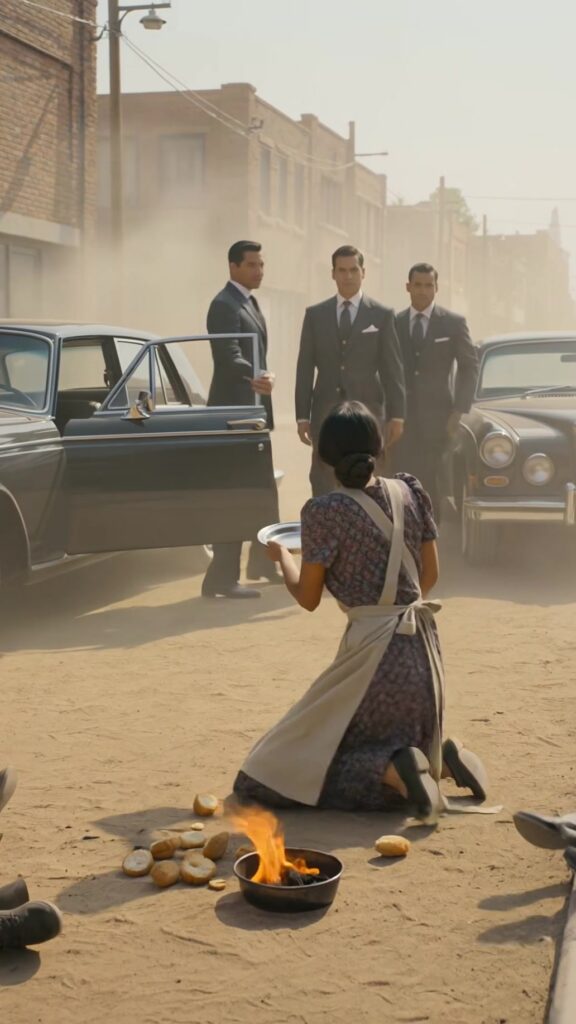
Two black vintage luxury sedans rolled into view, paint glossy enough to reflect the sun like water. They were clean—unnaturally clean—like they’d never met a pothole. They braked hard, tires grinding grit, and stopped just behind her little fire.
Dust jumped up in a cloud. The boys froze with food halfway to their mouths.
Doors opened. Three men stepped out, tall and pressed and calm in dark suits that didn’t belong in this street. No shouting. No showing off. Just quiet, coordinated movement like they’d practiced it.
Mara stood slowly, keeping her body between the cars and the boys without even thinking about it. She still had the empty metal plate in her hand, a ridiculous shield, but she gripped it anyway.
In her experience, expensive cars meant trouble. Someone powerful was annoyed. Someone wanted something. Someone thought they could take it.
“Can I help you?” she asked. Her voice shook despite her best efforts. She hated that. Fear was one more thing she couldn’t afford.
The man in the center stopped close enough that she could see the faint scar at the edge of his jawline, and the way his eyes kept flicking down to the plate like it mattered.
For a second, he looked like he’d forgotten how to talk.
Then he exhaled, and his voice came out rougher than his suit suggested. “You already did.”
Mara frowned, confused and irritated. “I don’t know you.”
“No,” he said, and his mouth twitched like it might become a smile and then didn’t. “But we know you.”
The two men beside him moved toward the trunk of one of the cars. They didn’t rush. They didn’t need to. One popped it open.
Mara’s breath snagged in her chest.
Inside were sacks of rice and flour. Boxes stacked neatly, the kind with brand-new tape. Wooden crates stamped with fruit logos. Cases of bottled water. A thick envelope that looked heavy even from a distance. And another. And another.
The boys stared like they were witnessing magic. The smallest one actually leaned forward, eyes wide, then pulled back as if the sight might burn him.
Mara took one step back, plate clanging softly against her thigh. “What is this?”
The man in the center blinked fast, and for the first time, she saw something raw and young in him beneath the polished surface. He looked over his shoulder at the boys on the curb and then back at Mara.
“There was a day,” he said quietly, “when three kids sat right there. Same curb. Same heat. Same kind of hunger that makes you dizzy.”
Mara didn’t answer. Her mind raced through memories she kept buried on purpose. Too many hungry faces. Too many nights where she’d handed away what she needed and pretended it didn’t matter.
The man’s voice softened. “A woman with a stained apron fed them anyway. She gave them her bread and acted like she wasn’t starving. Like she wasn’t shaking. Like she wasn’t counting the minutes until her body would stop feeling empty.”
Mara swallowed. Her throat was painfully dry. She glanced at his eyes, then at the eyes of the other two men, and something in her chest twisted. Familiar, but distant—like recognizing a song you hadn’t heard since childhood.
The youngest of the men reached into his suit jacket. He pulled out a folded scrap of cloth. It was thin, old, the color of faded mustard. The edges were frayed like they’d been loved and handled too much.
His hands shook just a little as he held it up. “Do you remember what you wrapped the bread in?” he asked.
Mara stared at the cloth. Her mind snapped backward in time so hard it made her dizzy: a different fire, a different day, her own hands moving fast because the kids looked like they might faint. She’d torn fabric because she didn’t have paper. She’d tied it off with a string because she didn’t have a bag.
She whispered, barely audible, “That… that was mine.”
The man in the center nodded, and now his eyes shone like he was fighting tears. “I kept it,” the youngest said. “I told them it was proof. Proof that somebody did something kind when they didn’t have to.”
Mara’s knees went weak. She grabbed the edge of the oil drum to steady herself. “You’re…” she started, and the word stuck. It felt impossible to say.
“We were those boys,” the center man said. He looked toward the curb like he could see ghosts sitting there. “We didn’t forget.”
One of the men by the trunk lifted out a sack of flour and set it gently on the ground like it was fragile. “We looked for you for years,” he said. “We didn’t know your name. We only knew the street and the apron and the way you told us to eat like we deserved it.”
Mara covered her mouth with her free hand. The metal plate trembled. She wanted to laugh, to cry, to scold them for showing up with all this attention like she hadn’t spent her whole life trying to stay unnoticed.
“I wasn’t—” she began, and then stopped. What was she going to say? I wasn’t a hero? That she’d just been hungry too? That she’d only done what she wished someone had done for her?
The oldest-looking boy—no, man—stepped closer and held out the thick envelope. “We can’t redo what you lost,” he said. “But we can make sure you don’t have to pretend you’re full ever again.”
Mara stared at the envelope and then at the three kids on her curb, the present-day ones, holding their bowls like the world might steal them. She thought about how hunger didn’t care about good intentions. How it just kept coming back, day after day, until it broke you.
She let out a shaky breath. “You know,” she said, voice cracking, “I fed you because you were right there. That’s it. No big story.”
The center man finally smiled, small and real. “That’s the whole story,” he said. “You were hungry too, and you still chose us.”
Mara looked at the cloth in the youngest man’s hands—the old bread wrapper turned into a relic—and she surprised herself by laughing, the sound coming out wet and half-sobbing. “Alright,” she said, wiping her face with the back of her wrist. “Then help me feed these ones too.”
The men didn’t hesitate. They rolled up their sleeves like they’d been waiting for permission their whole lives. And as the street watched—neighbors peeking from doorways, kids inching closer—Mara set down her empty plate, finally not pretending it was full, and started a new pot on the fire.
This time, there was enough.