When Martin got the call, he didn’t ask questions. He didn’t even turn off the coffee maker properly; he just grabbed his keys and drove like his own heartbeat was late for work. The neighbor’s voice had been tight and weirdly formal on the phone: “You should come. Right now. It’s about Lila.”
Lila was his whole world in a small, wobbly body. Seven years old, blonde curls he used to dry with a towel like she was a puppy, and a wheelchair that had become such a permanent fixture in their lives that Martin sometimes forgot to picture her without it. He’d learned the ramps, the accessible entrances, the way strangers’ pitying eyes slid away as soon as he met them. He’d learned how to smile back anyway. He’d learned how to be soft.
He hadn’t learned how to be calm when something sounded wrong.
The front yard of Maren’s house looked like every other yard on the block: wet grass from last night’s rain, a few plastic toys half-sunk in mud, the lazy shine of morning on a minivan. For half a second Martin thought he’d overreacted. Then he saw the spray of water, bright and aggressive in the daylight, and the small shape in the wheelchair taking it head-on.
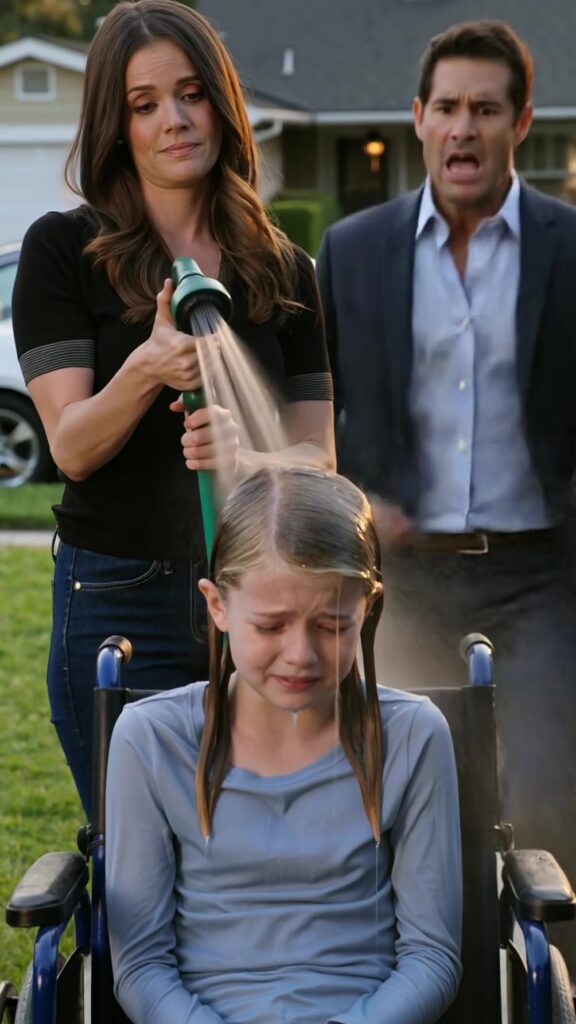
Lila sat there drenched, her dress clinging, hands locked tight around the armrests like she could hold the world in place if she squeezed hard enough. Behind her stood Maren—his ex-wife’s sister, the one who always spoke like she had an invisible clipboard—holding a garden hose with the calm focus of someone rinsing patio furniture. Water beat against Lila’s face and shoulders. Lila’s chin was tucked down, her breathing little shudders you could see in her back.
Martin didn’t think. He just moved. “What are you doing?!” His voice cracked in the middle like it couldn’t decide if it wanted to be a dad or a siren.
Maren didn’t jump. Didn’t gasp. Didn’t even flinch. She angled the hose down a little, more toward Lila’s lap, like she was correcting her aim. “I’m washing your daughter,” she said, as if she’d been asked why she was loading the dishwasher.
That sentence lit something in Martin’s chest. He stomped across the yard, shoes sinking into the wet ground. “Have you lost your mind?” He yanked the hose from her hand and the water went wild—over his jeans, across the lawn, into the flowerbed. He snapped the nozzle shut. The sudden quiet made Lila’s trembling louder.
Maren stepped back, folding her arms, expression flat. Not guilty. Not embarrassed. Just stubborn, like she’d been interrupted mid-task and wanted to finish it.
Martin turned to Lila, already talking softer. “Hey, hey, baby. It’s okay. I’m here.” He crouched, hands hovering because he never knew if touch would help or overwhelm her. He went to grab a towel from the patio chair—anything to cover her, warm her, protect her—when he noticed her face.
Lila wasn’t crying. Her eyes were wide, her mouth pressed hard closed. She looked terrified, but not of Maren. Not of the hose. It was the kind of fear you see in a kid who knows something is about to come out, something they’ve been hiding, something they’ve practiced keeping tucked away like a secret candy wrapper.
“Lila?” he said, the word turning into a question without his permission. “Are you hurt?”
She shook her head just barely. Her fingers tightened on the armrests, knuckles white. Then, slowly, like she was following instructions only she could hear, she leaned forward. Her shoulders pitched. Her elbows locked. Her bare feet slid under her as if searching for the ground.
Martin’s breath got stuck.
Lila pushed down with both hands, her body trembling like a new foal. And then she stood. Not straight and confident. Not like a movie. More like a fragile, wobbly miracle that didn’t know it was supposed to be impossible. Water streamed off her dress and dripped from her bangs onto the grass.
Martin’s first thought was ridiculous and automatic: I need to catch her. His second thought was worse: How long has she been able to do that?
“No,” he whispered, because the word showed up before any other. “No… that’s not possible.”
Maren’s eyes were cold in a way that made the morning feel less sunny. “That’s what I said,” she replied, “the first time I saw her walk.”
Martin looked from Maren to Lila and back, his brain scrambling for explanations like a dog pawing at a buried toy. “What do you mean ‘first time’?” His voice went sharp again. “When did you see that?”
Lila’s legs shook. She lowered herself back into the chair with a careful, practiced motion that made Martin’s stomach twist. Practice meant repetition. Repetition meant time. She stared at her hands, water still dripping from her fingertips like evidence.
Maren nodded toward the house. “Inside,” she said. “We should talk inside.”
Martin didn’t move. “Talk. Here. Now.”
Maren’s jaw tightened. “Fine.” She glanced at Lila like she was checking whether a prop was still where it belonged. “She started standing a few months ago. Little steps, holding onto furniture. I noticed when she came over for the weekends. At first I thought… I don’t know. Maybe therapy finally kicked in. Maybe I was seeing things.” She paused, and for the first time her voice wobbled, just a fraction. “Then I realized she only did it when she thought no adults were watching.”
Martin’s heart thudded. “Lila,” he said, gentler, pleading without meaning to. “Sweetie… why didn’t you tell me?”
Her lips trembled. She kept staring down, like the truth was written on her wet shoes. “Because,” she whispered, “Mom said I shouldn’t.”
The word “Mom” felt like stepping into a pothole. Martin’s ex-wife, Jenna. The way she’d cried after the accident. The way she’d become a different kind of fierce—protective, desperate, sometimes mean without noticing. The way she’d insisted on handling the doctors, the insurance, the therapy schedules. The way she’d told Martin he was “too hopeful” whenever he asked about progress.
“She said…” Lila swallowed. “She said if people knew I could walk a little, they would make me walk all the time and it would hurt and then if I fell, you’d be sad. She said it’s safer if everyone thinks I can’t. She said it’s easier. She said… you’d love me more if I stayed your brave wheelchair girl.”
Martin felt his throat close up around something hot. He reached for Lila’s wet hand, and this time she let him take it. Her palm was cold, but her grip was strong. Too strong for a kid who supposedly couldn’t use her legs. He hated that his mind even went there. Hated that the thought sounded like suspicion, like accusation, like the world’s ugliest kind of math.
“I love you,” he said, voice shaking. “I love you sitting, standing, rolling, running, any way. Do you hear me?”
Lila’s eyes lifted to his. They were glossy and frightened, but there was something else there too—relief, maybe. Like she’d been holding her breath for months and finally found a crack in the wall to breathe through.
Maren cleared her throat, and Martin remembered she was still there, still holding her arms like armor. “So why the hose?” he snapped, the fury returning with somewhere to land. “Why would you do that to her?”
Maren’s gaze didn’t soften, but it shifted, like she was choosing her words carefully. “Because she wouldn’t show you,” she said. “I tried talking. I tried coaxing. She panicked every time I said we should tell you. She begged me not to. And then last night, I overheard Jenna on the phone. She was talking about renewing paperwork. About how the chair keeps the support payments steady. About how ‘if Martin ever sees her take a step, it’s all over.’”
Martin’s stomach dropped so hard it felt like gravity doubled. He stared at Lila, at the little shiver in her shoulders, at the way she looked like she expected him to explode. He stared at Maren, at the hose coiled on the grass like a snake that had already bitten.
“I didn’t know what else to do,” Maren said, quieter now. “I needed something she couldn’t control. The water makes the fabric cling. It shows where braces are. It shows what’s under the story.” She nodded toward Lila’s knees, where the soaked dress outlined the faint shape of lightweight supports strapped beneath. “I knew if you saw it with your own eyes, you’d stop believing whatever Jenna’s been feeding you.”
Martin’s hands shook. Not because of the cold water, but because his life had just split into before and after. He wanted to scream Jenna’s name at the sky. He wanted to wrap Lila in every towel in the county. He wanted to go back ten minutes and arrive at this yard with a different kind of strength—one that noticed lies sooner.
Instead, he did the only thing that felt remotely steady. He took off his hoodie and draped it over Lila’s shoulders. He pressed his forehead to hers for a moment, wet hair tickling his skin, and whispered, “You’re not in trouble. You’re not a story. You’re my kid.”
Lila nodded, tiny and fierce.
Martin stood up and looked at Maren. “You should’ve called me,” he said, voice low. “Before the hose. Before any of this.”
Maren’s eyes flicked away. “I did,” she said. “Three times. Jenna blocked my number on your phone.”
Martin’s breath came out in one rough exhale, like his body finally understood what his brain couldn’t stop replaying: he hadn’t been sprinting into a rescue. He’d been sprinting into the part of the story that had been hidden from him—layered carefully, month after month, right in front of his face.
He looked down at Lila again. “Can you stand one more time?” he asked gently. “Not for them. Not for paperwork. Just for us. Just so I know what you can do.”
Lila hesitated, then nodded. Her fingers tightened. Her feet found the ground. And when she rose, shaky but real, Martin didn’t see a miracle or a betrayal. He saw a kid who had been carrying an adult-sized lie on her back and still had enough strength left to stand up anyway.
He took her hand, steadying her, and glanced toward the street where Jenna’s car would eventually appear. “Okay,” he said, more to himself than anyone. “We’re done pretending.”
And for the first time all morning, Lila’s shoulders loosened, like she believed him.