The room stopped respecting him the moment he asked permission. It happened so fast you could’ve missed it—like a change in air pressure, a tiny tilt in gravity. One second he was invisible in the way servers are supposed to be invisible, and the next he was visible in the worst way: as a joke.
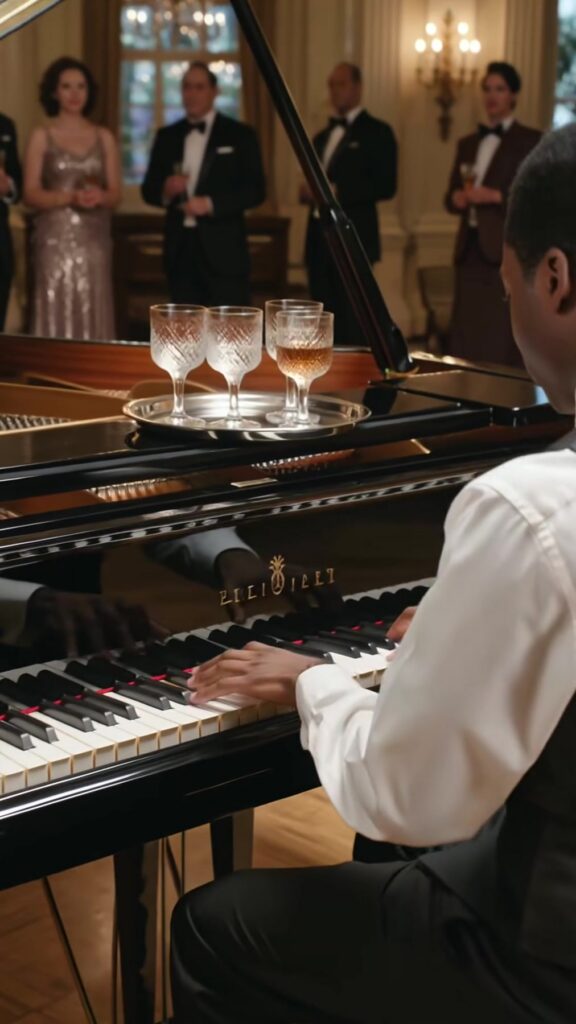
Elliot stood beside the black grand piano with a tray tucked against his ribs, wearing a fitted vest that made him look borrowed from the catering company’s closet. The mansion’s ballroom was all warm chandelier glow and expensive fabric, the kind of place where even the ice cubes looked like they’d gone to private school. People drifted in slow circles, laughing softly, not because anything was hilarious, but because that was what you did at a charity gala hosted by the Halberts.
He’d been circulating with champagne for forty minutes when he noticed the piano. The lid was open like a mouth, glossy and impatient. A pianist was supposed to arrive later—he’d overheard the event planner complaining about a delayed car, a flat tire, something boring and tragic in rich-person terms. The piano sat there unused, a status symbol waiting for someone with the correct last name to touch it.
Elliot should’ve ignored it. He’d promised himself he’d keep his head down tonight. In, out, collect the paycheck, go home to his apartment where the radiator clanked like an offbeat drummer.
But the piano looked like an old friend you haven’t forgiven yet.
He approached it as if he was just passing through, tray balanced, posture professional. A small cluster of guests stood near the bench. One of them—a thick-shouldered man with a velvet jacket and a laugh that came pre-loaded with cruelty—was holding court with two women in jewel-toned gowns.
Elliot cleared his throat lightly, not to interrupt the conversation, but because his own voice needed a test run.
“Hey,” he said, keeping it soft. “Would it be alright if I played something? Just until the pianist gets here.”
The question landed wrong. Not because it was unreasonable. Because it was permission.
The man in velvet blinked like Elliot had spoken in a foreign language, then barked a laugh mid-sip. “You?” he said, dragging the word out with interest, like he’d found an odd stain on a sleeve. “You mean… you can play?”
Someone nearby smiled the way people smile when they’re relieved it isn’t them being singled out. Another guest made a little “oh!” sound, as if this was entertainment now.
Elliot felt his face go warm, but it wasn’t embarrassment. It was something older, like a muscle waking up after years.
“Just a bit,” he said.
The velvet-jacket guy leaned closer, eyes scanning Elliot like a menu. “Have you ever even touched a piano?”
That did it. Not the question itself—plenty of people doubted plenty of things. It was the way the room tilted into agreement. The way the jokes were already being written in their heads. The way asking politely had made him small enough to step on.
Elliot didn’t argue. He didn’t defend himself. He didn’t offer credentials, because credentials were for people who thought their lives were a resume.
He stepped to the side, set the tray down gently on a small table beside the piano, and sat on the bench.
There was a pause where the room didn’t know what to do with him. Then someone snickered, because that was safer than admitting curiosity.
Elliot rested his hands over the keys without playing. He let his fingers hover until they remembered what to be. The piano smelled faintly of polish and old performances. For a second he thought about leaving—about the paycheck, the radiator, all the careful choices that kept his life from falling apart.
Then he started.
The first notes didn’t sound like a flex. They sounded like a door opening in a house nobody knew was haunted.
Conversation thinned around the edges. People kept talking because they were determined to be unbothered, but their voices started to trip over the music. The piano line was steady, clean, and oddly intimate—like someone speaking too honestly in a room built for small talk.
Across the ballroom, a woman paused mid-laugh with her phone raised for a photo and forgot to lower it. A waiter carrying a tray of canapés slowed down without meaning to. Even the velvet-jacket guy quieted, though his expression was still set in that stubborn disbelief people wear when their assumptions are being dismantled.
Elliot’s wrists moved in a familiar arc, the kind of motion that wasn’t taught in a weekend class. His fingers found a melody that lived behind his ribs. It wasn’t a popular tune. It wasn’t a showpiece. It was something with a strange, unfinished tenderness, like a sentence you don’t know how to end.
He felt the room changing. Not impressed exactly—more like caught. As if the music had grabbed everyone by the collar and asked them to pay attention without raising its voice.
Someone stepped closer. Not to interrupt, just drawn in. Then another. The circle around the piano tightened quietly.
The velvet-jacket man shifted, eyes narrowing. He leaned forward and, for the first time, looked at Elliot’s hands instead of his vest.
That’s when he saw the ink.
A small tattoo near Elliot’s right wrist: a cluster of notes, not a generic treble clef like someone gets on spring break, but a specific phrase—tiny marks that, if you knew how to read them, were a fragment of music. The velvet guy’s face changed the way a lock changes when the right key turns.
His smirk drained out of him.
“Hold on,” he murmured, more to himself than anyone. “No way.”
Elliot kept playing, eyes on the keys. The melody shifted, subtle at first. A chord stretched wider. A theme returned, then twisted, like someone walking through a familiar hallway and realizing the doors have been moved.
The velvet-jacket man took a step closer to the bench, the way someone approaches an animal they’re suddenly afraid of. “Wait,” he said, voice thin now. “Are you… are you the one who—”
Elliot didn’t look up. He didn’t need to. The music did the looking.
Across the crowd, an older gentleman with silver hair and a careful posture—the kind of man whose suit looked like it came with a board seat—had frozen with his drink halfway to his mouth. His eyes were wide, locked on Elliot like he’d seen a ghost do a cartwheel.
He started walking, slow at first, then faster, threading through the guests without apology. People moved aside automatically, confused by the sudden urgency in a man who’d been calm all night.
When he reached the piano, his hands were trembling. He didn’t speak right away, as if he was afraid that words would break whatever was happening.
Elliot played on, and the piece revealed its secret: a melody that was both beautiful and unresolved, circling a final cadence it refused to reach. It sounded like someone leaving mid-thought. Like someone disappearing.
The older man swallowed hard. His voice, when it came, was almost swallowed by the music. “That’s… that’s her theme,” he said.
Elliot’s jaw tightened. He let the next phrase fall exactly where it always fell, like a confession hitting the same bruise.
The older man leaned in, eyes glossy under the chandelier light. “My wife wrote that,” he whispered. “Before she vanished.”
The room, which had been holding its breath without realizing, finally exhaled in a ripple of shocked murmurs. Heads turned. Phones lowered. Someone set down a glass too hard on a table.
The velvet-jacket guy looked like he wanted to unhear everything. “This is some kind of stunt,” he said, but it came out weak, like he didn’t believe himself anymore.
Elliot finished the phrase and let the last chord hang, not resolving it. He lifted his hands from the keys with care, as if touching the air could smudge the sound.
Only then did he glance up, meeting the older man’s eyes. “She didn’t finish it,” Elliot said quietly. “I did.”
The older man’s face went pale, as if the chandeliers had switched from warm light to interrogation. “How?”
Elliot’s fingers hovered over his wrist, brushing the little tattoo like it was a map. “Because she asked me to,” he said. “And because I promised I’d make sure someone heard it.”
The room was no longer laughing. Nobody was smiling automatically. Nobody was thinking about the auction items or the press photos or the tasteful floral arrangements. The mansion’s ballroom had stopped being a stage and started being a witness.
Elliot stood up from the bench, and it wasn’t a server rising—it was someone reclaiming space he’d been renting by the hour. He picked up the tray again, not because he needed it, but because the vest and the silver and the role had been his camouflage all night.
He looked at the older man. “If you want the rest,” Elliot said, voice calm, “we should talk somewhere that isn’t full of people who only listen when they’re surprised.”
The older man nodded once, sharp, like it hurt. Behind him, the velvet-jacket guy stared at Elliot as if trying to rewind time to the moment permission was asked. As if he could undo the mistake of assuming the person in the vest didn’t belong.
Elliot walked away from the piano. The room stayed silent, holding the unfinished chord in its throat, suddenly aware that respect wasn’t something you granted. It was something you lost the second you thought you were entitled to deny it.