It was the kind of afternoon that made you forget anything bad could happen in daylight. Not sunny, exactly—more like the sky had given up and settled into a soft gray. The sidewalks were damp from earlier drizzle, the winter grass looked like it had been rinsed and combed, and the bare trees stood in the yards like patient skeletons waiting for spring.
Mara Givens walked with the careful pace of someone who’d learned her knees had opinions. She was sixty-eight, stubborn, and proud of not needing anyone’s help except, occasionally, a handrail. Her bright scarf—red with tiny white dots—was the one bold thing about her. Everything else in her outfit was sensible: brown coat, black gloves, shoes that were ugly but honest.
She’d just left the pharmacy with a paper bag of refills and a lecture from the pharmacist about taking them with food. She had half a mind to stop at the little bakery near the corner, but the wind was annoying and she didn’t want to argue with it.
She passed the white two-story house with blue shutters. It was a tidy place, the sort of house that looked like it came with a rulebook: mow the lawn, wash the car on Saturdays, don’t leave trash bins out past sunset. Mara didn’t know who lived there. She knew the neighborhood in a general way—faces and dogs, not names.
Then she heard it.
Not a distant siren, not a car alarm. A voice. Right there, close, inside the white house.
“Help! Someone please help me!”
Mara stopped mid-step so hard her shopping bag swung forward. Her heart did a weird, quick stumble like it had tripped over a curb. She waited, frozen, because her brain wanted to pretend she’d misheard. Maybe a TV show. Maybe a prank.
“Please! No!” came the second scream, raw and thin as torn paper.
Mara’s body moved before her thoughts caught up. She turned toward the house, her gloved hand tightening around her handbag like it was a weapon. She took one step off the sidewalk, then another, eyes locked on the front porch.
The front door flew open.
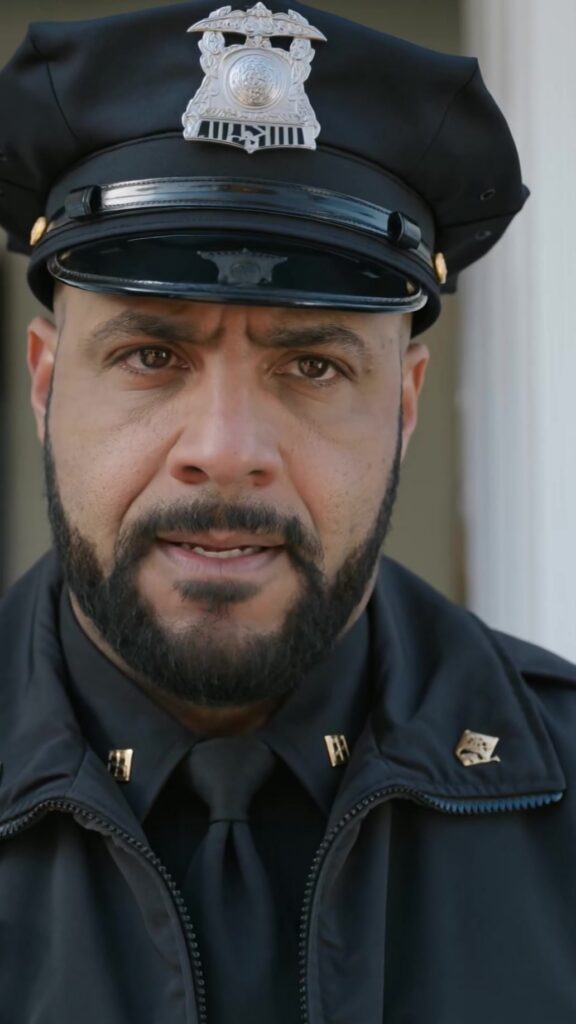
A large police officer stepped out like he had all the time in the world. He was big—shoulders squared, face calm, hair cropped close. His uniform looked crisp, too crisp for a day that damp. Behind him, in the shadow of the doorway, another officer stood half-hidden, like a bad idea trying not to be seen.
And then the screaming stopped. Instantly. Not fading out, not turning into sobs. Just—gone.
That abrupt silence turned Mara’s stomach in a way the screaming hadn’t. Screaming made sense. Silence didn’t. Not when it came the exact moment a police officer appeared.
The big officer looked right at her. Not the normal passing glance that said, Mind your business, citizen. This was steady, direct, as if he’d expected someone to be watching and didn’t like that she was.
He lifted his chin a fraction. “Relax,” he said, voice low and flat. “Everything is under control.”
Mara didn’t relax. She didn’t even breathe right. Her mouth opened, but no words came out at first.
“I—” she started.
He cut her off with a small shift of his stance, like he was stepping in front of her words. “And if you value your safety,” he added, tone still calm, “you didn’t hear anything.”
It wasn’t a suggestion. It was a lid closing on a pot.
Mara’s skin went cold under her coat. She’d lived long enough to recognize the difference between authority and threat. The badge was supposed to be the opposite of fear. But fear was exactly what she felt.
She backed up a step, nodding without meaning to. “Of course,” she heard herself say, the automatic politeness of a woman raised to keep the peace. Her brain screamed at her for it.
Then she turned and hurried down the sidewalk, walking faster than her knees preferred, heart pounding, not daring to look back. She told herself a dozen things to make it normal: maybe it was a domestic argument, maybe the woman was unstable, maybe the officer was just gruff. Maybe she’d imagined the edge in his voice.
She was almost past the next yard when she heard it: a small tapping sound, delicate and quick, like someone trying to get a bird’s attention.
Tap. Tap-tap.
Mara stopped again, despite herself. She felt ridiculous, like a character in a horror movie who goes back for the dropped keys. Her whole body begged her to keep walking.
But she glanced up.
In the upstairs window of the blue-shuttered house, a little hand was pressed against the glass. The palm was flat, fingers spread. It was small enough to belong to a child. A face hovered behind it, blurred by the window’s reflection, pale and indistinct. Mara couldn’t make out features, just the shape of a forehead, a nose, the dark holes where eyes should be.
Tap. Tap.
Mara’s throat tightened. She looked away so fast she nearly hurt her neck. Her feet started moving again, faster now, not quite a run but close. She felt heat rising in her cheeks, shame mixing with terror. She was leaving. She was actually leaving.
At the end of the block she reached into her handbag with shaking fingers, found her phone, and dialed 911. Her thumb hovered over the call button.
Then she remembered the officer’s eyes. The way he’d looked at her like he already knew her name. The warning dressed up as advice.
She hit call anyway.
The line rang once. Twice.
“Nine-one-one, what’s your emergency?” The dispatcher’s voice was bright, bored-professional.
Mara swallowed. “I—um. I heard screaming,” she said, forcing her words through the lump in her throat. “On Hawthorne Lane. White house, blue shutters. There were officers there, but… it didn’t feel right.”
There was a pause, the kind that made Mara picture someone typing. “Ma’am, what is your name?”
“Mara Givens.”
Another pause. “And your address?”
Mara hesitated, because she didn’t want her address attached to this, didn’t want any part of her life to be reachable by the kind of calm threat she’d just heard. But the dispatcher waited, and Mara told her anyway.
“Okay,” the dispatcher said, voice a fraction less casual now. “Stay on the line. Can you describe the officers you saw?”
Mara tried. Big. Square jaw. Too composed. Another one behind him. She mentioned the child’s hand in the window. She heard her own words and felt like she was dropping stones into a deep well, waiting to see if anything would splash back.
“We have units in that area already,” the dispatcher said carefully. “Did you see a vehicle number? Any names?”
“No,” Mara admitted. “I wasn’t that close.”
“All right,” the dispatcher said. “Ma’am, for your safety, I need you to go inside your home and lock your doors. Do not return to that house.”
Mara’s stomach turned again. “Why?” she asked before she could stop herself.
The dispatcher exhaled softly, like she’d reached a line she wasn’t supposed to cross. “Just do it, okay?” she said, and the brightness was gone now. “We’ll handle it.”
Mara almost laughed at the irony of that phrase. Handle it. Under control. Words that sounded comforting until you realized they could be used like a curtain.
She walked the last two blocks to her house with her phone pressed to her ear, every parked car suddenly suspicious, every rustle of branches sounding like footsteps. When she got inside, she locked the deadbolt, then the chain, then stood with her back against the door like the wood could absorb her shaking.
Through her front window she could see a slice of Hawthorne Lane. She watched it like she was waiting for lightning to strike. A few minutes passed. Then a dark SUV rolled slowly down the street, unmarked, windows tinted. It didn’t have lights on. It didn’t have a logo. It moved like it belonged there anyway.
It stopped in front of the white house with blue shutters.
Mara held her breath. From her distance, she saw the big officer step onto the porch again. He didn’t look surprised to see the SUV. He didn’t look worried. He looked… prepared.
Mara’s phone was still connected. The dispatcher didn’t speak, but she was still there—Mara could hear faint keyboard clicks, the soft background hum of a room full of emergencies.
Upstairs in the blue-shuttered house, the curtain twitched.
And for the briefest second, the little hand returned to the glass—open-palmed, pleading, like a sign that said, Don’t leave me. Don’t forget.
Mara’s knees threatened to buckle. She slid down the inside of her front door until she was sitting on the floor, scarf slipping loose at her neck. She whispered into the phone, barely audible, “Please,” though she wasn’t sure who she was begging anymore.
Years later, when she tried to explain to her granddaughter why she checked the locks twice every night, she’d always circle back to that afternoon. The wet sidewalk. The blue shutters. The calm officer with the threat hidden inside his voice. The tiny hand against the window.
And the cruelest part of it, the part that stayed sharp no matter how much time dulled everything else, was how ordinary her day had been right up until she stopped walking.
Because she would later wish—more than she’d ever wished for anything—that she had kept going.