Mara had learned a weird math out on the street: gifts weren’t free, smiles weren’t neutral, and anything wrapped in warmth probably came tied to a string you couldn’t see until it yanked. Food was the trickiest. Half the time it was old, or someone had messed with it, or it came with a sermon attached that made your throat feel even tighter than hunger did. So when a small paper bag appeared in front of her—held out like an offering—Mara’s first instinct was to pull her hands into her sleeves and pretend she hadn’t noticed.
Snow was drifting sideways that afternoon, the kind that looked soft from behind glass and turned mean the second it hit skin. The bus stop bench had a thin crust of ice on the metal, and Mara had layered newspapers under her jeans to keep from freezing to it. Her shoes had given up weeks ago; she’d been wearing mismatched socks and plastic bags when she could find them, and when she couldn’t, she just tried to keep moving. Today she’d lost the will to pace. Her toes were numb enough that she couldn’t tell if they were still hers.
“Hey,” a kid’s voice said, close and bright. “Are you super cold?”
Mara lifted her head. A little girl stood a few feet away, bundled in a yellow coat with a hood too big for her face. The hood had faux fur around it, and the fur was already collecting snowflakes like it was proud of them. Her cheeks were pink in that way kids get when they’re still safe. Mara’s chest tightened. Safe kids weren’t supposed to look directly at people like Mara. Safe kids were taught to glance away.
“I’m okay,” Mara said automatically, the grown-up lie she used when the truth felt like it would stain someone. “Just waiting.”
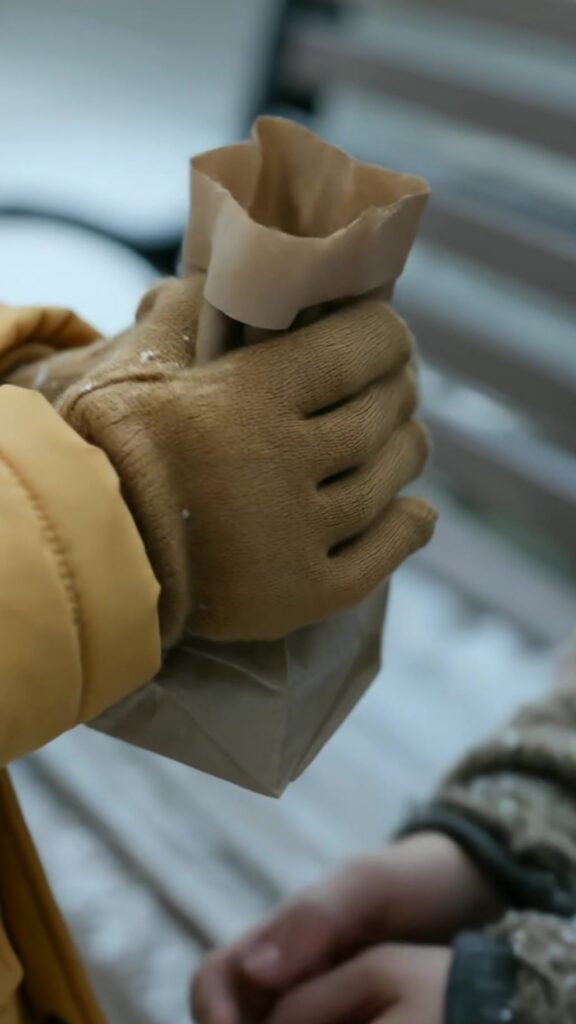
The girl frowned like she didn’t buy it. She held out the paper bag again. It wasn’t one of those thin, greasy ones from a fast-food place. This was thicker, folded at the top, and it gave off a faint smell of cinnamon through the cold.
“This is for you,” the girl said. “Dad got them for me but I already ate one and I’m not even that hungry anymore. You look… like you didn’t eat.”
Mara stared at the bag. Her stomach did a painful little twist, like it was trying to remind her of its existence. But her hands stayed tucked in her sleeves. “No, sweetheart,” she said gently. “You keep it.”
“It’s okay,” the girl insisted, stepping closer. Her mitten brushed Mara’s knuckles, and the contact made Mara flinch. Not from pain. From surprise. The mitten was warm. The warmth made her remember her own hands used to be warm too.
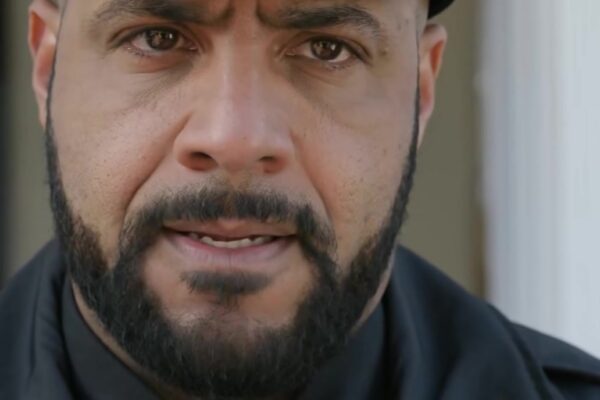
Before Mara could say anything else, an adult voice called, “Lila.” It wasn’t a shout, more like a warning note. A man stood a few steps back, near the bus schedule sign, holding a coffee cup and a shopping bag. He had that tired-but-put-together look of someone who lived indoors: clean jeans, decent coat, hair that had seen a comb this morning. His eyes were on Mara, not unfriendly, just careful—like he was measuring a situation.
“She’s fine,” the man told the girl, though he wasn’t looking at his daughter when he said it. He was looking at Mara like he was trying to place her, or like she was a word he knew but couldn’t remember the meaning of.
“She’s not fine,” Lila said, voice firm in the way only little kids can be. “Her feet are out.”
Mara almost laughed at that, a short sound that didn’t make it all the way out. Her feet are out. Like her feet had wandered away from home and forgotten to come back.
“Please,” Lila said, softer. “Just take it.”
Mara’s pride had been worn down by winter and bad luck and the endless small humiliations of trying to exist when you’re inconvenient. But it still had sharp edges. “It’s kind,” Mara said. “It’s just… you don’t have to.”
“I want to,” the girl said, and shoved the bag into Mara’s lap like she’d solved the problem with simple physics.
Mara’s fingers finally moved. She uncurled them from her sleeves and touched the bag. It was slightly warm, like it had been inside a coat. She held it like it might vanish. The smell of cinnamon and sugar rose up, and suddenly her eyes burned. Her body was so exhausted that gratitude felt like grief.
“Thank you,” Mara managed, voice small. “Really.”
The man didn’t step forward. He stayed where he was, coffee steaming in his hand. Watching. Not like a guard dog, not like a hero either. Just… present. That was almost stranger.
Lila tilted her head, studying Mara’s face with an intensity that made Mara’s stomach flip for a different reason. The girl’s eyes were brown, the color of wet dirt after rain, and they kept searching Mara like they were trying to match a picture to a real thing.
“You need a home,” Lila said, as casually as if she were pointing out that Mara’s hair was messy. “And I need a mom.”
Mara blinked hard. “What?”
The word came out rough. Not because she didn’t understand the sentence, but because it landed somewhere tender.
Lila didn’t smile. She didn’t do that kid thing where they say something wild and then giggle. She looked serious enough to make Mara uneasy. “I already have a dad,” Lila continued, as if that clarified everything. “But I don’t have… the other one. And he has a scarf. A blue one. He keeps it in the hall closet. He says it’s important but he never wears it.”
Mara’s breath stopped. The world didn’t exactly tilt, but the snow seemed to get louder, like someone had turned up the volume on winter.
Blue scarf.
There were a million blue scarves in the world. Mara knew that. But there was also one specific scarf: knitted, uneven at the edges because she’d made it herself one December when she still had a job at the diner and a tiny apartment that smelled like garlic and laundry soap. She’d wrapped it around her neck the day she left—left before the argument got worse, before the police were called, before she said something she couldn’t take back. She’d left it behind by accident, hanging on a hook. She’d regretted it more than she’d admitted to herself, because it meant leaving a part of her life where it had been.
Mara looked past Lila at the man. The carefulness in his eyes changed into something else. Recognition, slow and heavy.
“Mara?” he said, and it wasn’t a question he expected to be answered. It was like he’d been carrying the sound of her name around for years and it had finally found a place to land.
Mara’s throat tightened. “Evan,” she whispered, and hated how quickly the name came back. Like her mouth had been waiting.
Evan took a step forward, then stopped, like he was afraid he’d spook her. He looked older, but not in a bad way—more like life had been busy with him. The coffee cup shook slightly in his hand. “I didn’t—” he started, then tried again. “I didn’t know you were here. I didn’t know you were… like this.”
Mara wanted to say something sharp. She had a whole drawer of sharp things saved up. But Lila’s mittened hand was still near her knee, steady and warm, and the bag in her lap smelled like cinnamon and mercy, and Mara was too tired to fight a war that started years ago.
“I didn’t plan it,” Mara said. Her voice sounded flat, like someone else’s. “Nobody does.”
Lila looked between them, satisfied in the way kids get when adults finally admit what the kid already figured out. “See?” she said to Evan. “I told you she’s real.”
Evan swallowed. “Lila, honey, go stand by the sign, okay? Just for a second.”
Lila hesitated, then obeyed, still watching like she didn’t trust the world not to mess this up.
Evan crouched in front of Mara, keeping a respectful distance. He took off his gloves and held them out, palms up, like he was offering proof he wasn’t hiding anything. “We kept the scarf,” he said quietly. “I couldn’t throw it away. It felt wrong. And when Lila was little, she used to wrap it around her stuffed rabbit like it was a blanket. She asked about you. I didn’t… I didn’t know what to say.”
Mara’s eyes stung again. “You could’ve said I was selfish,” she murmured. “Or scared. Or both.”
“I said you were someone I cared about,” Evan replied. “And that sometimes people disappear when they think they don’t deserve to be found.”
The words hit Mara hard because they were too close to the truth. She looked down at the bag, unfolded it with clumsy fingers, and saw two pastries inside—still soft. She broke one in half without thinking and the steam rose like a tiny ghost.
“I can’t be what she thinks,” Mara said, voice shaking. “I’m not… I’m not stable. I don’t even have shoes.”
“You don’t have to be anything today,” Evan said. “Just come inside somewhere warm. Let me get you socks. Let me buy you a pair of boots. Let’s start with stupid basics.” He paused. “And if you want help after that—real help—I can help. No strings. No speeches.”
Mara looked up. “Why?”
Evan’s expression cracked, and for a second he looked like the man she’d known: stubborn, earnest, too willing to hope. “Because I never stopped worrying,” he said. “And because she handed you that bag like she’s known you her whole life.”
Mara glanced at Lila. The girl was hugging herself against the cold, bouncing on her toes, trying to pretend she wasn’t listening while clearly listening to everything.
Mara exhaled, and it came out shaky. Hungry people learned to fear kindness when it came too suddenly, because sudden kindness had a way of vanishing just as fast. But this didn’t feel sudden the way a stranger’s pity did. This felt… delayed. Like something that had been trying to reach her for years and finally had.
She held the paper bag tighter. Then, slowly, she reached out and took Evan’s offered glove. Not as a contract. Not as forgiveness. Just as a bridge.
“Okay,” Mara said, the simplest word in the world, and the hardest. “But I’m keeping the pastries.”
Evan let out a breath that sounded like a laugh and a sob had collided. “Deal,” he said.
Lila sprinted back over, boots kicking up little puffs of snow, and grabbed Mara’s sleeve like she’d always belonged there. Mara felt the tug, the warmth, the small fierce certainty in the kid’s grip, and for the first time in a long time, she stood up—unsteady, embarrassed, human—and let herself be led toward somewhere with a door.
The snow kept falling, soft and quiet, but it didn’t feel like it was trying to erase her anymore.