The river was the color of old pennies and the air smelled like wet concrete and tire rubber. Under the bridge, the city made a different kind of sound—less honking, more dripping, more distant rumbling like somebody was dragging a dresser across the sky.
The girl had picked her spot the way you pick a seat in a movie theater when you don’t want anyone sitting behind you. Back against a pillar. Good sightlines. Close enough to the slope that she could run, far enough that anyone coming down would have to slow and show their hands.
She was wrapped in a coat that looked like it had belonged to a grown-up with broad shoulders and optimism. The sleeves swallowed her hands. Her knees were tucked up tight. The only thing she held tighter than her own body heat was a piece of paper that had gotten soaked and then dried into ripples, like the world had tried to erase it and gotten bored halfway through.
Beside her was a paper cup that had once held coffee and now held two nickels, a bent quarter, and rainwater. That cup wasn’t really for money. It was a prop. People got weird when you didn’t give them an easy category—beggar, runaway, lost kid. A cup made the decision for them. It gave them a script. She didn’t care about their script. She cared about their shoes.
Clean shoes were a warning sign. Clean shoes meant you hadn’t stepped in the stuff that happens to people when nobody’s watching. Clean shoes meant you could leave. Clean shoes meant you could afford to be brave. And the bravest people, in her experience, were the ones most likely to grab your wrist and tell you what was “best” for you.
She’d learned the shoe thing the hard way. The shelter lady with glossy sneakers who smiled like a cartoon. The guy with polished dress shoes who offered her a sandwich and asked her name like it was a key. The caseworker in bright white trainers who promised she wouldn’t have to go back, and then drove her right back anyway because “protocol.”
So when she heard footsteps coming down the slope—slow, careful, like someone trying not to spook a skittish animal—she didn’t look up right away. She watched the shadow first. Then the shoes.
Too clean. Not brand-new, but clean in a way that suggested wipes and routine. The kind of clean you can maintain only if you sleep in a bed. The kind of clean that never accidentally ends up under a bridge.
“Hey,” the man said, soft voice, low volume, like he’d seen movies about this. He crouched a few feet away, not close enough to be threatening, close enough to show he was serious. He had the kind of face people trusted on autopilot. Gentle eyes. No sharp edges. The type who probably got asked for directions a lot.
“Are you here by yourself?” he asked.
She didn’t answer. Not because she was scared. Because she didn’t do free information anymore. Words were like coins: spend them wrong and you’re broke when it matters.
The man noticed the paper in her arms. “Is that… a drawing?”
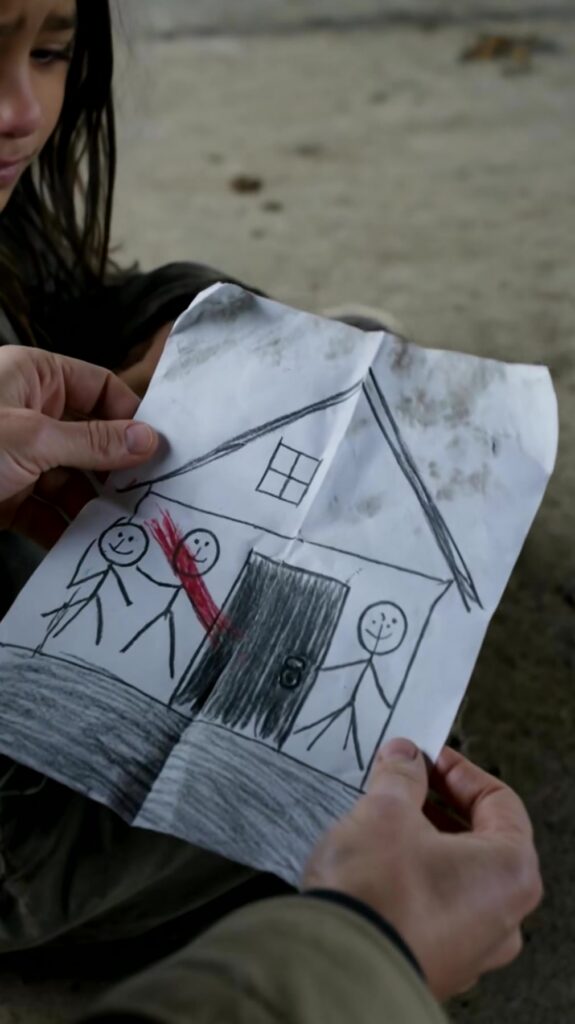
Her fingers shook as she unfolded it just a little. The paper was tough from being wet and dried again. It showed a lopsided house, a dark rectangle that could’ve been a basement door, and three stick people. One of them had been attacked with red crayon so aggressively the paper had started to tear.
She watched his eyes flick across it. People’s eyes always gave them away. The ones who didn’t care glanced and moved on. The ones who wanted to help leaned in too hard, too eager. The ones who recognized something tried to pretend they didn’t.
He held out his hand, palm up, asking without saying it. She hesitated, then let him take it. Not because she trusted him—because she wanted to see what he’d do when he thought he’d gotten what he came for.
He turned it over. On the back was messy handwriting that leaned downhill like it was running out of space and time.
If he finds me, show this to the woman with the silver cross.
The man’s face changed in a tiny way, like a curtain moving with a draft. He didn’t gasp or jump or do anything dramatic. He just stopped breathing for half a beat, and she caught it because she watched for that kind of pause the way other kids watched for punchlines.
“Where did you get this?” he asked, still gentle, still careful. Too careful now.
She shrugged. The coat slid off one shoulder, revealing a collarbone bruised yellow and green. She saw his eyes go there and then away, like he didn’t want to be caught looking at proof.
He shifted, and his shirt collar moved. Something silver slipped into view at his throat.
A small cross on a chain. Not huge, not flashy. Clean. Just like his shoes.
She lifted her eyes to his, slow and steady. Not pleading. Not grateful. Just… confirming a suspicion.
“You came first,” she said.
His smile faltered, tried to reassemble itself. “What’s that supposed to mean?”
She didn’t answer directly. She leaned forward and tapped the paper cup with a fingernail. The coins clinked softly. “You know, people who really live out here don’t stay clean,” she said. “Not their shoes, not their hands, not their… jewelry.”
He swallowed. “I’m just trying to—”
“Help?” she offered, like it was a word she’d heard in a song once but never bothered to learn. “Yeah. That’s usually the line.”
Somewhere beyond the pillar, out of sight, an engine turned over. Not a distant car on the street above. This was down here. Close. The sound bounced weirdly off concrete, the way thunder does when it’s right on top of you.
The man’s eyes flicked toward the noise and back. That tiny glance was all she needed. People who are alone don’t check in with invisible partners.
She stood up fast, coat dragging behind her like a cape made of someone else’s life. The man reached out, not grabbing her yet, still pretending he was the safe kind.
“Wait,” he said. “I think there’s been a misunderstanding.”
“No,” she said. “There’s been a pattern.”
She snatched the drawing from his hand and folded it tight. Then she did the thing she’d practiced—she moved like she was going left, but she went right, slipping around the pillar where the shadows were thicker and the ground was slick.
“Kid!” the man snapped, gentleness cracking like ice. “Stop!”
His clean shoes scraped as he lunged after her. Behind him, the engine revved again, impatient. The bridge noise swallowed most of it, but not the intention.
She ran toward the slope, but not straight up. Straight up was obvious. Straight up was what people expected. Instead she cut toward a gap between two chunks of broken concrete where somebody had dumped old rebar and a bent shopping cart. A stupid place to run—unless you already knew the exact path your feet could land without twisting an ankle.
“Over here,” a voice hissed.
She froze for half a second, heart hitting her ribs like it wanted out. From behind a low wall of graffiti-tagged boards, an older man leaned out. His beard was patchy, his jacket was frayed, and his boots looked like they’d been through a war and lost. His hands were filthy, the kind of filthy you couldn’t fake with a weekend in the woods.
“Boots,” she whispered, and it sounded stupid, but it also sounded like relief.
“Yeah,” the older man said. “Real ones.” He grabbed her sleeve—gentle, quick—and pulled her behind the boards. “You got the paper?”
She nodded and shoved it into his hand. He didn’t read it like it was a curiosity. He read it like it was a map.
The clean-shoes man rounded the pillar, breathing harder now, looking around like he’d misplaced something he owned. “Listen,” he called out, trying to sound calm again. “You don’t have to do this the hard way.”
“Funny,” the older man muttered, crouched with her in the damp. “That’s what they always say right before they make it the hard way.”
She peeked through a crack. The clean-shoes man stood still, scanning, trying to spot movement. The silver cross at his neck glinted when he turned his head.
“Who’s the woman?” she whispered.
The older man tapped his own chest. Under his dirty shirt, a chain hung too. He pulled it out just enough for her to see—not a shiny cross, but a dull little silver one, scratched and worn, like it had been carried through a lot of bad days and refused to quit. “Her,” he said, jerking his chin toward the far end of the underpass where a figure waited in the shadows. “Detective. She wears one like mine. Doesn’t keep it clean on purpose. She said if anyone showed up down here looking polished, I was supposed to move you.”
“So you’re… with her?”
“I’m with whoever doesn’t treat kids like lost property,” he said. “Come on.”
They moved low and fast, sliding along the boards and ducking behind a pillar. The detective stepped forward from the dark—a woman in a battered jacket and boots that had clearly met mud on a first-name basis. Her hair was pulled back messy, and the silver cross at her throat looked like it had lived a whole life before it ever touched her skin.
She held out a hand, palm up, copying the clean-shoes man’s gesture but somehow making it mean something different. “You did good,” she said, voice plain, no sugar.
The girl hesitated. Trust didn’t switch on like a light. But she watched the woman’s boots, the scuffed toes, the dirt on the laces. Watched the way her gaze didn’t slide away from bruises. Watched the way she didn’t rush.
Above them, traffic kept humming like nothing mattered. Under the bridge, the clean-shoes man took a step, saw the detective, and stopped like he’d hit an invisible wall.
“Evening,” the detective called, casual as if she’d run into him at a grocery store. “Nice shoes.”
The girl finally took the woman’s hand. The detective’s grip was warm, firm, real.
And for the first time in a while, the girl let herself believe in a new rule: it wasn’t that you could trust dirty shoes. It was that clean ones were never the whole story, and tonight, the story was finally starting to tilt in her favor.