No one in that ballroom had ever seen a man that powerful fall apart so completely. Not in this city, not in this zip code, not under a chandelier that cost more than most people’s houses. Elias Crowne didn’t fall apart. He acquired. He negotiated. He won. He had the kind of calm that made other people feel like they were late for something important.
So when he stood on the little stage at the front of the ballroom—tux immaculate, knuckles white around a wireless microphone—people didn’t know where to look. The light from the chandelier turned everything warm and expensive, but his face looked gray under it, like the glow couldn’t reach him. Tears slid down his cheeks without permission. Beside him, his daughter Wren stood in a pale blue princess dress, the kind with a tulle skirt that tried way too hard to be cheerful. She held her hands together like she’d been told to do that to look “nice.” She looked like a doll someone had forgotten to wind up.
Elias swallowed so hard the microphone picked it up. “My daughter can’t speak,” he said, voice cracking through the sound system. “If anyone can bring back her voice… I will give everything I own.”
You could hear the room inhale. A few guests stared at their champagne like it had suddenly grown teeth. A handful of phones appeared, half-hidden behind clutch purses and suit sleeves. Nobody wanted to be obvious about recording a billionaire’s breakdown, but nobody wanted to miss it either. In this city, tragedy was like celebrity: it got passed around quietly, then loudly, then packaged into a rumor you couldn’t put back in its box.
Everyone knew why Wren didn’t talk. A year ago, her mother—Marisol—had vanished after the Lantern Gala, the same fundraiser that was happening tonight. The official story was “missing,” which is what rich people call it when the truth makes everyone uncomfortable. There were posters for weeks, private investigators with slick hair, helicopters, reward offers that made the news. Then, slowly, the posters came down and the city moved on. The only thing that didn’t move on was Wren. She hadn’t said a single word since the night her mother didn’t come home. Doctors said her vocal cords were fine. Therapists said trauma could lock a kid up like that. Healers said to burn herbs and talk to the moon. Elias paid everyone, flew everyone in, tried everything. Wren remained silent.
Tonight was Elias trying something else: public desperation, wrapped in velvet and served with plated scallops. It was both heartbreaking and, in a way, terrifying—because when a powerful person gets desperate, they start doing unpredictable things. It’s one thing when your neighbor loses it. It’s another thing when someone who owns half the skyline does.
Elias lowered the microphone for a second, like he couldn’t bear the sound of his own pleading. The room stayed frozen. Then, from the back, the crowd shifted. Not the usual shift of waiters and coats. This was a ripple of surprise, as if someone had walked in wearing the wrong costume.
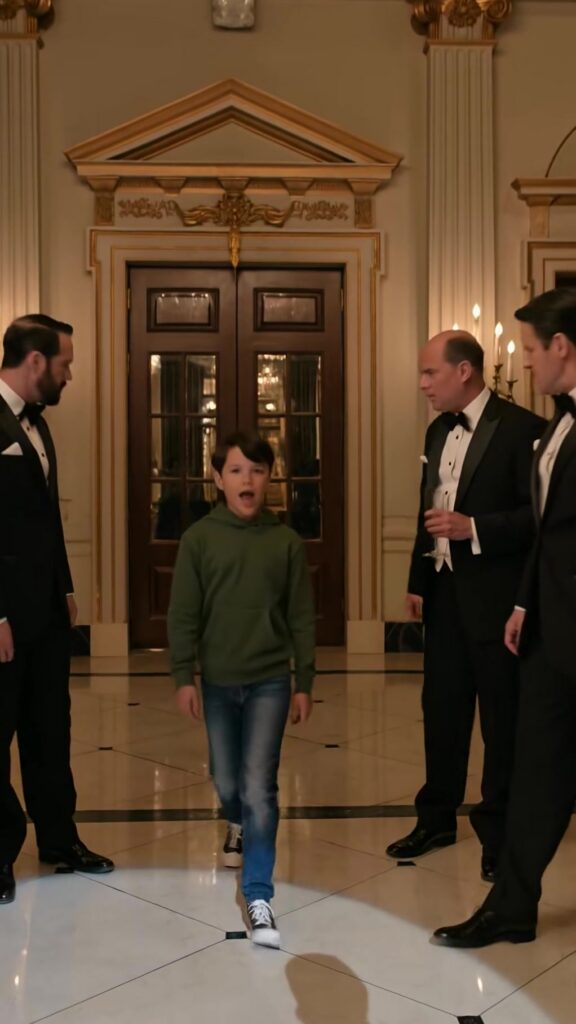
A boy in a green hoodie and faded jeans came down the center aisle like he belonged there. He was maybe thirteen, maybe fourteen, hair a little too long, sneakers that had seen better days. He didn’t look impressed by the gold. He didn’t look scared by the money. He looked… focused. Like a kid who’d decided something and was now simply going to do it.
People parted around him. Someone whispered, “Whose kid is that?” Someone else hissed, “Security?” But nobody moved fast enough to stop him, partly because the scene was too strange, and partly because the guards were used to stopping adults with bad intentions, not kids with quiet confidence.
He stopped a few feet from the stage and tipped his chin up. “I can do it,” he said, not loudly, but clearly. The words carried in the hush.
Elias snapped his head toward him, grief hardening into rage so fast it looked like a physical transformation. “Get out,” he barked into the mic. “This is not a performance. This is not a joke.”
The boy didn’t flinch. “I’m not joking,” he said. “And I’m not here for your money.” He glanced at Wren, and something in his expression softened. Not pity. Recognition. Like he’d seen her somewhere that mattered.
Wren hadn’t moved all night. Not when people stared. Not when a string quartet played a sad song like the universe was showing off. But when the boy looked at her, her eyes flicked to his face. One tear slid down her cheek in slow motion. Her hands, clasped together, started to tremble.
Elias saw it. Everyone saw it. The entire room held their breath like they’d been trained to do it.
“What is this?” Elias demanded, voice lower now, dangerous in a quieter way. “Who sent you?”
The boy took a step closer, careful, like you approach a skittish animal. “Nobody sent me. I’ve been outside for like… an hour,” he said, casual tone clashing with the ballroom’s stiffness. “I saw the lights and the cars and figured it was the Gala again. I didn’t plan to come in.” He rubbed the back of his neck. “But I heard you.”
“Heard me,” Elias repeated, incredulous. “So you decided to stroll in and fix what specialists couldn’t?”
“Not fix,” the boy said. “Just… unlock.” He looked at Wren again. “She’s not broken.”
That hit the room in a different way. People had been calling her tragic, poor thing, damaged, fragile. Nobody had said not broken out loud, not in this building. It sounded almost like permission.
Elias’ jaw worked. “Name,” he said. “Now.”
“Cal,” the boy replied. “Cal Mercer.”
The name didn’t land with the guests, but Elias blinked once, hard. Like a file in his mind had just opened. His grip on the microphone loosened a fraction. “Mercer,” he said, quieter. “I knew a Mercer.”
Cal nodded slightly, as if confirming something that didn’t need a speech. “Yeah,” he said. “My mom worked here. Not here-here. For your family.” He kept his eyes on Wren. “She used to braid Wren’s hair when you were on calls.”
The air turned sharp. People who’d been leaning in for drama suddenly wished they could lean out. The Crownes did not talk about employees in public. Employees were background. Employees were supposed to be invisible.
Elias’ face changed again—confusion, then alarm, then the kind of fear that only shows up when the past walks through a door you thought you’d locked. “Where did you come from?” he asked, and it sounded like he meant more than the ballroom.
Cal lifted one hand, palm open, showing he wasn’t a threat. “I’m not here to accuse you of anything,” he said. “I’m here because Wren remembers something, and it’s stuck. And I think… I think she’s been trying to say it this whole time.” He glanced at the chandelier like it might be listening. “This is the same night, right? Same party, same lights, same song?”
The string quartet had stopped playing without anyone telling them to. Silence filled the room like water. Elias looked at his daughter, finally really looking, not at her dress or her posture but at her eyes. Wren stared at Cal like he was a doorway.
Cal stepped up onto the first stair of the stage and crouched so he was closer to her height, keeping a respectful distance. “Hey,” he said gently. “I’m not gonna make you talk. Promise. I just wanna ask you something, and you can answer however you want. Okay?”
Wren’s lower lip quivered. She didn’t nod, but her eyes stayed on him.
Cal took a breath. “When your mom didn’t come back,” he said, slow and careful, “did you see someone with her?”
Wren’s hands tightened into fists. She looked past Cal, over his shoulder, toward the glittering crowd. Her gaze fixed on something—someone—near the right side of the room. A man in a silver tie, smiling too hard, froze mid-sip of champagne.
Elias followed her stare. His face went blank in the way powerful people go blank right before they do something irreversible. He lowered the microphone completely. The room could still hear him anyway, because nobody was breathing.
Cal didn’t look back. He kept his voice soft. “You don’t have to say it out loud,” he told Wren. “You can just… make a sound. Any sound. Just to prove to yourself you still can.”
Wren’s throat moved. It looked like swallowing a stone. Another tear rolled down her cheek. Then, from deep inside her, a tiny noise escaped—more breath than word, but undeniably her voice. A rough little “ha,” as if she’d startled herself.
The room reacted like a wave hit it. A few gasps. A few muffled sobs. Someone dropped a fork. Elias made a sound that was half laugh, half cry, and he reached for his daughter with shaking hands like he was afraid she might vanish too.
Wren didn’t flinch away. She looked at Cal again, and her mouth opened. This time, something clearer pushed through. It wasn’t a full sentence. It was just one word, scraped raw but real.
“Mom.”
Elias collapsed to his knees on the stage, tux pants creasing on marble, pride shattering in front of a chandelier and a hundred witnesses. He covered his face, shoulders shaking. Power didn’t protect him from that moment. Money didn’t soften it. The entire city, all in one room, watched him become just a father.
Cal stayed crouched, steady as a handrail, and he whispered to Wren like it was a secret meant only for her. “Good,” he said. “That’s enough for tonight.” Then, quieter still, as if he were speaking to the part of the room that had been pretending not to hear, he added, “Now we figure out what really happened that night.”