The courthouse always smelled like lemon cleaner and old paper, like someone was trying to scrub history off the walls. By the time the Ashford case hit day four, the place was packed the way people pack into a theater when they already know the ending. Reporters hogged the aisle seats. Society ladies clutched handkerchiefs like props. Even the bailiff looked bored, as if he’d seen a hundred maids accused and a hundred rich families nod solemnly through it.
Mara Hales stood at the defense table in a borrowed blazer that didn’t fit her shoulders right. She kept smoothing the sleeves anyway, a nervous habit, like the fabric could turn into armor if she rubbed it long enough. Across the room, the prosecutor’s voice rolled on about motive and opportunity—about jealousy, about money, about a “heated confrontation” in a library that was now a pile of ash behind an iron gate.
“The defendant was the last person seen near Mr. Ashford,” the prosecutor said, tapping a folder. “The defendant had keys. The defendant had access. And the defendant had reason.”
Reason. Mara’s throat tightened around that word. Six years of folding linen and learning everyone’s coffee order, six years of fixing the little things the family never noticed, and now her entire life reduced to a tidy list of reasons.
In the front row, Victor Ashford sat with his hands neatly clasped. He wore mourning black like it was a uniform he’d had tailored months in advance. He’d shaved that morning, clean and sharp, the kind of man who looked like he belonged in a frame on the wall. Beside him was the estate’s lawyer, and beside the lawyer, a boy in a gray suit that made him look like a miniature accountant.
Julian Ashford hadn’t said a word to anyone in nearly a year. Not to doctors. Not to therapists. Not to the relatives who kept leaning down to speak slowly at him, like silence was a language barrier. The papers called him “the tragic heir,” and the photos always caught him staring past the camera, like he was watching something on a different timeline.
Mara didn’t look at Julian anymore when she could help it. Not because she didn’t care. Because it hurt. She still remembered the weight of him on her shoulder the night of the fire, his arms tight around her neck, his hair smelling like smoke and expensive shampoo, his small body shaking like a trapped bird.
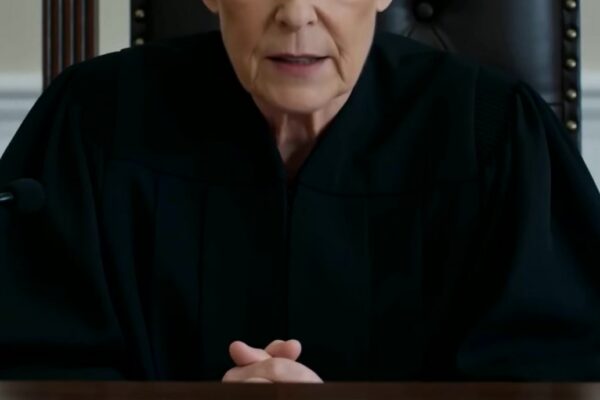
The judge adjusted his glasses and glanced down at his notes, ready to steer the trial toward its neat conclusion. Mara’s public defender—tired, overworked, and clearly regretting law school—was whispering about how they could maybe ask for leniency if they accepted a plea.
That was when a chair scraped.
The sound sliced through the room the way a sudden scream would. People turned before they even knew why. Julian stood up from the bench, his face pale under the courtroom lights, his hands clenched so tight his knuckles blanched. For a second he looked like he might sit back down and vanish into his silence again.
Instead, he lifted his arm and pointed.
“It wasn’t her,” he said.
Not loud at first. But audible. Real. A sentence with air and intention behind it, like he’d been holding it underwater and finally had to let it go.
The room froze in that weird way crowds do when they realize they’re witnessing a moment that’ll get replayed on the evening news.
Mara’s head snapped up. Her mouth opened and nothing came out—because what do you say when the only person who could possibly save you just did something no one believed he could do?
“Young man,” the judge said, voice stern with a tremor of surprise, “you need to sit down.”
Julian didn’t move. His finger stayed out like a compass needle.
“She was protecting me,” he said, and his voice cracked on the last word like it was heavier than the rest of the sentence.
Victor shifted. It was small, a tiny adjustment of posture, but it set off a chain reaction—his lawyer leaned in, whispering fast, the kind of whisper that sounded like a command.
Victor rose, smoothing his jacket as if he were heading to a podium at a charity gala. He stepped toward Julian with a practiced smile that didn’t reach his eyes.
“Julian,” he said softly, hand reaching for the boy’s shoulder, “you’re overwhelmed. That’s understandable. Let’s not do this.”
Julian flinched at the touch. Not a dramatic flinch. Just the quick recoil of someone who’s learned pain comes dressed as affection. And suddenly the courtroom saw it—the thing you can’t unsee once you notice it.
Victor wasn’t worried about the boy’s feelings.
He was scared.
Julian pulled away enough to keep pointing. “The guilty one is here,” he said, louder, and his voice wasn’t small anymore. It had the sharpness of a kid who’s been listening for months while adults talked around him like he was furniture.
Gasps rippled. A reporter’s pen dropped. Someone’s phone camera lifted before the bailiff snapped, “No recording!” like that mattered now.
“He’s confused,” Victor said, and his voice went cold on the edges. “He was a child. He saw flames. He saw smoke. He’s mixing it up.”
Julian swallowed. You could see his throat work, like his body was trying to drag the words back down. Then he forced them out anyway. “I’m not confused.”
The judge banged the gavel once, but it sounded weak compared to the pounding in the room. “Order. Order!”
Julian’s eyes flicked to Mara for half a second—an apology there, and something else too, like he was asking permission. Mara didn’t know what her face did, but she felt her own head give the smallest nod.
Julian turned back to Victor. “Mara didn’t lock the library that night,” he said. His voice shook, but his finger didn’t. “You did.”
Silence hit so hard it felt physical. The kind of silence that makes you hear the hum of the lights.
Victor’s smile twitched. “That’s absurd,” he said quickly, but he said it the way people say “calm down” when they’re the ones panicking.
The prosecutor, caught off-guard, stared at Julian like he’d just walked in with new evidence. The defense attorney blinked like his brain was buffering. The judge leaned forward. “Julian,” he said, careful now, “why do you believe that?”
Julian’s fingers flexed, but he kept them aimed. “Because I saw him,” he said. “I was in the hallway. I was hiding.”
Victor’s hand shot out again, faster this time. “That’s enough—”
“Don’t touch him,” the judge snapped, and for the first time all day his voice had real authority.
Julian’s breathing sped up. He looked like he might bolt, like the old instinct to run away from the memory was trying to yank him out of the room. But he stayed. “He told me to stay quiet,” Julian said, and his voice dropped low, almost conversational, which somehow made it worse. “He said it was a family matter. He said if I talked, Mara would go away and it would be my fault.”
Mara’s knees threatened to fold. She gripped the table edge so hard her fingers hurt. That’s why. That’s why the boy avoided her eyes. That’s why he’d sat in her kitchen that one afternoon, months ago, staring at the mug she’d placed in front of him without taking a sip—because he’d been holding a threat inside his chest and it was poisoning him.
“Julian,” the judge said, softer, “what happened in the library?”
Julian blinked rapidly, tears gathering like they’d been waiting behind a dam. “My dad and Uncle Victor were yelling,” he said. “Dad said he wouldn’t sign. Uncle Victor said he’d regret it. Then… the door slammed. I heard the lock. I heard Dad hit it. I heard him coughing.” He wiped his cheek with the back of his hand, angry at the tears. “Mara found me and carried me out. She tried to go back.”
He looked at Mara now, really looked at her. “She was screaming his name,” he said. “She was trying to open the door. She got burned.”
Mara’s sleeve rode up just enough to show the shiny patch of scar near her wrist. She’d hidden it under long sleeves for months because people loved scars when they meant bravery—until the scars belonged to someone convenient to blame.
The judge sat back, face hardening as the pieces slid into a new picture. “Bailiff,” he said, voice like a blade, “separate the witnesses. And someone get child services in here. Now.”
Victor lifted his hands, palms out, a politician’s gesture. “Your Honor, this is… outrageous. A traumatized child—”
Julian cut him off. “You practiced with me,” he said suddenly, and that sentence hit the room with a different kind of shock. “You made me repeat it. You said, ‘If anyone asks, it was Mara. If anyone asks, you didn’t see anything.’ And I did. I did it because I thought that’s what good kids do.”
Victor’s face drained so fast it looked like someone turned down his color. He glanced toward the door like he was measuring the distance.
Mara didn’t even enjoy it. Relief didn’t feel like fireworks. It felt like her lungs had been crushed for a year and someone finally lifted the weight—except now she could breathe in the awful truth too.
Julian’s arm finally lowered. The effort of speaking seemed to catch up to him all at once, and his shoulders slumped like he’d run a mile. He sat down hard, hands trembling in his lap.
Victor didn’t sit. He stood there with his mouth slightly open, calculating, searching for a new story to tell.
The judge’s gavel came down again, sharper this time, like punctuation. “This court is in recess,” he announced. “And Mr. Victor Ashford—do not leave this building.”
As the courtroom erupted into chaos—voices, footsteps, cameras flashing despite the rules—Mara stepped back from the table, dizzy. She looked at Julian, and he looked at her, and for the first time in a year he didn’t look past her.
He looked like a kid who’d finally stopped drowning.
And Mara realized something that made her chest ache: the boy was never supposed to speak, because if he did, the wrong person would go free. But he spoke anyway, because sometimes the only way to survive a fire is to tell the truth about who lit the match.