The woman looked like rain had been chasing her for days—like it had started as weather and turned personal somewhere around mile twenty. Her gray hoodie had darkened into a second skin, the cuffs dripping steadily onto the tile floor. Her jeans were ripped at both knees in a way that said “I fell” more than “fashion.” And her face… her face had that hollow calm people get when they’ve already screamed about it, already begged, already been told no.
She pushed into Merritt & Sons Jewelry with the attitude of someone walking into a dentist’s office: not afraid of the man, just furious she had to be there. The bell above the door chimed, a polite little sound that didn’t belong to the night outside. Rain ticked against the front window in tiny, impatient taps.
Behind the counter, David Merritt looked up from his magnifier. He’d been in this neighborhood long enough to recognize the three main flavors of late-night customers: romantics with last-minute apologies, teenagers with fake confidence, and people who were out of options. This woman was the third kind. Her hands shook when she pulled something from her pocket and set it on the glass like it might burn her.
A gold necklace. A locket. Not flashy, but unmistakably expensive—warm, old gold with a faint softness from years of being touched. It didn’t match her at all, which made David’s suspicion flare automatically. He’d seen theft. He’d heard the speeches. “My grandma gave it to me.” “I’m just in a jam.” “I don’t want to, but…”
She didn’t offer a story. She just stared at the locket like she didn’t want to see it and asked, “How much will you give me for this necklace?”
David lifted it with two fingers, the way you handle something you don’t trust. He opened his drawer for his loupe, checked the clasp, the chain, the mark inside. Twenty-four years of doing this and he could estimate value in a breath. He could also decide what kind of night he wanted to have.
“Fifty,” he said, flat and practiced. “Not more.”
Her jaw tightened. For a second, he thought she might snatch it back and leave. She didn’t. She blinked like her eyelashes were heavy, then nodded once, almost resentful of her own choice.
“Okay,” she said. “Deal.”
David slid open the register and counted the bills. He handed them over. Her fingers closed around the money fast—fast enough that he saw the raw skin on her knuckles, the way they’d cracked and bled and scabbed again. She turned immediately, like staying another second would cost her something she couldn’t afford.
Then David, out of habit more than curiosity, flipped the locket open.
His hand stopped mid-motion. The store seemed to go quiet in a way it never really did; even the rain outside felt like it paused to listen.
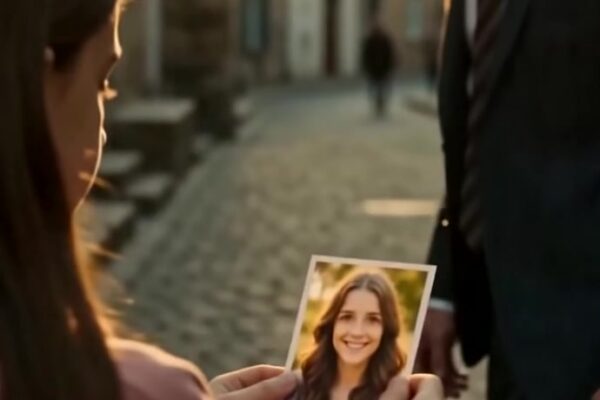
Inside the locket was an old photo—slightly faded, the corners softened. A man holding a little girl, both of them smiling so hard it hurt to look at. And beneath the photo, engraved in tiny, careful letters that had been worn down by time and touch: For my daughter Clara.
David swallowed and tasted metal. That engraving wasn’t just familiar. He remembered ordering it. He remembered the day, like it was trapped behind his eyes and suddenly let loose: Clara at nine years old, sitting on the counter when the store had been slow, swinging her legs and asking if gold tasted like sunshine. Clara turning the locket over and over in her palms, reverent like it was a holy thing. Clara disappearing two years later and leaving behind a house full of grief and a police file thick enough to break your heart.
David looked up. The woman was already at the door, her shoulders hunched as if she could shrink small enough to slip between raindrops.
“Hey!” David’s voice came out too sharp. He pushed back from the stool so hard it skidded. “Wait—”
She flinched, one hand on the handle.
David didn’t even bother locking the register. He vaulted from behind the counter, nearly slipping on the clean tile, and followed her out into the rain.
Outside, the world smelled like wet asphalt and cold leaves. Water sheeted off the awning. The woman had already stepped off the curb, like she planned to keep walking until her legs quit.
“That necklace,” David shouted over the storm. “It belongs to my daughter. My missing daughter!”
She stopped so abruptly it looked painful, like someone had yanked a leash. For a moment she stood with her back to him while rain soaked her hood and ran down her sleeves. David watched her shoulders rise and fall once, twice, like she was forcing air into lungs that didn’t want to cooperate.
He took a step closer. “Where did you get it?” His voice cracked on the last word. “Do you know where she is?”
The woman didn’t turn right away. When she finally did, her face was slick with water, but her eyes were dry—wide and glossy in a way that had nothing to do with weather. Terrified. Not guilty. Not caught. Terrified like someone cornered by a memory.
She held the cash up like proof of something. “I didn’t steal it,” she said quickly, as if that was the obvious first accusation. “She gave it to me.”
David’s brain tried to reject the sentence. “Clara?” he breathed.
The woman’s mouth twitched, like his saying the name hurt her. “Yes.”
David stepped closer until they were both under the thin awning, rain hammering the sidewalk inches away. His hands were shaking now too, matching hers, as if the locket had passed the tremor to him.
“Where is she?” he asked. “Is she alive?”
The woman’s throat bobbed. Her gaze flicked to the street, then back to him, like she expected someone to come flying around the corner any second. She lowered her voice. “If Clara is your daughter… then why did she make me promise never to bring this back to you?”
David stared at her, rainwater dripping off his hair into his eyes. “What are you talking about?” he whispered. “Clara loved me. I—” The words stumbled over each other. He could see Clara at ten, scrunching her nose when he called her ‘kiddo.’ He could hear her laughing when she beat him at cards. “I’ve been looking for her for years.”
The woman’s laugh was short and bitter, like a cough. “So you’re telling me you’ve been looking,” she said, “and she’s been hiding.” She rubbed her wet hands on her jeans, smearing water and dirt. “Clara didn’t say you were a monster. She didn’t talk about you like that. That’s what messed me up.”
David’s stomach twisted. “Then why?”
She stared past him into the store window, where warm light made everything look safe and simple. “Because the people who took her,” she said, each word careful, “told her you were the only person they were watching for.”
David went cold. “Who took her?”
The woman hesitated. She looked like she wanted to clamp her mouth shut and run. Then her shoulders sagged in a way that made David realize she’d been carrying this alone for too long.
“Her mother,” she said. “Not… not the one on paper.” She wiped rain from her forehead, but it kept coming. “Clara didn’t tell me details at first. Just that there were rules. Never use her real name. Never post photos. Never go near places connected to you. And especially—” she nodded at the locket, still in David’s hand like it weighed a hundred pounds, “—never, ever bring that back. She said if you saw it, you’d come. And if you came, they’d know where she was.”
David’s head spun. “Her mother is dead,” he said automatically, because he’d said it to detectives and grief counselors and himself. “Clara’s mom died when Clara was six.”
The woman’s expression softened for half a second. “That’s what you were told,” she said. “That’s what Clara was told too—until someone let something slip. I don’t know the whole story. I just know Clara grew up being moved around like furniture whenever anyone got nervous.” She swallowed. “And last week, she got nervous.”
David leaned closer, his heart hammering against his ribs like it wanted out. “Why? What happened last week?”
The woman’s voice wobbled, but she held it steady. “She saw your face.”
“My—” David blinked water from his lashes. “Where?”
“On a missing-person flyer,” she said. “Old, sun-faded, tucked into a bulletin board at the laundromat. Someone had pinned it up and never took it down. It had your photo too, pleading for information. She stared at it for a full minute like she was watching a ghost. Then she went pale and said, ‘He’s still looking.’”
David felt something inside him crack open—hope, pain, anger, all mixed together. “So she’s nearby,” he said. “She’s here. She’s—”
“She was,” the woman corrected softly. “She left two days ago.”
The sentence hit like a slap. “Left where?”
“I don’t know,” she said, and her eyes flashed with shame. “I swear I don’t. She didn’t tell me. She just—” She rubbed her face, smearing rain across her cheeks. “She gave me the locket and said, ‘If things go bad, you can sell this. But you can’t bring it to him. You can’t. Promise me.’ And I promised because she looked scared in a way I’ve only seen once or twice in my whole life.”
David stared at the locket again. The gold gleamed under the store’s light spilling through the window. It looked unchanged, like it had been waiting patiently through all those years, collecting fingerprints and secrets.
“Things went bad,” David said, more statement than question.
She nodded. “They came for me. Not directly. But enough.” She pulled her sleeve back. On her wrist were faint bruises, thumb-shaped, mostly hidden under wet fabric. “I ran. I grabbed the one thing she’d given me that could pay for a bus ticket. And I came here because you’re a jeweler and… because you were on that flyer too. Your store name. I thought maybe you’d be gone. Or maybe I wouldn’t have the nerve to step inside.” She looked at him. “I didn’t expect you to open it.”
David’s hands closed around the locket. His mind raced through years of dead ends and false sightings and one terrible phone call that turned out to be a prank. “If you know anything,” he said, voice low and urgent, “anything at all—names, places, cars—tell me. Right now.”
She hesitated, then leaned in, as if the rain itself might be listening. “Clara used to talk about a house with green shutters,” she said. “Not here. Another town. She said it smelled like bleach. And there was a man with a ring that clicked when he tapped the table.” Her eyes flicked around again. “And she said the woman who claimed to be her mother hated jewelry. Hated it. Like it reminded her of something.”
David’s breath caught, a memory surfacing: Clara’s mom—his wife—had once snapped at Clara for playing with the locket before it was gifted. “It’s just metal,” she’d said, angry for no reason. David had laughed it off then. He didn’t laugh now.
The woman looked down at the cash in her hand, then back at him. “I shouldn’t be here,” she said, panic rising. “If they saw me come in—”
“Come back inside,” David interrupted. His voice surprised even him with how firm it sounded. “Now. You’re soaked, you’re shaking, and you’re not going back out there alone.”
Her eyes widened. “No, you don’t understand—”
“I understand enough,” David said, and he did: that grief had made him cautious, but love was making him reckless. He held the locket up, rainwater dripping from it like it was still traveling. “This isn’t a sale. This is a map.”
For a moment, the woman looked like she might bolt. Then she exhaled, a surrender that wasn’t relief so much as exhaustion finally letting go.
“Okay,” she said quietly. “But if you’re really her dad—if you’re really David Merritt—then you need to know something before we go inside.”
David’s throat tightened. “What?”
She swallowed hard, eyes locked on his. “Clara didn’t just hide from you because they told her to,” she said. “She hid because she thought you’d choose the wrong person again.”
Rain hammered the sidewalk. The warm store light waited behind glass. David stood under the awning with the locket in his fist and felt the past rearrange itself, piece by piece, into a shape he didn’t recognize yet—but one he knew he had to follow.