The park looked too gentle for a lie. It wore its late-afternoon calm like a clean shirt—soft light rinsing the benches, a mild wind combing through maples, the path quilted in brown leaves that muffled every step. Even the joggers seemed quiet, their bodies moving like distant metronomes between trunks and shadow.
On a wooden bench, Thomas Halden sat with his back straight, as if the bench were a witness stand. His gray suit belonged to another world—polished offices, murmured deals, clipped pleasantries—yet he had dragged it here, to this gentle place, because gentleness was supposed to help.
Beside him sat his daughter, June. She was eight. Dark sunglasses covered her small face, and a white cane leaned against her leg, the tip resting in the leaves. Her hair was tied with a ribbon that didn’t match her coat, and her hands lay folded in her lap like she’d been told not to move too much.
Thomas watched her the way a person watches a candle in a draft: with fear of the smallest flicker. The doctors had called it “functional,” the therapists had said “adjustment,” and Claire—his wife—had pressed his hand and said, “It’s temporary, Tom. We’ll be patient. We’ll build a routine.” Routine had become their religion. Sunglasses. Cane. Soft voice. The world simplified into safe edges.
June sat quiet, protected, and it broke him, every time, to see her in armor.
A small hand seized his sleeve.
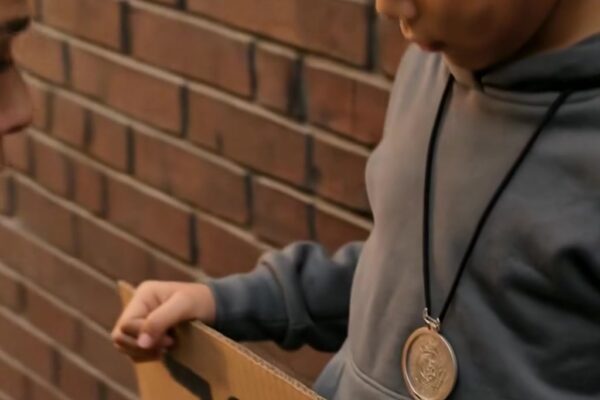
Thomas startled so hard the bench creaked. He looked down and saw a boy he didn’t recognize—thin to the point of angles, clothes too big as if borrowed from someone else’s life, a backpack gaping open with a torn zipper. The boy’s fingers were filthy, his nails rimmed black, but the cold that soaked his grip was what made Thomas’s skin prickle. Not cold from weather. Cold from running out of time.
“Hey—” Thomas began, pulling his arm back.
The boy didn’t let go. He leaned in, panting, eyes wide and unblinking.
“Your daughter isn’t blind,” he said.
The sentence landed wrong—too sharp for the park, too loud for the leaves. Thomas’s first reaction was confusion, almost absurdity, as if he’d heard a stranger claim June wasn’t June.
“What did you just say?” he demanded. His voice came out thin, strained.
“She can see,” the boy said, breath shaking. “I saw her.”
Thomas’s throat tightened. Irritation flared, instinctive and fierce. People stared sometimes. People whispered, people offered pity like coins. But no one had ever walked up and said something like this. Not with such certainty, not with such desperation.
“Get away from us,” Thomas said, but it had the wrong weight. The boy’s gaze pinned him, not begging, not apologizing.
A leaf drifted down, slow as a thought, spinning in front of June’s sunglasses. Without thinking, she lifted her chin and turned her face, following its lazy spiral as it passed. Then her cane shifted, sliding toward the edge of the bench. Her hand shot out and caught it before it fell.
It was nothing, a reflex, a small adjustment—except it was everything. Thomas felt his blood drain, as if his body understood before his mind did.
He looked at June’s fingers wrapped around the cane—steady, sure. He looked at the angle of her face, aligned with the leaf’s path. He looked at the boy, whose eyes did not blink, as if blinking might waste the only seconds he had.
Thomas’s mouth opened. No sound came.
“I saw her look,” the boy whispered, voice cracking on the last word.
Thomas’s arm tightened around June’s shoulders, protective, automatic. He didn’t mean to hurt her, but he felt her small body stiffen, a tremor running through her like a warning bell.
“June,” he said quietly, forcing tenderness into his voice. “Honey… can you… can you see that leaf?”
June turned her face forward again, perfectly composed. “No,” she said, and the word was practiced. It had corners, like something rehearsed in front of a mirror.
Thomas’s heart stuttered. He tried to swallow and found his throat dry.
He looked up and realized there was a jogger coming along the path, a woman in a blue running jacket. At first she had been background—movement among movement—but now Thomas saw her shape, her stride, the way she lifted her wrist to check a watch.
Claire.
She was not running toward them exactly; she was running as if passing by were an accident. But her eyes were on the bench. They had been on it the whole time, hadn’t they?
Thomas’s fingers went numb on June’s shoulder.
“Who are you?” Thomas asked the boy, his voice low. “Why are you doing this?”
The boy’s grip loosened only to wipe his mouth with the back of his sleeve. He looked toward Claire, then back at Thomas as if terrified of being seen.
“I sleep near your house,” he said. “Behind the hedge by the garage. People don’t look there. They don’t see me.” His eyes flicked to June, and something like pity tightened his face. “I see things.”
Thomas’s skin crawled at the idea of a child living outside their tidy brick home, a child he’d never noticed. It shouldn’t have been possible. Yet he remembered, now, small signs he’d ignored: the trash bin lid left ajar, crumbs on the patio, a shadow by the hedge that he’d assumed was a raccoon.
“What did you see?” Thomas asked. His voice sounded like someone else’s.
The boy swallowed so hard his throat bobbed. “It’s your wife,” he said, and his words came out in a rush, like stones tumbling down a slope. “She puts something in her food.”
Thomas stared. The park tilted for a second, the trees leaning, the world slipping out of its calm. “In whose food?” he managed.
“Hers,” the boy said. “In the little girl’s.”
Thomas’s arm loosened around June for one stunned heartbeat, his mind struggling to imagine a shape for the accusation. Medicine? Vitamins? Something the doctors prescribed? But the boy had said it like a verdict, not a misunderstanding.
June sat very still. Too still. Her hands were clenched around the cane now, white-knuckled, as if she could anchor herself by it.
Claire drew nearer, her ponytail bouncing, her cheeks flushed with the theater of exercise. She smiled in their direction, and the smile was perfect, practiced in the same way June’s “No” had been practiced.
Thomas’s brain flashed with memories he’d filed away as harmless. Claire’s insistence on preparing June’s meals herself. Claire’s gentle scolding when Thomas tried to help: “No, Tom, she’s sensitive. Let me handle it.” Claire’s hand on his wrist, steering him away from the kitchen with affectionate authority. Claire’s calm voice on the phone with therapists, her quiet certainty. And June, at night, asking in a whisper, “Daddy, do you love Mommy when she’s mad?”
Thomas had laughed then, uneasy. “Mommy isn’t mad.”
June had been silent a long time. “Sometimes she is,” she’d said.
Now, on the bench, June turned her face slightly—not like a blind child tracking sound, but like a child who knew exactly where her mother was on the path. The sunglasses hid her eyes, but her attention was unmistakable, sharp as a blade under cloth.
Thomas’s lungs wouldn’t fill. His mind scrambled: If June could see, then the specialists, the cane, the sunglasses—what had it all been for? Sympathy? Money? A story Claire could hold up to the world like proof of sainthood? But the boy’s words dug deeper than that. “She puts something in her food.” Something that could make a child stumble. Something that could make vision blur. Something that could make a lie feel real.
Claire was close enough now that Thomas could smell her shampoo carried on the wind. She lifted a hand, waving lightly, a mother arriving at a scene she believed she controlled.
The boy stepped back, fear sparking through him as if Claire’s proximity burned. He released Thomas’s sleeve at last and whispered, barely audible, “She’ll know I told. She looks at the hedge sometimes. Like she knows I’m there.”
Thomas’s pulse hammered in his ears. He wanted to stand, to grab June, to run—yet his body stayed locked to the bench, pinned by the absurd civility of the setting. Leaves. Light. Joggers. Normal.
Claire slowed to a walk, her smile broadening. “There you are,” she called softly, as if greeting skittish animals. “I thought you might head home without me.”
Thomas couldn’t answer. His gaze darted to June. Under the sunglasses, her face was pale and composed. Her lips pressed together, then parted slightly, and for the first time since the boy arrived, she spoke without being prompted.
“Daddy,” June said, and her voice was small, urgent, real. “Don’t let her touch my dinner tonight.”
Claire’s smile did not falter, but something in her posture changed—an almost invisible adjustment, like a door clicking shut. Her eyes fixed on June’s face, on the sunglasses, on the cane, and then flicked to the boy lingering at the edge of the path like a shadow that had learned to speak.
The park remained gentle. The leaves kept falling. The joggers kept passing, half-blurred and indifferent. And Thomas realized the gentleness was the lie’s best disguise: no one expected violence to choose such a quiet place to reveal itself.
He stood, slowly, placing himself between Claire and June, and for the first time in years he felt the shape of his own fear sharpen into something else—decision.
Claire stopped a few steps away. “Tom?” she said, still warm, still calm, as if the world were exactly as she’d arranged it. “What’s going on?”
Thomas looked at her, really looked, and saw the patience in her expression the way one sees a knife in a sleeve. He did not answer her question. He asked his own, in a voice that surprised him with its steadiness.
“What did you put in her food, Claire?”
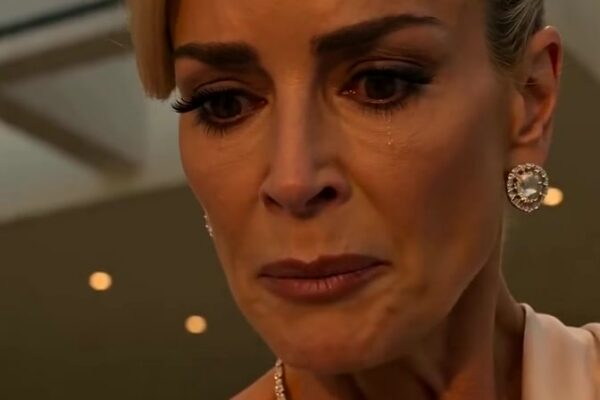
June’s fingers tightened on the cane, and the boy, trembling, melted back toward the trees—toward the hedge, toward whatever thin safety he had left—leaving Thomas standing in a park too gentle for any of this, facing the woman whose love had worn a mask so believable he had mistaken it for air.
Claire’s smile finally wavered, just a hairline crack. Her eyes hardened, and in that small change Thomas saw the truth he’d been living beside: the lie was not in the park.
It had been on his bench all along.