The wedding had already begun to sound expensive when the boy started crying on the steps.
From the street, the old chapel looked like a relic someone had polished into wealth: fresh garlands draped along the iron railings, hired valets in black gloves, and a string quartet tucked just inside the open doors where music could spill outward without letting the chill in. Crystal light from a chandelier fell in bright squares across the stone landing. Below, a black car waited at the curb, its hood buffed to a mirror, its ribboned sign grinning about permanence as if permanence were something you could rent by the hour.
A few guests noticed him the way people notice a stain on a white tablecloth—an interruption in the picture. A small boy in a fitted black suit sat on the top step, knees drawn high, forehead pressed to his sleeves. His shoulders trembled with quiet, exhausted sobs. The suit was too formal for a child and too careful, as if someone had dressed him for a role rather than a day.
“Where are his parents?” someone murmured, without much kindness. Another voice said, “Maybe he belongs to the bride’s side,” and then, after a pause, “Or maybe he doesn’t belong at all.”
Marianne Voss, the groom’s aunt—sharp-eyed, a woman who carried tissues and judgments in equal measure—moved first. She set her purse down as if claiming the step as her territory and crouched beside him. “Sweetheart,” she said, softening her voice into a tone she rarely used, “are you lost?”
The boy didn’t look up. Marianne reached carefully, meaning to lift his chin. When her fingertips touched his sleeve, fabric slid back a fraction, revealing the inside of his wrist.
Marianne’s breath caught, not in melodrama but in genuine shock, the way air catches on something jagged. There was a mark there—part scar, part bruise—an ugly ring that looked as if something had cinched tight and held for too long. Not a scrape from a bicycle, not a tumble off a swing. This was the kind of injury that came from restraint, from someone else’s decision.
Her mouth opened and closed without sound. Behind her, the music inside trilled on, bright and costly, utterly unaware that an old fear had surfaced on the chapel steps like a body in a river.
“Marianne?” a voice asked.
Luke Hargrove stepped out through the doors, adjusting his cuff as he did what grooms did moments before vows: tried to look calm while the world tightened around them. He had a boutonniere pinned too perfectly, and his tie was knotted with the meticulousness of someone who believed neatness could keep disaster away. He saw his aunt kneeling, saw the boy curled in grief, and his brows drew together in confusion.
Then Luke’s gaze dropped to the child’s wrist.
Something in Luke’s face changed so quickly it seemed to unmake him. His shoulders went rigid. The color drained from his cheekbones. For a second, he did not look like a man about to marry; he looked like someone who had walked into a room and found his own past waiting there.
“Hey,” Luke said, voice not loud, but edged. “Kid. Look at me.”
The boy slowly raised his head. His eyes were red-rimmed and too old with fatigue. A faint smudge of something—dried mud, or makeup, or tears that had carried dirt—streaked his cheek. His lips parted as if each word might cost him.
Luke crouched, bringing himself down to the boy’s level. “What’s your name?”
The boy hesitated. His gaze flicked toward the open doorway and then away, like looking at the mouth of a cave. “Eli,” he whispered.
Luke’s throat worked. “Eli,” he repeated, testing it like a truth. “Who brought you here?”
Eli’s hands tightened into fists, the hurt wrist tucked protectively to his chest. “I wasn’t supposed to say,” he murmured. “If I told you… she said the other child would vanish too.”
The words did not rise. They dropped. They hit the stone steps and, in the sudden silence that followed, seemed to roll into the chapel, nudging the music into a faltering conclusion.
Guests nearby shifted, sensing the temperature change. Someone stopped laughing mid-sentence. Someone else, embarrassed by their own curiosity, leaned in anyway. Luke’s eyes stayed locked on Eli’s face with a focus that felt like pain.
“The other child,” Luke said carefully. “What other child?”
Eli swallowed hard. He looked at Marianne, then back at Luke, as though deciding which adult might shatter first. “Mara,” he whispered. “My sister. She’s little. She still thinks—” He shook his head and his face crumpled again. “She thinks people don’t lie when they smile.”
Luke’s jaw clenched. He rose to his feet slowly, like a man standing in deep water. He turned toward the doorway.
Inside, the chapel was dressed for a dream: ivory flowers, candlelight, linen programs with gold lettering. At the front stood Corinne Vale in her white gown, her veil pinned like a coronet. Bridesmaids hovered around her, startled into stillness. Corinne’s smile had been rehearsed for cameras and applause, but now it was slipping, the way a mask slips when the string snaps.
Luke stared at her as if he were trying to see what had been behind her expression all along. The air between them thickened. Corinne’s fingers tightened around her bouquet until the stems bent.
She took one step backward, heel catching on the carpet runner. Her eyes darted toward a side door that led to the vestry, to the back halls, to anywhere not lit by witnesses.
“Luke,” Corinne said, voice thin and careful, like glass. “What is this? We’re about to—”
Luke didn’t answer her. He looked down at Eli, still on the steps, still trembling.
“Tell me,” Luke said, each word clipped. “Is it her?”
Eli’s breath hitched. He lifted his trembling hand—the one with the bruised ring, the one with the half-healed scar—and pointed.
He pointed directly at the bride.
No one moved. Not the photographer with his finger poised above the shutter. Not the officiant with his book open like an unanswered question. Not the bridesmaids in their matching dresses, suddenly aware that matching did not mean safe.
The quartet’s bowing stopped, leaving a naked quiet so complete it felt like the chapel itself had held its breath.
Corinne’s eyes widened, and in them flashed something not bridal at all: calculation, anger, a sharp edge of fear. “That’s ridiculous,” she said too quickly, too loudly. “He’s a child. Children invent things.”
Marianne stood, her voice finally finding its strength. “Then explain his wrist.”
Corinne’s gaze flicked to the mark, and for a heartbeat her expression betrayed her—an involuntary tightening at the corners of her mouth, not surprise, but recognition. She caught herself at once, smoothing her features back into practiced innocence. “There are explanations for injuries,” she said. “He could have—”
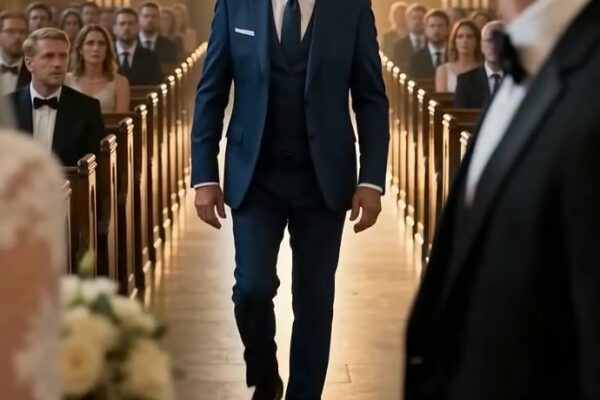
“No,” Luke interrupted, and the single syllable silenced her more effectively than shouting. He stepped forward, down the aisle, each footfall heavy with realization. “I know that mark.”
The guests stirred, uneasy, searching for context the way people search for exits in smoke. Luke stopped halfway between the doors and the altar, as if the aisle had turned into a courtroom.
“Years ago,” Luke said, voice low but carrying, “I worked at the Vale Foundation. The grant office.” His eyes never left Corinne’s. “We processed ‘emergency placements.’ Kids moved in and out like paperwork. People praised the charity while no one asked where the children went.”
Corinne’s smile faltered again. “You’re spiraling,” she said. “This isn’t—”
“I saw a boy,” Luke went on, ignoring her. “A boy with the same kind of mark. He told me someone promised him he’d never see his sister again if he spoke.” Luke’s voice shook, not with uncertainty, but with rage restrained by sheer will. “I reported it. The file disappeared. The boy disappeared. I spent years telling myself I’d imagined details because it was easier than admitting I was frightened.”
He nodded toward Eli. “And then today, when I’m supposed to pledge my life to you, that boy is sitting on my wedding steps.”
Corinne’s cheeks blanched beneath her makeup. Her hands trembled, not enough to drop the bouquet, but enough to betray her. She glanced again toward the side door.
Luke took a step closer. “Where is Mara, Corinne?”
“I don’t know what you’re talking about,” she whispered, but her voice had lost its shine.
Eli’s sobs turned into words, broken but urgent. “She’s not supposed to be here,” he said. “She’s in the car. The one behind the church. She told me if I behaved, Mara would get to eat cake. She said if I ruined it, Mara would—” He choked, unable to finish.
The black wedding car at the curb suddenly looked less celebratory and more like a waiting mouth.
Luke’s head snapped toward the doors. “Call the police,” he said, not to anyone in particular but to everyone. “Now.”
Marianne was already fumbling for her phone, hands shaking with fury instead of shock. A groomsman moved as if to block Corinne’s escape, surprised at his own courage.
Corinne lifted her chin, and for an instant she regained her composure, as if deciding the room could be controlled. “You’re going to ruin everything,” she said, voice sharpened into accusation. “Do you understand what you’re doing?”
Luke turned back to her, eyes bright with a cold clarity. “No,” he said. “I’m interrupting what you’ve been doing.”
He walked past her, past the altar, and pushed open the side door himself, moving into the shadowed corridor beyond. The chapel’s light spilled after him like a spotlight determined to follow truth wherever it went.
Behind him, Eli’s small, shaking body finally leaned into Marianne’s embrace, as if he had been holding himself upright by nothing but fear. Outside, the expensive day stood suspended, all its ribbons and music suddenly meaningless, as the first siren in the distance began to rise—faint at first, then louder, threading through the silence like a promise that this time, someone would not look away.