The terrace above the harbor looked like it had been polished for a magazine shoot. Afternoon light poured across white stone tiles, turning the sea into hammered gold and the rows of crystal goblets into tiny prisms. Conversations drifted in low, practiced tones—soft laughter, careful compliments, the quiet commerce of people who never had to ask the price.
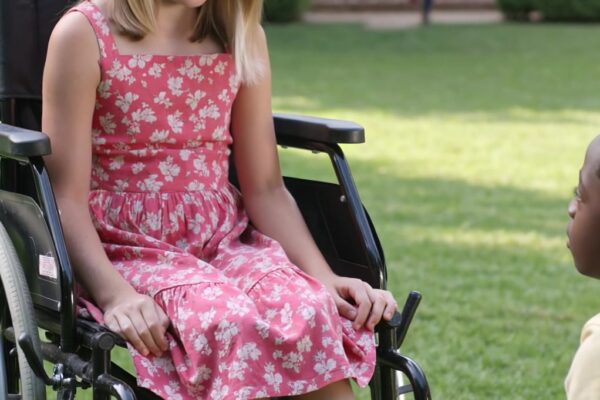
At the center table, everyone angled their bodies as though orbiting a planet. Valeria Sanz sat in a chair built like an automobile seat—sleek, black, expensive. Her hair was pinned with surgical precision. Her pearl earrings caught the sun and threw it back. She didn’t need to raise her voice; waiters read her posture the way sailors read wind.
She hadn’t walked in seven years. The doctors called it a “complete injury,” the kind of phrase that sounded tidy enough to fit on insurance forms. Valeria had learned to live inside the tidiness. She had learned to make paralysis look like dignity.
The first scream cracked the terrace like a thrown glass.
“Hey—stop! What are you doing?”
Chairs scraped. Heads snapped around. A cluster of tourists near the railing fumbled for phones. Valeria turned, annoyance already forming, prepared to hand out consequences with the smallest tilt of her chin.
Then she saw him: a boy, no older than eight, with knees pressed to the stone and a shirt that hung from his shoulders like it had been borrowed from someone twice his size. Dirt streaked his shins. His hair was chopped unevenly, as if by kitchen scissors. He wasn’t begging. He wasn’t smiling. He was focused with a frightening kind of purpose.
He reached both hands toward her.
For a moment, Valeria thought he was going for her handbag. She jerked it away and shouted, “Get away from me!”
But his fingers closed around her lower legs instead—firm, almost reverent, like he had been taught where to hold a fragile thing. He yanked. The chair lurched forward and bumped against the marble seam with a dull thud.
Gasps rippled around them. A waiter rushed in, then froze as if he’d hit an invisible wall. Someone hissed, “Call security!” Another voice said, “Don’t touch him—what if he has a knife?”
Valeria’s cheeks flamed. The humiliating intimacy of it—hands on her body, in public, under a hundred eyes—made her grip the armrests hard enough to ache.
“Let go,” she said, crisp as a judge. “Now.”
The boy didn’t flinch. His mouth opened, then closed. When he spoke, his voice wobbled as if the words were heavier than he’d expected.
“Don’t fight me,” he whispered. “Please. Just… try.”
He slid one of her feet from its resting position and pressed it down to the stone with a slow, deliberate force, aligning her heel the way a physical therapist might. It was a small movement, almost nothing—yet the boy’s hands shook with the effort of insisting on it.
Valeria’s anger faltered, confused. “What is this?” she demanded. “Are you—are you playing some trick?”
He shook his head, eyes shining too brightly. “No trick. I know it’s there.”
Her lips parted to call for help, for guards, for anyone who could wipe this moment away. Then something unexpected flickered under her skin.
Not pain. Not the familiar dead silence of nerve damage.
A faint pressure, as if the floor had reached up and touched her through glass.
Valeria’s breath hitched. She stared at her own shoe as though it belonged to a stranger. The terrace, a moment ago filled with murmurs and clinks of cutlery, went oddly quiet—as if the whole scene had been placed under a dome.
“Wait,” she heard herself say, and her voice wasn’t commanding anymore. It was bare.
The boy leaned closer, his face upturned. His eyelashes were clumped from salt air. A bruise shadowed one cheekbone. “You felt it,” he said, not as a question, but as a confirmation.
Valeria swallowed. “That’s impossible.”
“My mama said it wasn’t,” he replied, the words tumbling faster now, with desperation behind them. “She said you used to stand up even when you didn’t want to. She said you could do it again if you remembered how.”
Valeria’s fingers loosened on the armrests. Her throat tightened with a sensation she hated because it wasn’t tidy at all. She searched the boy’s face for the angle of a scam, the sheen of practiced pity. But his gaze held nothing like that. It held need.
“Who are you?” she asked, softer.
He shifted his grip, pulling her shin forward a fraction. The chair creaked. Her torso rocked. Somewhere behind the crowd, someone whispered, “This is insane.” A phone camera trembled above a shoulder, recording breathlessly.
Valeria’s legs—her legs—answered with a tremor so small she would have dismissed it as imagination if she hadn’t felt the strain in her thighs. Heat crawled up her spine, an uninvited sensation, like a match touched to a fuse.
“No,” she murmured. “No, I can’t—”
Her heart hammered. She pictured the neurologist’s face, calm and final. She pictured the X-rays, the white bones like maps that led nowhere. She pictured herself signing papers in a hospital room while rain ran down the window like something trying to escape.
The boy’s voice cracked. “Please,” he said. “If you don’t, they’ll take me back.”
Back. The word struck her harder than the physical effort. Back to where?
She braced her palms on the armrests and, against every rule her body had taught her, she pushed. The boy anchored her feet with both hands. The muscles in her abdomen clenched. Her vision narrowed.
For a fraction of a second, she rose.
Not straight. Not steady. But undeniably lifted, her hips off the seat, her weight transferred to a pair of legs that had been declared useless.
A sound moved through the terrace like wind through dry leaves—shock, awe, fear.
Valeria wavered and dropped back into the chair with a sharp inhale, as if she had surfaced from deep water. Tears she hadn’t permitted in years blurred the scene. She stared at the boy as though he had reached inside her and touched something locked away.
His eyes didn’t leave hers. “You did it,” he breathed.
And in that instant, memory—dangerous, alive—rose up. A night of rain. A cheap apartment that smelled of bleach. A woman’s laugh. A baby’s crying. A promise made and broken. Valeria’s mind snapped around the boy’s features: the slant of his eyes, the stubborn line of his chin, the way his lower lip trembled when he tried not to cry.
Recognition came like a sudden fall.
Her mouth formed a name before she could stop it. “Your name is—”
“Don’t say it.”
The voice cut through the silence with the authority of a gavel. It came from behind the crowd, low and controlled, carrying the kind of menace that didn’t need to shout.
People parted reluctantly. A man stepped forward in a tailored linen suit, his watch flashing as he adjusted his cuff. His hair was silver at the temples, his face composed into the expression of someone used to being obeyed. Two security men flanked him, but they looked less like staff and more like shadows that had learned to stand upright.
Valeria knew him. Not as a friend. As a consequence.
He smiled without warmth. “Valeria,” he said, as if they were meeting at a charity gala instead of a public unraveling. “How touching. A miracle on a sunny afternoon.”
The boy’s grip tightened on her legs, and for the first time, his fierce focus wavered into fear. He glanced at the man, then back at Valeria, as though silently pleading: Don’t let him take this.
Valeria’s hands trembled on the armrests. She felt again—faintly, unmistakably—the floor beneath her foot, the pressure of reality returning where it shouldn’t. And with it came a different sensation, colder and sharper: the sense that her carefully curated life had been built over a hole.
The man’s eyes dropped to the boy. “You’ve caused enough trouble,” he murmured.
Valeria’s voice came out ragged. “Who is he?”
The man’s smile held. “He’s a mistake that should have stayed buried.”
Valeria looked down at the child kneeling before her—dirty knees on clean marble, small hands braced as if he could hold the world in place. The terrace air smelled suddenly of salt and ozone, like a storm arriving early.
She lifted her gaze to the man. For years, she had survived by controlling every frame of her existence. But something had shifted under her—something waking, something furious, something that remembered.
“Then you buried it wrong,” Valeria said.
And she pressed her foot into the stone again, daring her body to answer, daring her past to show its teeth in public.
The boy whispered, almost inaudible, “Try again.”
Valeria inhaled, and the terrace waited with her—crystal, sunlight, a hundred unblinking witnesses—as she prepared to stand not just on her legs, but on the truth she had been ordered never to name.