Snow had been falling since dawn, the kind that didn’t look dangerous until it started to sting. It found every tear in the pavement and packed it with ice. It hid the color of the city the way grief hides the color of a life. By late afternoon the boulevard outside the Ardene Towers was a sheet of glass, and the wind came off the river sharp enough to cut.
The boy on the curb had stopped counting the minutes. He’d been counting hunger instead—how it rose and fell like a tide, how it made the air smell like things he couldn’t afford to imagine. His sneakers were soaked through. His fingers, split at the knuckles, shook around the paper cup he hadn’t had the courage to lift in an hour. He kept his eyes down, because looking up made it worse—people looked past him like he was a crack in the sidewalk, something to step over and forget.
He was watching his own breath when a shadow fell across him. Not the shadow of a man in a hurry, not the sharp slice of a woman’s heels, but a steady presence that didn’t flinch at the cold.
“Hey,” a voice said, careful, as if it didn’t want to scare him away.
The street boy lifted his head.
The boy standing over him wore a wool coat too clean for this weather and gloves that matched. The kind of gloves that meant there was always warmth waiting somewhere. His cheeks were pink from the cold, not hollow from lack. Still, his eyes weren’t the usual bright, indifferent blue of the kids who climbed into black cars. His eyes looked like they were trying to understand something.
In his hands was a small paper bag. The smell of fresh bread leaked through it, warm and impossible.
“I… I got extra,” the rich boy said. His voice was high, embarrassed by its own kindness. “You can have it.”
The street boy didn’t reach for it right away. His body had learned suspicion as an instinct; kindness was sometimes a joke with teeth. But the bread was so close he could feel it in his throat, like a memory of being fed.
The rich boy crouched, ignoring the wet, and held the bag out with both hands as if it were an offering.
When the street boy’s fingers finally closed around it, they met warmth through the paper. He stared at his own hands, at the way they looked suddenly human again.
“Thank you…” he whispered, voice shaking, like gratitude hurt.
The rich boy smiled—not triumphant, not proud. Just relieved. Then, with an almost reckless simplicity, he leaned forward and wrapped his arms around the street boy, hugging him right there on the frozen pavement as if there were no rules about who could touch whom.
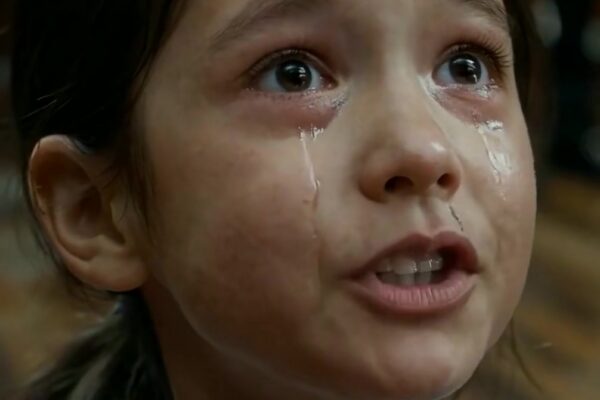
The street boy broke at the contact. It wasn’t the bread. It was the arms. It was the sudden proof that he was real enough to be held. Tears spilled down his face, hot against the wind, and he buried his forehead into the other boy’s shoulder like it might be a doorway to somewhere safer.
“You’re safe now,” the rich boy murmured, the words small but certain.
From somewhere—maybe a lobby speaker, maybe someone practicing in one of the tower’s bright apartments—soft piano drifted into the cold. The notes trembled under the wind and made the moment feel like a scene in a movie the city didn’t deserve.
Then the rhythm changed.
Heels struck the sidewalk fast, panicked, slicing through the music. A security door behind them slammed open. A woman burst out from the Ardene Towers like she’d been thrown, her elegant coat flaring, her expensive bag swinging on her arm. Her breath came in white bursts, and the look on her face wasn’t anger at first—it was fear, raw and immediate, the way a mother looks when she thinks danger has hands.
“No!” she shouted. “Get away from him!”
The rich boy startled and loosened his grip, still half-crouched. He looked up at her, confusion knitting his brow. “Mommy?”
She stormed toward them, one hand outstretched as if to snatch her son back into the world of doormen and disinfected elevators. “Do not touch him,” she hissed, eyes fixed on the street boy as though poverty were contagious.
“But Mommy…” the rich boy said, voice cracking with earnestness. “He’s cold.”
Her stride faltered. She was close enough now for the street boy to see her mascara trembling at the edges, as if she’d been crying earlier or had been near to it for years. Her hand hovered over her son’s shoulder—then stopped midair, fingers curling inward.
Something in her face changed. The terror that had been aimed outward turned inward, like a knife turning in a wound.
Her gaze locked on the street boy’s features with a focus that hurt to witness. The shape of his nose. The faint scar above his eyebrow, white against chapped skin. And when his trembling fingers clutched at the collar of his threadbare hoodie, a small silver chain slipped into view—a cheap thing, dull with age, but unmistakable in the way personal objects become unmistakable to the people who love them.
The woman’s mouth opened as if she might scream again, but the sound didn’t come out. Instead, her hand rose slowly to cover her lips.
The street boy blinked through tears. He studied her face as if it were an old photograph he’d carried too long in his mind until it blurred. Something in her eyes—gray, with a fleck of amber near the pupil—caught on his memory and pulled.
He had a flash of warmth that didn’t fit the street: a lullaby humming near his ear, fingers tracing the scar above his eyebrow, a voice saying his name like it was sacred. He couldn’t remember the name, only the softness around it. He swallowed, throat burning.
“Mom?” he whispered, not certain if he was asking or confessing.
Everything around them seemed to fall away. The wind faded. The piano became a single thin thread. The towers, the cars, the people hurrying by—blurred like they were on the other side of glass.
The woman’s knees buckled. Her expensive bag thudded to the icy sidewalk. She dropped to the pavement in front of the street boy, the hem of her coat soaking dark where it met the slush. For a heartbeat she looked like she’d been shot, then she reached out with shaking hands and touched his face as if she were afraid he would dissolve.
“Elias,” she breathed, the name breaking free of her like it had been locked behind her ribs. “Oh God… Elias.”
The street boy flinched at the name, and then the memory snapped into place: a hospital corridor, an alarm, smoke, hands pulling him away, his small fingers ripping at a chain while someone screamed. He had been five. He had worn that chain because she’d said it would keep him safe.
Behind her, the rich boy straightened slowly. The color drained from his cheeks, leaving them pale beneath the cold. His eyes moved between the woman and the street boy as if he were watching a story rearrange itself, page by page, into something he didn’t recognize.
“Mom?” he said again, but this time the word sounded different—less like a claim and more like a plea.
The woman looked over her shoulder at him. Her face was a battlefield of love and horror and a guilt so old it had become part of her bones. “Lucas,” she whispered, as if speaking his name might keep him from shattering. “Sweetheart—”
The rich boy took a step back, his boots slipping slightly on the ice. His voice came out thin. “If he’s…” He swallowed, eyes wide and wet. “If he’s your son… then who am I?”
The question hung there, heavier than the snow, heavier than the towers. The street boy—Elias—looked down at the bread in his hands, still warm. Then at the woman trembling in front of him. Then at the boy who had offered him an embrace without fear.
Somewhere inside Elias, the part that had learned to survive by expecting nothing whispered that answers could be crueler than hunger. But he also saw something else: the way Lucas’s kindness had been real, the way the woman’s collapse was real, the way the chain at his throat had led him back to a door he hadn’t known existed.
He drew a shaky breath. His fingers tightened around the paper bag until it crinkled like a heartbeat.
“Maybe,” Elias said, voice low and unsteady, “you’re the one who found me… when everyone else didn’t.”
The woman sobbed once, sharp as a crack of ice. She reached for both boys at the same time, as if she could hold the past and the present in one desperate embrace. Lucas didn’t move at first. Then, slowly, he stepped forward, his gloved hand hovering near Elias’s shoulder like a question.
The city kept moving around them, indifferent and cold. But on that patch of frozen pavement, three lives tilted toward one another, and the snow fell softer, as if even the sky was holding its breath for what came next.