The rain didn’t fall so much as it attacked—hard slanted sheets that made the streetlamps look bruised and the sidewalks shine like fresh-cut stone. Mara ran with one arm clamped over her head and the other hand around a small velvet pouch in her coat pocket. Her shoes skidded on the slick pavement, and the city blurred into a smear of headlights and water.
She saw the jewelry shop the way a drowning person sees a surface: gold lettering, warm light, the promise of air. The door resisted a heartbeat, then gave way. Wind shoved her inside. The bell over the frame shrieked. Her foot slipped on the threshold, and her forehead struck the edge of the doorjamb with a sound that made her eyes explode with stars.
She grabbed her temple, teeth bared against the pain, and stood there swaying as the shop’s warmth licked at her soaked coat. Behind glass cases, rings and bracelets lay arranged as if nothing in the world could be urgent. The smell was polish and velvet and old money.
A man sat on a stool behind the counter, his hair silver and combed too neatly for the weather outside. He didn’t rise. His gaze slid over her like she was a wet dog that had found its way in.
“You’re dripping on the floor,” he said, not unkindly—simply as a fact. “What do you want?”
Mara swallowed. Her tongue tasted of copper. “To sell something,” she managed.
He pushed a cloth toward her with two fingers. “Dry your hands before you touch my glass.”
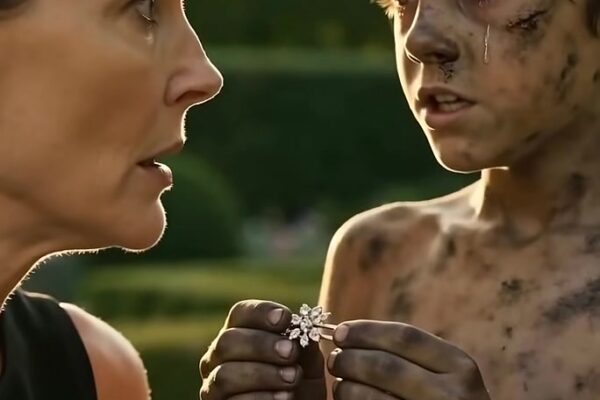
Her fingers trembled as she wiped them, then reached into her pocket and brought out the velvet pouch. She hesitated long enough that the man’s brows lifted in impatience. She opened it and set a necklace on the counter. The chain was thin, dull with years. At its center hung a small oval locket, scuffed at the edges as if it had been opened and closed too many times by someone who couldn’t decide whether to remember.
The man didn’t ask where it came from. He didn’t ask why her eyes were rimmed red, why she looked like she’d been running for more than the rain. He picked up a loupe, turned the locket, tested the clasp.
“Fifty,” he said. “Cash.”
Mara’s throat tightened. She had expected insultingly low. Still, the number struck like a slap. She needed medicine money, bus fare, something to keep the lights on another week—she told herself the story she’d rehearsed. It was just metal. Just an object.
Her hand remained on the counter, close to the locket, as if she could hold the past in place by refusing to let go.
“Okay,” she whispered. “Deal.”
Outside, thunder rolled like a heavy cart. Inside, the air thickened. The jeweler reached under the counter, already moving toward a cash box.
Then, almost absentmindedly, he flipped the locket in his palm and pressed his thumbnail into the seam.
Click.
The oval sprang open.
Mara’s breath snagged. She hadn’t seen the inside in years—not since Clara’s hands had shoved it into hers with a fierceness that bordered on anger. Keep it, Clara had insisted. Don’t take it to him. Promise.
The jeweler didn’t look at the chain anymore. He stared into the locket’s small frame. His face, which had been carved into professional indifference, went oddly blank, as if someone had stolen the script he’d memorized for life.
His fingers tightened around the metal.
“No,” he said, so softly Mara almost missed it.
His throat worked. “Clara…?”
The photo inside showed a girl of maybe eight, with a gap-toothed smile and a blue ribbon in her hair. The background was a familiar shoreline, all pale sand and wind-bent grass. The smile was bright in a way that hurt to look at.
Mara stepped backward, the shop suddenly too small, the lights too warm, the glass cases too reflective. She turned toward the door. She could still run. She could still vanish into the rain where no one’s eyes could pin her down.
“Wait,” the man said, and the word cracked. He stood so abruptly the stool toppled behind him. “Wait!”
Mara paused with her hand on the door handle. Rain hissed against the glass. The bell above her trembled in its bracket.
“That necklace—” His voice failed, returned altered. “That belongs to my daughter.”
Silence fell in a way that made even the storm seem distant. Mara felt her heartbeat in her injured forehead, pulsing pain into her skull.
She didn’t turn at first. She couldn’t. She pictured Clara’s face in the hospital light, pale and stubborn, eyes too old for her age. The way Clara had gripped Mara’s wrist, nails digging in, the locket pressed into her palm like a secret that could burn through skin.
Mara forced herself to rotate slowly, as though any sudden movement might shatter what little control she had left. The jeweler was holding the locket open, the photo exposed like an accusation.
“Then why,” Mara asked, and her voice shook, “did she make me promise not to bring it back to you?”
The man’s mouth opened. For a moment nothing came out. He looked at Mara as if seeing her for the first time—not a soaked stranger, but someone who had been standing just outside his life for years, listening to the echoes.
“Who are you?” he whispered. “How do you have that?”
Mara’s laugh was small and wrong. “She gave it to me.”
“When?”
“The day she left.”
His face tightened, lines deepening as though grief had always been there and now simply remembered to show itself. “She didn’t leave,” he said. “She was taken.”
Mara flinched. The word slammed into her. Taken. She had heard the news years ago—an amber alert on a phone screen, a blurred photograph, a last-seen location near the coast. But she’d never connected it to Clara because the Clara she’d known had been hidden under a different last name, a different school, a different town like a disguise. Clara had been living inside a lie Mara only half understood.
“She wasn’t taken from you,” Mara said, the pieces rearranging with sick clarity. “She was taken away by you.”
The jeweler’s eyes flashed. “You don’t know—”
“I know she used to wake up screaming whenever it rained,” Mara snapped, and then the sharpness broke into something softer, rawer. “I know she’d lock the bathroom door and count under her breath like someone taught her to. I know she hated the smell of metal because it reminded her of keys.”
The jeweler stared, and in his stare Mara saw something worse than anger: recognition.
“She’s dead,” he said abruptly, as if saying it fast could keep it from cutting him. “I buried an empty coffin because they never found her. I’ve spent six years waiting for a phone call that doesn’t come. Don’t stand there and tell me stories.”
Mara’s hands curled into fists at her sides. “She died last Tuesday,” she said. “In a hospital two towns over. Pneumonia. She’d been sick for a while, but she wouldn’t go in until she couldn’t breathe.”
The man’s knees seemed to weaken. He gripped the counter edge. “No,” he said. “No, that’s—”
“She didn’t want you called.” Mara stepped forward despite herself, pulled by an old promise. “She made me swear.”
His voice lowered to something desperate. “Why?”
Mara drew a breath that scraped her throat. “Because she said you’d come for her again. She said you’d wrap her in velvet and call it love, and no one would believe her because you smile so well.”
The rain hammered at the door. The jewelry lights hummed. Somewhere deeper in the shop, a clock ticked with maddening patience.
“She was my child,” he said, and his eyes shone now, wet and furious. “I kept her safe.”
“Safe from what?” Mara demanded.
His jaw clenched. He looked down at the locket, at the photo of a girl who had once trusted him. When he spoke again, it was in a voice stripped of its polish.
“From her mother.”
Mara’s stomach turned cold. She remembered Clara’s mother in fragments: a woman with a cigarette voice, a soft hand that shook when she tried to sign forms, a smile that appeared only when Clara wasn’t looking. A woman who vanished from Clara’s stories as if she’d been erased.
“You took her,” Mara said, because the sentence felt inevitable now, built of everything Clara had never said outright.
He flinched as if struck. “I rescued her,” he insisted, but the word sounded rehearsed. “There was a custody order—there were… circumstances.”
“And then what?” Mara asked. “You hid her? Changed her name? Made her disappear so you could keep her like one of these stones behind glass?”
The jeweler’s gaze snapped up, sharp as a cut. “Where is she buried?”
Mara stared back, and for the first time since she’d slammed into the shop, she felt steady. The promise in her bones tightened like wire.
“I won’t tell you,” she said. “Not until you tell me the truth.”
He opened his mouth, and whatever answer he might have given was swallowed by a sudden knock at the shop’s front window—firm, official, timed with a flash of lightning that lit the street in stark white.
Two silhouettes stood outside in raincoats, their badges briefly catching the light like small, cold stars.
The jeweler didn’t move. Mara didn’t either. The locket lay open between them, Clara’s smiling face exposed to the air as if it had been waiting years to be seen by the right eyes.
And in that suspended second—before the door opened, before anyone spoke—Mara understood why Clara had begged her not to bring it back.
It wasn’t because the necklace would lead her father to Clara.
It was because it would lead the world to him.
Mara lifted her chin, her pulse steadying under the bruise on her forehead. “Tell me,” she said to the man behind the counter, “what you did to keep her.”
The jeweler’s fingers trembled on the locket, and for the first time, fear—not of loss, but of consequence—flickered across his face as the police knocked again and the rain kept trying to break its way inside.