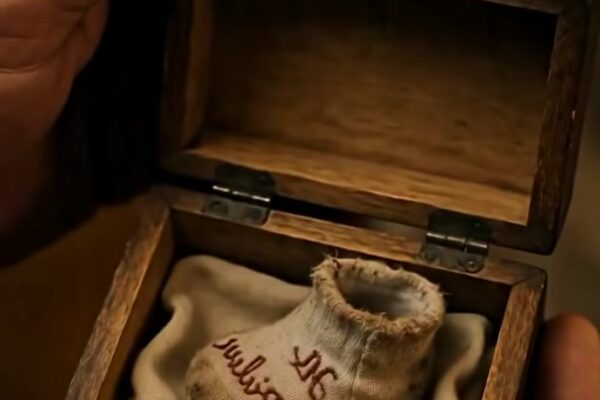
The maternity room was dim and quiet, the kind of hush that made every sound feel sacred. The overhead lights had been lowered to a soft amber, and the only steady rhythm came from the monitor beside the bed—small, obedient beeps that counted time in heartbeats. In the bassinet, a newborn slept with her fists tucked beneath her chin as if she’d arrived already determined to hold on to something.
Mara lay propped against crisp hospital pillows, her hair damp at the temples, her body a map of aches she hadn’t known it could survive. She watched her daughter’s tiny chest rise and fall and tried to believe the night could stay like this: safe, sealed off from the world. She had asked for no visitors. She’d signed the papers. She’d told the nurse, gently but firmly, that she needed rest. That she needed quiet.
When the door opened, it did not creak the way the bathroom door did. It swung too confidently, as if it had never been told no. Mara’s head turned, expecting a nurse with a clipboard or a doctor with a brief update. Instead, two women stepped inside, silhouettes at first against the hall’s brighter light. One carried a large purse that looked empty despite its size. The other moved as though her shoes made no sound, her face unreadable in the dim.
“You shouldn’t be here,” Mara said, voice thin, the words snagging on the rawness in her throat. It took more effort than it should have to speak at all. “Visiting hours—”
The first woman—Leena—closed the door behind them and turned the lock with a click that cut through the beeps. Her expression was almost tender, the way a person looks at a fragile thing before deciding whether to break it. “We’re not visiting,” she said. “We’re collecting.” She crossed the room in three brisk steps and reached for Mara’s hair with a hand that smelled faintly of cigarette smoke and winter air.
Pain exploded at Mara’s scalp. Leena’s fingers twisted into her hair and yanked her head back so hard the back of her neck screamed. The world tilted; the ceiling swam. Mara gasped, her stitches pulling, her muscles refusing to cooperate. “Stop—” she tried, but the sound came out like a sob. Leena leaned down, her breath hot against Mara’s cheek. “Give us the card,” she hissed. “Now. The hospital account, the password, the little plastic lifeline. You know what I mean.”
Behind Leena, the second woman—Daria—stood near the bassinet. She didn’t touch the baby. She didn’t have to. Her stillness made the room feel smaller. “You owe us,” Daria said, as if reading from an old receipt. “You walked away and left debts. You left us to explain things. You left us to pay.”
Mara’s mind raced, fogged by exhaustion and medication and the shock of being pulled backward by her own hair. She saw them not as they were now—well-dressed enough to pass as family, eyes bright with a certain practiced menace—but as they’d been in the cramped apartment over the salon, where every night had ended with someone crying and someone else calling it discipline. Back then she’d learned to measure her breaths, to swallow words before they became reasons for punishment. Back then she’d had no baby in a bassinet, no bracelet on her wrist with her name printed clear, no nurse down the hall who knew her face.
“I don’t have anything,” Mara whispered. Her hands trembled on the blanket. She could barely lift them. “I’m done. I’m not… I’m not giving you anything.”
Leena’s grip tightened, a sharp reminder that pain was an easy language for her. “You don’t get to decide that,” she said. She looked toward the bassinet. Not at the baby, but at the idea of the baby—at leverage. Mara followed her gaze, and something in her chest cracked open in a way that didn’t feel like breaking, but like air finally reaching a room that had been sealed for years.
The baby made the smallest sound, a soft, questioning whimper, and her fingers unfurled like petals. Mara felt tears spill down her cheeks, hot and immediate. Not from the pain—though it burned—but from the sudden clarity of what was at stake. Leena and Daria didn’t want just a card. They wanted the same old power, the same old ownership. They wanted Mara to believe she was still theirs.
On the wall near Mara’s right hand was a small button panel, half hidden by the bed’s rail. The nurse had pointed it out earlier, smiling as if it were a simple comfort. Call button. Light control. And, in red, the emergency alert. Mara’s fingers shook so badly she wasn’t sure she could aim them, but she forced her wrist to move, inch by inch, while Leena’s hand still knotted in her hair. Mara’s palm found the raised edge of the red button. Her hand hesitated, a lifetime of consequences gathering behind the moment.
Then she pressed it.
The alarm blared instantly, loud enough to swallow the steady beeping of the monitor, loud enough to make Leena flinch. A harsh light above the door snapped on. Footsteps erupted in the hallway—quick, heavy, multiplying. Voices called out. A cart clattered. Someone shouted for security. The calm, private world of the room shattered, replaced by bright, unforgiving reality.
Leena let go of Mara’s hair as if she’d been burned. For a fraction of a second, she and Daria stood frozen, their confidence collapsing under the weight of witnesses rushing toward them. The door flew open. Two nurses flooded in, followed by a security guard whose presence filled the doorway. One nurse moved straight to Mara, hands gentle but eyes fierce; the other planted herself between the visitors and the bassinet.
“Step away,” the nurse barked, not asking. “Now.”
Daria’s composure cracked; her mouth opened, searching for an excuse. “This isn’t—she’s our—”
“Step away,” the nurse repeated, sharper, and the security guard reached for his radio.
Mara’s whole body shook as adrenaline crashed through her, but she managed to lift herself enough to reach for her baby. The nurse placed the newborn carefully into Mara’s arms, and the weight—so small, so real—anchored her. She looked past the nurses, past the guard, straight at Leena and Daria. Her voice was still hoarse, but it held something it had never held before: refusal without apology.
“You’re not taking anything from me again,” Mara said. The words landed like a door finally locked from the inside.
Leena’s eyes flickered, not with remorse, but with disbelief. She had built her life on other people’s surrender, and she didn’t know what to do with a woman who wouldn’t give it. Security took hold of their arms. Leena jerked once, then stopped, suddenly aware of uniforms and cameras and the fact that she could not twist her way out of this with a smile.
As they were led out, Daria’s gaze snagged on the baby, and for the first time there was something like fear in it—not fear of consequences, but fear of losing the story she’d told herself about control and entitlement. The door closed behind them, and the alarm was silenced. The monitor resumed its quiet beeping, as if reclaiming the room’s rhythm.
Mara held her daughter tighter, breathing in the faint milk-and-skin scent at the crown of her head. Tears still slid down Mara’s cheeks, but they didn’t taste like defeat. They tasted like a line drawn, like a future defended. In the dim light, her baby stirred, then settled, trusting the arms around her. Outside, voices faded down the corridor, replaced once again by the hush of night—and this time, the quiet felt earned.