The diner smelled like grease, coffee, and rain on old pavement. It clung to the curtains and the cracked vinyl booths, lived in the seams of the counter stools, and rose from the floor whenever the door opened and let in the wet breath of the street. A tired neon sign hummed in the window as if it was trying to remember how to shine.
Marla Hensley had worked there long enough to stop noticing most things. The sizzle of the flat-top had become her pulse. The clatter of plates was a second language. She could tell what kind of night it was by the way the rain hit the glass. And on that particular night, the rain sounded like someone tapping on a coffin lid—soft, persistent, impossible to ignore.
That was how she noticed the child in Booth Nine. Not because the girl asked for anything—she didn’t. She sat with her knees tucked under her, swallowed up by an oversized sweater the color of dishwater. Her hair looked like it had fought with a comb and won. Dirt shadowed her cheeks, and her gaze kept drifting to the pass-through window where orders came out steaming and whole. Her own table held nothing but a stack of napkins she’d folded into tight little squares, as if neatness could fill her stomach.
Marla brought water without being asked. The girl’s hands hovered over the glass but didn’t lift it. Her eyes flicked up, then down. Fear lived in her shoulders, in the way she pressed herself toward the wall. Marla had seen plenty of runaways and plenty of kids who learned too early that adults were unpredictable. This one had the quiet, practiced kind of caution—like she expected the world to slap her if she moved too fast.
Before Marla could decide what to do, Lou Denton lumbered out from the back with the register tape in his hand. Lou wasn’t the owner, just the kind of man who acted like he was owed the building because he’d been loud inside it for years. He stopped beside Booth Nine and leaned over until his shadow covered the girl’s face. “You think you can just sit here?” he said, his voice sharp enough to cut toast. “You didn’t pay.”
The girl flinched so hard the spoon in the sugar caddy rattled. Her mouth opened, closed again, and then the words slipped out thin and small. “I’m sorry.” Lou made a sound that might have been a laugh if it hadn’t been cruel. “Sorry doesn’t buy you dinner.” His eyes slid toward Marla as if daring her to interfere.
Marla’s hands moved before her mind finished arguing with itself. She took a plate from the window—fried chicken that still hissed, fries that shone with salt, a biscuit split and steaming like it had a heart. She set it down in front of the child with the steadiness of someone laying a blanket over a shivering body. “Eat,” Marla said, not loud, just certain.
Lou’s face reddened. “That’s coming out of your tips,” he snapped. Marla didn’t even turn her head. “Then take it,” she answered, and the words landed heavier than any threat. For one moment the entire diner paused—forks hovering, coffee cups midair. Even the rain seemed to hesitate. The girl stared at the plate as if it might vanish for daring to exist. Her fingers trembled when she reached for a fry, and when she bit into it her eyes squeezed shut. A tear slid down her cheek, leaving a clean track through the grime.
“Why?” the girl whispered, her voice breaking around the question. Marla’s throat tightened in a way that surprised her. She thought of a small bedroom she no longer rented. A toy she couldn’t bring herself to throw away. A name that still echoed in her dreams. She kept her face gentle anyway. “Because you’re hungry,” she said. That was all. No lecture. No bargain. No demand for gratitude.
The girl ate like someone trying not to breathe too loudly. Between bites she kept glancing up at Marla, studying every line of her face as if committing it to memory. “I’ll remember,” the girl said, and there was a seriousness to it that didn’t belong in a child’s mouth. Marla felt the sting behind her eyes and turned away fast, pretending to wipe a clean counter. Behind her, Lou grumbled himself back into the kitchen, defeated by a kindness he couldn’t calculate.
After the girl finished, she slipped out with the rain. Marla never got her name. She only found the folded napkins on the table—careful squares stacked like an offering—along with a single button, dark blue, probably torn from the child’s sweater. Marla kept it in the drawer under the register for years, a small hard reminder that sometimes you could choose to be the thing that didn’t hurt.
Time did what time always does: it wore the diner thinner. The booths cracked more. The coffee pot started to leak. The regulars aged into ghosts. Marla’s knees began to complain every morning. The owner talked about selling more than once, each time with the tired resignation of someone watching a ship take on water. Marla listened and said nothing, because there were bills and there was nowhere else to go.
Then, on a bright afternoon that felt wrong for the season, the bell over the door rang with a clean, confident chime. A woman stepped in wearing a tailored suit the color of midnight. She carried herself like she had learned how to survive rooms that wanted to swallow her. Rain wasn’t falling, but the air still smelled like it might. She paused, taking in the counter, the booths, the pale light in the windows—like she was standing inside a photograph she’d carried for years.
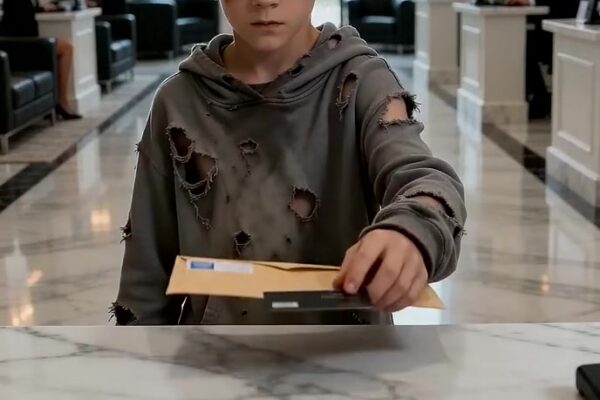
Marla was behind the counter, wiping the same spot she always wiped when she was nervous. She looked up and saw the woman’s eyes—dark, steady, too familiar to dismiss. The woman walked forward and set a small ring of keys on the counter, along with an envelope sealed in thick paper. “Ms. Hensley?” she asked softly. Marla’s hands went still. “That’s me.”
The woman’s composure wavered just enough to reveal something raw underneath. “You fed me,” she said, and Marla felt the room tilt. A button in a drawer. A child’s shaking hands. The taste of guilt and hope all at once. Recognition struck like lightning belatedly finding its ground. Marla’s mouth parted, and for a moment she couldn’t make sound.
“I looked for you,” the woman continued, voice roughening. “I didn’t know your name back then. Only your face. I drew it on scrap paper in shelters. I described it to social workers who didn’t listen. When I got older, I came back and the building was still here. You were still here.” She pushed the envelope closer. “Open it.”
Marla’s fingers shook as she broke the seal. The document inside was heavy with legal language, but one line rose above all of it: transfer of ownership. Her eyes blurred. “This can’t be—” she began, but the woman shook her head. “It can,” she said. “I’m an attorney now. I bought the property and paid off the liens. The diner is yours. Not because you asked. Because you gave without asking.”
Marla’s breath caught like it had hit a wall. “I just—” she tried to say, but the woman stepped closer, her eyes shining openly now. “You didn’t just,” she whispered. “You reminded a starving kid she was still human.” She swallowed, then added, “And I needed you to know that it mattered. That one plate changed everything.”
Marla gripped the edge of the counter to keep herself standing. The diner around them seemed to sharpen—the hum of the lights, the distant hiss from the grill, the murmur of customers who didn’t understand they were witnessing something holy. “What’s your name?” Marla asked, as if saying it would make the years real.
The woman’s smile broke like sunrise through clouds. “Elena,” she said. “Elena Pierce. But once, I was just a kid in a booth trying not to look hungry.” She placed her hand over Marla’s trembling one, warm and steady. “I came back,” she said, voice low with a promise kept, “so you wouldn’t have to be the one who loses everything.”
Marla closed her eyes, and the tears she’d held for so long finally fell. Outside, the pavement shone dark and clean as if the world had been washed for this moment. Inside, the diner still smelled like grease and coffee—but now, threaded through it, was something else: the scent of rain lifting, and a future opening its door.