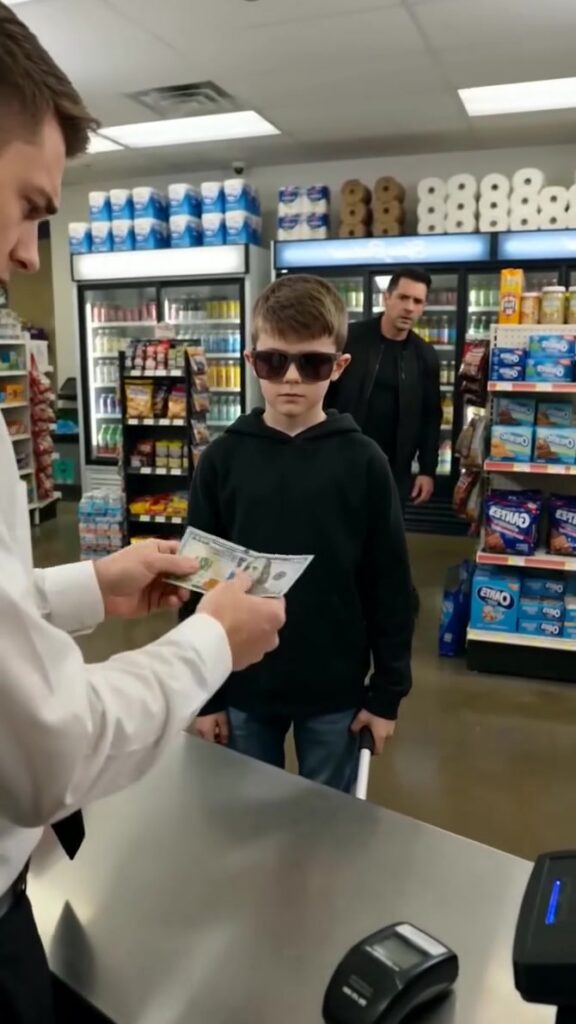
The bell above Darlow’s Corner Market gave a soft, tired jingle, the kind that never startled anyone. It was late afternoon, when the sun angled through the front windows and made the aisles look warmer than they were. A few customers wandered between shelves, half-listening to a radio that hissed more than it sang. Behind the counter, the cashier—Evan Rusk—leaned on his elbows and watched the door like it owed him money.
Then the sound came: a bill slapped down on laminate with a sharp crack, louder than it had any right to be in that quiet room. Conversations broke off. A basket stopped rolling. Someone’s hand hovered mid-reach over a rack of candy bars. Heads turned as if pulled by a string.
A boy stood at the counter, slight, too neat, his dark glasses hiding what his face refused to reveal. A white cane rested against his leg, held with the relaxed certainty of someone who knew exactly where he was. His other hand lay flat on the counter, the $100 bill pinned beneath his palm like a claim. He didn’t fidget. He didn’t look around. His stillness felt like something practiced.
Evan’s mouth curled with a kind of irritation that people mistook for authority. “Hey, kid,” he said, not bothering to lower his voice. “You don’t even know what you’re handing me. You could be buying anything.”
The boy’s chin lifted a fraction, as if following a voice he’d already mapped. “Ring it up,” he said. Quiet, but not timid. The words weren’t a request. They were an instruction delivered without cruelty—almost politely—and that made it worse. Evan grabbed the nearest thing to the register display, a small package of batteries, and swiped it across the scanner. The beep sounded ordinary. Evan’s fingers pressed keys out of habit.
He slid the bill off the counter, and the change in him was instant. His eyes narrowed at the paper’s edge, then flicked to the screen, then back to the bill again, like he’d been offered a photograph of his own face taken from an angle he didn’t recognize. “This is too much,” he muttered, the irritation thinning into something else.
“I’m aware,” the boy replied, as if he’d expected those exact words. His head angled slightly toward the register, not at it—at Evan. “You’ll give me the difference.”
A woman near the aisle with cereal stepped closer, her cart squeaking. A man in a work jacket paused with a soda halfway to his mouth. Evan turned the bill over and over, not because he needed to check it—he’d checked bills a thousand times—but because his hands were trying to find a way to be busy. “Where did you get this?” he asked, softer now. Cautious.
The boy’s fingers drummed once on the counter, a small, measured tap. “My father said you’d recognize it.”
The store seemed to lean in. Even the radio hiss felt quieter, as if the air had tightened around the words. Evan’s throat bobbed. He forced a short laugh that didn’t convince anyone. “Recognize what? It’s a hundred.”
The boy lifted his hand, and the gesture wasn’t searching—it was deliberate, like someone pointing to a door they’d been told was there. His finger aimed straight at Evan’s chest and stayed there. “Not the value,” the boy said. “The scar.”
Evan went pale in a way that had nothing to do with fluorescent lights. His gaze dropped to the bill, and his fingers pinched one corner as though the paper might bite him. He brought it closer to his face, squinting, then squinting harder. At first there was nothing—just the usual fine lines, the familiar portrait, the thread. Then, in the margin near the seal, a tiny indentation caught the light: a shallow groove, more felt than seen, like a fingernail had pressed into the cotton and left a secret. A mark too subtle for a customer, too pointless for a prank.
But Evan knew it. The knowledge struck him with the force of memory. His lips parted. “That’s… that’s impossible.”
The boy didn’t smile. He didn’t need to. “My dad couldn’t see it either,” he said, and the sentence landed like a door closing. “Not at first.”
Evan’s hands began to tremble. Behind him, the store’s security monitor showed grainy black-and-white squares—aisles, door, counter—each one a silent witness. Evan glanced at it the way a person glances at a ledge they’re standing too close to. “Who is your father?” he managed, though his voice sounded like he already knew and was begging the universe to disagree.
The boy’s palm slid forward until it rested on the edge of the counter, close enough that Evan could see the clean nails, the faint scar along one knuckle. “Daniel Hale,” he said.
The name moved through the room like cold water. A few customers blinked as if they’d heard it on the news. Evan’s shoulders stiffened; his eyes darted to the door, then back, calculating distances. Daniel Hale had been the kind of man who walked into places with a notebook and an earnest face, asking questions no one wanted to answer. A man who’d made complaints about missing deposits and cash drawer shortages. A man who’d gone quiet when the police said there wasn’t enough proof.
The boy continued, each word measured. “My father used to fold money with his hands when he thought. He’d crease the corner, smooth it, crease it again.” The boy turned his head as if listening to a sound no one else could hear. “The last night he came home, he sat at the table and said, ‘If anything happens to me, you’ll take this bill to the man who thinks I couldn’t catch him.’ He pressed the edge into my finger so I could feel the notch.”
Evan swallowed hard. “Your dad’s not—”
“He isn’t coming back,” the boy said. The bluntness of it stole the breath from the store. “He left for a meeting he said was ‘just to scare a thief’ and never returned. The police called it a disappearance. My mother calls it a hole in the world.” The boy’s hand tightened on the cane. “I call it a debt.”
The work-jacket man stepped up beside the counter, uncertainty and suspicion fighting on his face. “Kid,” he said, “what are you doing?”
The boy didn’t turn toward him. “Listening,” he answered. “My dad told me voices carry more truth than eyes. Eyes can be fooled. People can smile and mean harm. But a throat knows when it’s lying.” He faced Evan again, the dark glasses reflecting the counter’s clutter like twin coins. “And you,” he said softly, “sound like someone who has practiced saying ‘I don’t know’ in front of mirrors.”
Evan’s jaw clenched. He slid the bill beneath the counter like he could hide it from the room, from the cameras, from history. But the movement only made people lean closer. The woman with the cart brought a hand to her mouth. Someone near the door quietly pulled out a phone. Evan’s eyes flashed to it, then to the boy, then to the security monitor.
The boy reached into his jacket and placed something on the counter. Not a weapon. Not money. A small digital recorder, the kind reporters used. His fingers found the button without searching. The red light bloomed. “I’m not here to buy batteries,” he said. “I’m here to ask you one question while the store records you from three angles.”
Evan’s face twitched. “Turn that off.”
“Did you take the night deposit bag from the office,” the boy asked, “or did you only arrange for someone else to do it?”
Silence thickened until it felt like pressure. Evan’s hands hovered over the register keys, unsure what to press to make this stop. He licked his lips, and the sound was loud in the quiet. The boy waited, unmoving, as if he had all the time in the world and Evan had none. In that pause, the whole store could hear Evan’s breathing—quick, uneven, the breath of a man running while standing still.
At last Evan whispered, “You can’t even see me.”
The boy’s head tilted, and for the first time something like grief crossed his face—brief, controlled, devastating. “I don’t have to,” he said. “I know exactly who you are.”
Outside, a siren rose and fell in the distance, growing nearer, as if someone had already decided how this scene would end. Evan’s eyes widened at the sound, and the color drained from his cheeks again. The boy’s hand stayed on the recorder, steady as stone, while the red light blinked on, patient and unforgiving.
When Evan finally spoke, it wasn’t denial. It was a name, then another, then a shaky explanation that stumbled into confession. And in the moment the truth came out, the store exhaled as one body—too late to save a missing man, but just in time to make sure he hadn’t vanished without leaving a mark behind.