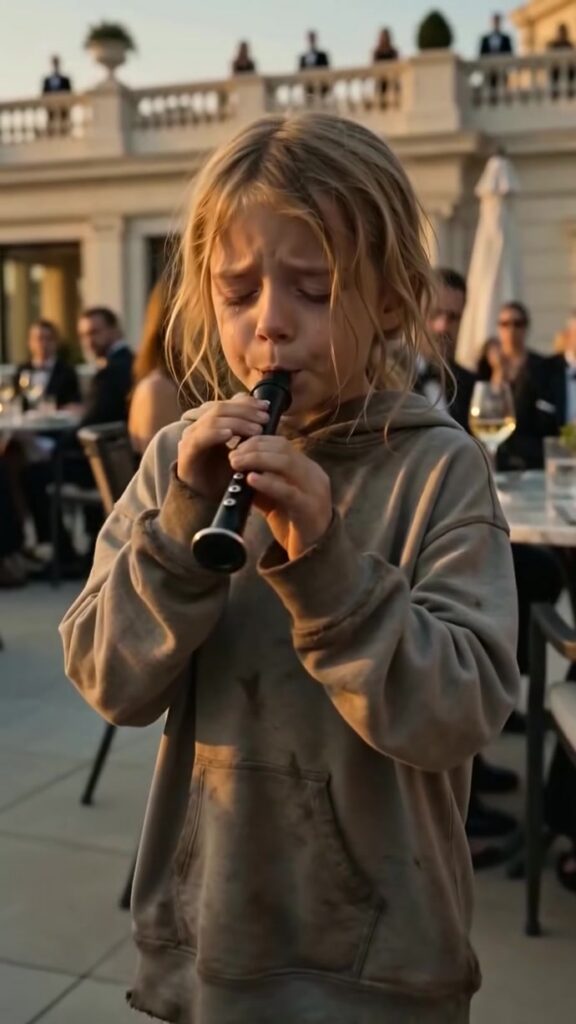
The terrace of Le Cygne Blanc hovered above the river like a polished ship, all linen and crystal, its candles sheltered by glass chimneys. The city’s evening traffic sounded distant from up here, softened by money and music and the steady murmur of people who had never had to count coins twice. Waiters moved like dancers between tables, bearing plates arranged as carefully as jewelry.
At the edge of the terrace, where a brass railing marked the boundary between luxury and street, a child appeared as if the night had pushed her forward. She was too thin for her coat, which had once been bright but now wore the color of dust. A strand of hair clung to her cheek. Her hands shook in front of her chest, not from cold alone. In one fist she held a small flute—wood, cracked and bound at two places with twine.
She stepped onto the tiles, eyes darting from table to table like a hunted animal searching for a gap in the fence. “Please,” she said, voice rough and too small for the room it landed in. “I… I just need something to eat.”
Conversation thinned. Forks paused midair. A laugh began at one table and died in a cough. Heads turned—slowly, with the careful distaste people reserve for stains on silk. The maître d’ started forward, already wearing the look that meant the child would be escorted out quietly, as if her presence might infect the view.
Before he reached her, a man near the center raised his hand and leaned back in his chair. His suit was charcoal, his watch face large enough to be a small mirror. He wore his smile like a hooked fish, shiny and cruel. “Don’t hurry,” he said, loud enough for the terrace to hear. “Let’s see what she’s doing here.”
The child’s shoulders rose toward her ears. Her gaze caught on the baskets of bread, the plates with sauces that gleamed under candlelight. Saliva flashed on her lower lip and disappeared.
“If you want money,” the man continued, tilting his chin toward the flute, “give us a reason. Impress us.”
Someone snorted. Someone else pulled out a phone and angled it toward her, ready for a clip to share. A woman in pearls frowned, torn between pity and the fear of being implicated in it.
The girl froze. For one breath it looked as if she might bolt—back through the glass doors, down the polished stairs, into the city where she could disappear among other invisible people. Her fingers tightened on the flute until her knuckles whitened. Then she swallowed, lifted it to her lips, and closed her eyes as if bracing against a blow.
The first note came out thin, the way a match flares before it catches. The second wavered. The flute was old and imperfect; the sound carried the rasp of its wounds. A few listeners leaned closer, waiting for the moment to laugh.
Then the melody found its path.
It was not the kind of tune piped in as background—no bright, forgettable charm. It moved like a hand across water, slow and deliberate, stirring a memory in everyone who heard it. The line rose with an ache that seemed too large for a child’s lungs, then fell into a hush that made the terrace feel suddenly hollow. Even the river below, unseen in the dark, seemed to pause.
Phones lowered without anyone deciding to lower them. Wine glasses stayed suspended in midair. The man with the watch stopped smiling; his mouth hung slightly open, caught off guard by something he couldn’t buy or control.
The girl played as if she had nothing left to bargain with except this. Tears slipped down her cheeks and shone in the candlelight, but the notes didn’t break. They grew steadier, stronger, until the cracked flute sounded whole. A wind brushed through the terrace, and for an instant the flames inside the glass chimneys leaned toward her like they were listening too.
At a table near the railing, a woman who had been staring into her drink slowly stood. She was dressed in black, not the fashionable kind but the kind that looked like a decision. Her hair was pinned with strict care. She held one hand against the back of a chair as if the floor had shifted under her.
Her eyes were fixed on the child with a fear so sharp it looked like anger. Her lips parted, and no sound came out at first. Then, in a voice she seemed to pull from somewhere deep and guarded, she whispered, “That melody…”
The girl reached the last phrase, a turn of notes that landed like a name spoken in the dark. The woman’s fingers began to tremble. On her wrist, a small scar caught the light, pale against her skin, as if it had been waiting to be seen.
The final note hung for a heartbeat and dissolved. The terrace remained frozen. The city seemed far away. The girl lowered the flute carefully, as though she had just set down something fragile and alive.
She opened her eyes. They were the color of stormwater. She looked at the faces staring back at her—faces that had been amused, annoyed, indifferent. Now they looked like people waking up in a strange house.
“My mom,” the girl said, and her voice was barely louder than the river. “She taught me that. She said it was for when you’re lost.”
The woman in black took one step forward. Her chair scraped the tiles, loud in the silence. “Who is your mother?” she asked, but the question came out as if it hurt her throat.
The child’s gaze drifted down to the flute, to the twine binding its crack, to the worn finger holes. “Her name was Anna,” she said, and the word sounded like something she had carried in her mouth for too long. “Anna Marek.”
The woman’s face went white so quickly it looked like the blood had been drained by the name. Her glass slipped from her hand. It struck the tile and shattered into a small constellation of shards. No one moved to clean it.
“That’s impossible,” the woman breathed. She lifted her hand as if to touch the child from a distance, then stopped herself, fingers hovering in empty air. Her eyes flicked to the girl’s left wrist, to a faint mark there—an old burn in the shape of a crescent, half hidden by the frayed sleeve.
The girl noticed the look and instinctively pulled her arm back. In that small gesture was a lifetime of flinching.
The man with the watch cleared his throat, trying to reclaim the room. “What is this?” he said, his voice suddenly too loud. “A performance? Some trick?”
The woman in black didn’t even glance at him. Her gaze stayed locked on the child as if letting it go would make her vanish. “Where did you get that flute?” she asked. “Tell me.”
The girl’s mouth tightened. “It’s mine,” she said, then after a pause, softer, “It was hers. I kept it.”
The woman’s knees seemed to weaken. She gripped the back of the chair harder, and for a second her composure—her practiced elegance—cracked like the glass on the floor. “Anna used to play that for my daughter,” she whispered, the confession spilling out before she could stop it. “Before… before the fire.”
A ripple passed through the terrace. The word fire landed with weight. Waiters, diners, strangers—all of them suddenly held inside a story they hadn’t agreed to join.
The girl blinked, as if trying to understand a language she didn’t know. “My mom said there was a woman who promised to come back,” she said. “She said not everyone forgets.”
The woman’s throat worked. Her eyes shone, not with delicate tears but with something raw. “What is your name?” she asked.
The child hesitated, then answered as if saying it might change the air around her. “Lina.”
The woman’s breath left her in a sound that was almost a sob. Her hand, still trembling, rose to her mouth. “Lina,” she repeated, and the name didn’t sound like a stranger’s. It sounded like a door unlocking.
On the terrace, candles burned steadily again. Somewhere below, a horn blared in traffic. Yet no one moved to return to their meals. The little girl stood barefoot on the edge of a world that had rejected her, flute in hand, while the woman in black stared as if she had just seen a ghost step into the light.
And in the silence that followed, the question became impossible to ignore: if Anna was gone, and Lina was here, then what, exactly, had happened the night everyone insisted was finished?