The royal ballroom was built to make ordinary people feel small. Its ceiling disappeared into painted clouds. Its chandeliers burned with a cold, steady brilliance that made every jewel on every throat look like a star caught and pinned. Beneath the light, the world moved in perfect circles—waltzing pairs, practiced laughter, polished smiles that never widened too far. Everything here was arranged. Everything had a place.
At the far end, a grand piano waited like a black animal asleep. It was not there for music, not truly. It was there the way the gilded mirrors were there—an heirloom, a symbol, a piece of history that looked expensive enough to be unquestioned. The hired quartet played, delicate as lace, while guests discussed investments, horse bloodlines, and whose family had been invited to which hunt.
When the first glass fell, it sounded like a gunshot disguised as crystal. Conversation cracked apart. A woman shrieked in outrage more than fear, and heads turned as one.
Near the piano stood a little girl.
She could not have been more than eight. Her dress was the kind you might find on a clearance rack and mend twice, its hem uneven as if someone had tried to make it longer and failed. Her shoes were scuffed to gray, the soles bending too easily. Dark hair, hastily braided, hung down her back. One hand still held the stem of the shattered glass, as if she had picked it up without realizing it cut her palm.
“Who let her in?” a man demanded, loud enough to be heard over the fading music. “This is a private event.”
Snickers followed. Someone muttered a joke about street performers. Another voice, sharper, called for security as if the child were a stain.
The girl didn’t shrink. That, more than the ruined glass, was what unsettled them. She looked around the room with an expression too steady for someone who should have been intimidated. Her eyes didn’t dart toward the doors, didn’t search for an adult to claim her. They went straight to the piano, and then—strangely—to the dais where the prince stood with his attendants.
Prince Julian was not tall enough to tower over a ballroom, but he carried the kind of quiet authority that made the air feel regulated. He had spent the evening smiling in measured degrees, shaking hands, remembering names, offering condolences for tragedies he’d only read about in briefing papers. Now his smile was gone. His gaze fixed on the girl with something like calculation, then softened into something harder to name.
A guard moved toward her, hand already half-raised. “Come along. You’re lost.”
“No.” The girl’s voice was not loud. It simply arrived in the center of the room as if placed there. “I’m not lost.”
The guard blinked, and the guests laughed again—until the girl added, very calmly, “May I play?”
That was when Julian stepped off the dais.
It wasn’t dramatic in the way stories liked, with sweeping capes and gasps. It was dramatic because it was small: one foot descending, then the next, his movements contained, his eyes never leaving her face. Around him, conversations faltered. The quartet stopped, uncertain. Even the guard hesitated when the prince’s hand lifted—barely a gesture, but unmistakable.
“Wait,” Julian said.
It was only a word, yet it tightened the room. The guard stopped as if caught by a leash. The laughter expired mid-breath. The girl’s shoulders didn’t change. She simply turned and walked to the piano.
She climbed onto the bench with awkward determination. Her legs dangled. Her feet did not touch the pedals. For a second, she sat very still, hands hovering above the keys, fingers trembling as if they carried their own weather. The silence became a kind of pressure. Guests leaned in without meaning to. A woman at the back whispered, “This is going to be embarrassing.”
Then the girl pressed one key.
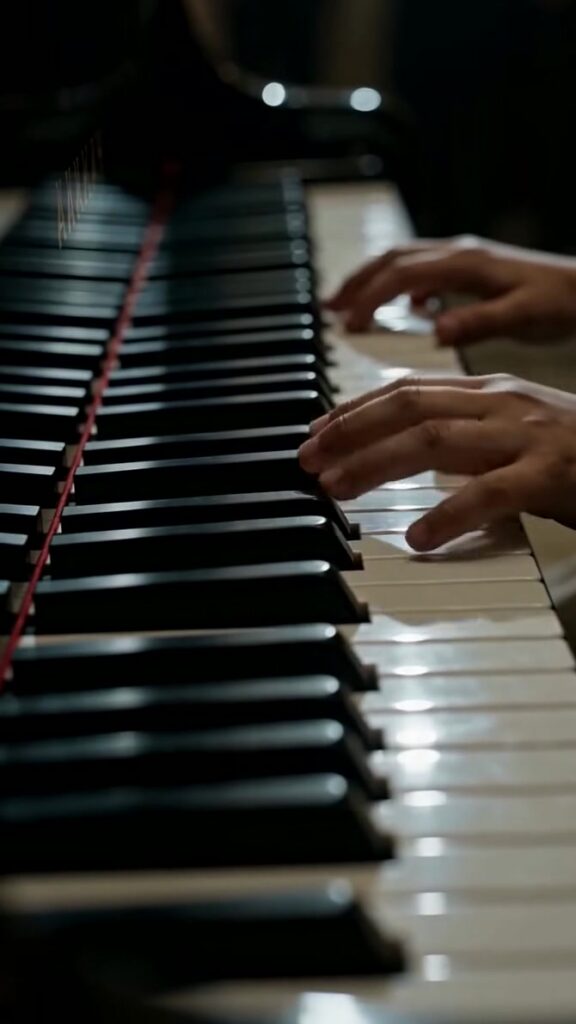
The note was pure. Not loud, not showy—just correct in a way that made the room’s polished surfaces feel suddenly fragile. She followed it with another, and another, and soon the sound took shape into a melody that did not belong to the repertoire of charity galas or palace receptions. It was not the sort of music meant to flatter the wealthy. It was the kind of music that remembered you when you tried to forget yourself.
Her hands moved with certainty that defied her smallness. She couldn’t reach the pedals, so she compensated with touch—softening where a pedal would have blurred, striking harder where a pedal would have swelled. The tune wandered through sorrow and returned, again and again, to a simple motif that felt like a name being called across water.
Faces changed. People who had been amused became uncomfortable, then quiet, then—unwillingly—attentive. A man lowered his phone as if ashamed to record it. A woman pressed her fingers to her mouth, eyes shining, though she couldn’t have explained why. Even the guard, trained to watch threats, stood frozen as if listening for an order he did not want to receive.
Julian moved closer, step by step, as if the music had a gravitational pull. The closer he came, the more his composure fell away. His jaw tightened. His eyes, usually controlled and distant, looked wet in the chandelier light. When the girl reached a certain sequence—three descending notes, then a leap upward—Julian stopped breathing.
It was a lullaby.
No, not merely a lullaby. A private one. A melody his mother had sung behind closed doors when the palace was still full of her voice and not just her portraits. A tune no one outside their family should have known. A tune that had died with her in a winter storm sixteen years ago, when the carriage slid off the mountain road and the kingdom learned what grief did to a crown.
The girl played the last note and let it fall into the marble like a droplet of ink. The silence afterward was not applause waiting to happen. It was something heavier—a shared sense that a door had opened somewhere and none of them knew what stood behind it.
Julian sank to one knee beside the bench, as if his body had decided for him. Up close, he could see the blood on her palm from the broken glass, a thin red line she seemed not to feel. He looked at her hands as if they were evidence, then at her face.
“Who taught you that?” he asked. His voice didn’t carry the polished authority of earlier. It sounded torn.
The girl met his gaze without flinching. Her eyes were dark and steady, too old and too present. “No one taught me,” she said. “I remembered.”
Julian’s throat worked. “From where?”
She glanced toward the tallest mirror, where the chandelier’s light fractured into a thousand smaller flames. In that mirror, Julian saw himself kneeling, the girl sitting straight, the guests crowded behind like witnesses. And for a heartbeat, the mirror showed something else—another child’s silhouette beside Julian’s, a little girl with a ribbon in her hair, standing where no one stood.
Julian’s hand rose, trembling, to touch the girl’s cheek. “What is your name?”
“It used to be Elara,” she said softly, as if saying it might break something. “Before the river. Before the storm. Before you stopped calling.”
The room reeled. The chandeliers seemed to dim, or perhaps everyone’s eyes had changed. Somewhere a guest whispered, “That was the princess’s name,” and the words moved like a chill through silk and stone.
Julian’s face drained of color. He stared at the girl as if she were both impossible and inevitable, like a ghost wearing flesh.
Behind them, a court official finally found his voice. “Your Highness, step away—this could be a deception.”
Julian didn’t look back. His hand closed gently around the girl’s bleeding palm. “Where did you come from?” he asked, and there was a plea in it that no one had ever heard from him in public.
The girl’s lips parted. Her eyes flicked toward the tall doors, toward the shadows beyond the bright circle of the ballroom. “Someone brought me,” she began.
And then every candle in the ballroom died at once.
Darkness crashed down like a curtain. Someone screamed. Bodies shifted, chairs scraped. In the sudden black, the piano’s glossy shape vanished, and Julian felt, with horrifying clarity, the small hand in his go slack—pulled away by a force he couldn’t see.
“Elara!” he shouted into the dark.
No answer came—only the faint echo of a melody that seemed to retreat down a corridor that had not existed a moment before.
When the lights sputtered back to life, the bench was empty. The broken glass still glittered on the floor. A thin smear of blood marked the piano’s edge like a signature.
Julian remained on one knee, staring at nothing, while the ballroom’s perfect world—so refined, so controlled, so untouchable—began to fracture around him.