The last fuel light blinked like a warning meant for someone else. Weston had been driving for hours through flatland that looked copied and pasted—fence, scrub, fence, scrub—until even the stars seemed bored. When the highway finally offered a sign for gas, it felt less like relief and more like an ambush.
The station appeared in a low dip of the road, a single island of fluorescent glare floating in a black ocean. Two pumps. A dark office with a soda sign buzzing in the window. A half-lit ice machine that looked like it had been punched once and never recovered.
Weston rolled in, tires whispering over gravel. He killed the engine and stepped into a cold that cut through his jacket as if it were paper. The wind carried the smell of dry grass and old diesel. Above him, the lights flickered with an irregular heartbeat.
He slid his card into the reader. The screen lagged, thought about it, then approved with a reluctant beep. The pump clanked into place, and the numbers began their slow, steady climb. He watched them the way you watch a clock at two in the morning—hoping time would hurry, knowing it wouldn’t.
Somewhere down the highway, a truck groaned, then faded. The rest of the world stayed still.
Weston was checking his phone for signal—one bar, then none—when the voice hit the air like a thrown stone.
“Please… don’t go!”
It came from beyond the reach of the lights, from the edge where the concrete surrendered to weeds and night. Too close. Too urgent. Weston’s hand tightened around the nozzle. The pump clicked, finished, and the sudden silence felt like a door slamming shut.
He turned slowly, eyes straining into the dark. “Hello?”
A shape moved, small and uneven, like a deer stepping into a clearing. Then she crossed into the harsh light.
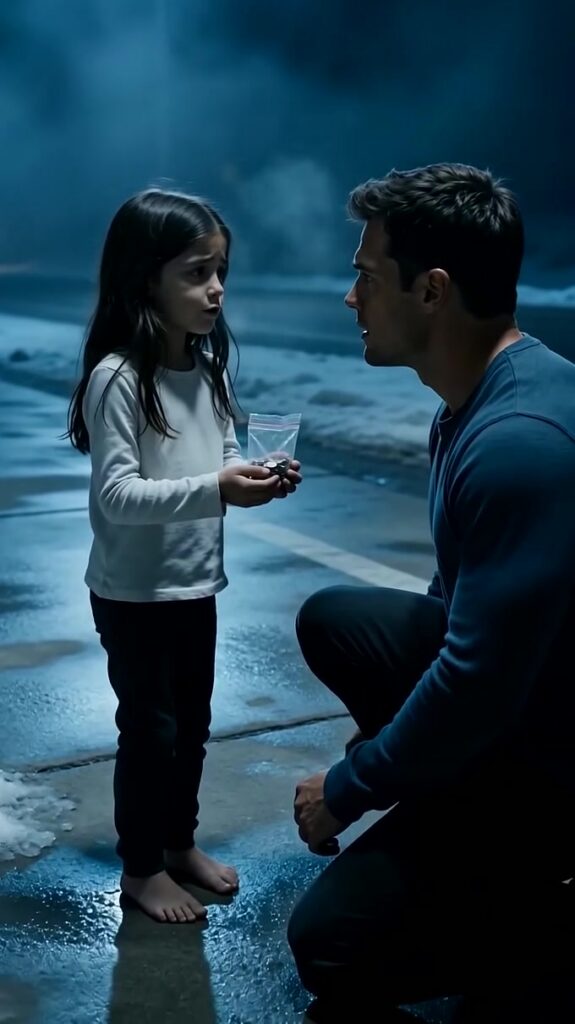
A girl—maybe nine, maybe ten—barefoot on the freezing concrete. Her hair hung in tangled ropes around her face. She held a thin plastic bag by the handles, and when she lifted it, coins chimed softly, an embarrassed little sound.
Weston didn’t rush her. He lowered himself into a crouch, making his body smaller, his voice gentler. “Hey. You’re okay. What’s your name?”
Her lips parted, but no name came. She stared at him as if measuring whether he was real. Finally she whispered, “Can you… can you help me buy milk? For my baby brother.”
The words should have been simple. They weren’t. They carried the weight of a decision she had been forced to make alone.
Weston’s throat tightened. “Where are you staying? Is someone with you?”
Her eyes flicked past him—toward the office window, toward the darkness behind the pumps—then dropped to the coins as if the metal could answer. “They’re in the car.”
“Your parents?”
She nodded once, quickly, like it hurt. Her shoulders folded inward. “They won’t wake up.”
The wind surged, and the fluorescent lights sputtered overhead, throwing the station into brief, stuttering shadow. Weston felt his own heartbeat suddenly loud. He rose, slow, careful. “Show me. Okay? I’m going with you.”
The girl backed away one step, then turned and led him along the side of the building, into a strip of darkness where the lights couldn’t quite reach. Weston’s eyes adjusted, and the world narrowed to her pale feet on gravel, the soft rattle of the coin bag, the whistle of the wind through a bent road sign.
A sedan sat behind the station, parked crooked as if it had rolled there and stopped when it ran out of will. Its windows were fogged from the inside. The engine was off, but the air around it smelled faintly sweet, like exhaust that had clung and settled.
The girl pointed at the back seat. “He’s there. He’s hungry. He keeps crying.”
Weston reached the door handle and felt the cold burn his skin. He pulled. Locked.
“Keys?” he asked.
She shook her head, panic flashing. “Mom has them.”
Weston peered through the fogged glass. Two figures sat in the front, heads lolling. Not asleep in any normal way. Their mouths hung open, their skin gray under the dim spill of light. In the back, a bundled shape shifted, a thin, reedy sound leaking out—an infant’s exhausted wail.
Weston’s mind sprinted. No service. No nearby homes. No other cars. The station office. The attendant.
He looked back toward the building. Through the glass, a man stood behind the counter, watching. He hadn’t been there a minute ago. Or maybe he had, and Weston hadn’t wanted to notice. The man’s face was a pale oval in the buzzing light, his eyes fixed on the girl.
Weston lifted a hand and waved, sharp and urgent—an unspoken call for help. The attendant didn’t move. He simply turned, as if he hadn’t seen anything, and disappeared deeper into the office.
Cold fear crept up Weston’s spine, slow and deliberate. He leaned toward the girl. “Stay right beside me,” he murmured. “Don’t run. Don’t go back to the road.”
He tried the front door. Locked. He circled the car, looking for any crack, any opening. The baby’s cry hitched, thinner, like a flame running out of air.
Weston grabbed a tire iron from the bed of his truck—he kept one for emergencies and never thought he’d meet an emergency that looked like this. He slid it under the edge of the rear window, hesitated only a second—then struck.
Glass spiderwebbed and collapsed inward with a brittle shatter. The baby startled and cried louder. Weston shoved his arm through, careful of the jagged edges, and unlocked the door.
Heat and stale air poured out. The baby’s face was red, damp. Weston unbuckled the child with hands that felt too big, too clumsy. He lifted the bundle into his arms. The infant’s crying softened to a whimper, as if even his fear was tired.
“Mom,” the girl whispered, reaching toward the front seat. Her fingertips brushed the woman’s shoulder. No response.
Weston checked for breathing—shallow, there, but wrong. His pulse hammered. “We need help now,” he said, and he said it like saying it could make it true.
He carried the baby toward the station, the girl glued to his side. The office door was locked when he tried it. He pounded on the glass. “Hey! Open up! Call an ambulance!”
Behind the counter, the attendant reappeared with a phone in his hand. Not dialing. Just holding it like a prop. He stared at Weston, then at the girl, and a thin smile pulled at his mouth.
Weston’s skin went cold in a different way. The man lifted his free hand and pointed, not at Weston, but behind him—toward the lot.
A second vehicle had rolled in without headlights. It stopped near the pumps. The driver’s door opened, and a shape climbed out, broad-shouldered, moving with the lazy certainty of someone arriving exactly where he expected to be.
The girl’s breath caught. She pressed into Weston’s coat. “That’s… that’s the man from earlier,” she whispered. “He told Mom to park behind.”
Weston’s mind snapped into a clean, terrifying line: this station wasn’t an accident. The empty highway wasn’t empty by chance. The parents in the car weren’t a tragedy waiting to be discovered—they were a problem waiting to be finished.
Weston backed away from the office door, baby clutched to his chest, and moved toward the pumps where the bright lights made hiding harder. He reached for his truck keys, then stopped—realizing the girl was shivering so violently her teeth clicked.
“In my truck,” he told her. “Get in. Lock the doors.”
She ran, small feet slapping the pavement, and scrambled into the passenger seat. Weston slid the baby in after her, buckled him into her arms like a fragile treasure, then slammed the door. The locks clicked.
The broad-shouldered man started across the lot. The attendant stepped out of the office, a shotgun cradled in his hands as if he’d been holding it all night.
Weston’s thoughts narrowed to a single, ugly fact: he had no signal, no witnesses, and no time. He grabbed the pump nozzle, yanked it free from its cradle, and squeezed. Gasoline splashed onto the concrete in a dark, spreading fan.
Both men paused, surprised.
Weston snatched the emergency flare from his truck’s roadside kit—something he’d bought after a winter breakdown and laughed about later. His fingers shook as he struck it. The flare flared to life with a violent red hiss, lighting his hands blood-bright.
He held it out over the gasoline, eyes locked on the men. “Back up,” he said, voice steady in a way his body wasn’t. “I will drop this.”
The broad-shouldered man’s smile vanished. The attendant’s shotgun dipped an inch, uncertainty creeping into his posture like rust. Fire was a language they understood.
For a heartbeat, everything froze: the hiss of the flare, the wind tugging at Weston’s hair, the girl watching through the truck window with wide, wet eyes.
Then, from far off, a new sound threaded through the night—thin at first, then rising. Sirens.
The attendant’s head snapped toward the highway. His face hardened. He lifted the shotgun again, but the sirens grew louder, multiplying, as if the empty road had suddenly decided to fill itself with consequence.
Weston didn’t have service, but he hadn’t been helpless. While the men had watched the girl, he’d hit the truck’s old CB radio and broadcasted on the only channel he remembered—an open call, frantic and broken, hoping a trucker would hear. Someone had.
The broad-shouldered man swore and retreated toward the dark vehicle. The attendant hesitated, eyes darting between Weston’s flare and the approaching lights, then he followed, shotgun tucked close, confidence leaking away.
Weston kept the flare raised until their car vanished into the night without headlights, swallowed whole by the same darkness that had delivered them.
When the first patrol car screamed into the lot, Weston’s knees finally went weak. He lowered the flare to the concrete, where it hissed and died in a puddle of red ash. He walked to his truck and opened the passenger door.
The girl was holding the baby as if she’d been born knowing how. Her face was streaked with tears that had dried into salt lines.
Weston crouched beside her. “You did the right thing,” he said softly. “You saved him. You saved yourself.”
She stared past him at the station, at the flickering lights, at the officers spilling out with flashlights and urgency. “Are they going to wake up?” she asked.
Weston glanced toward the sedan behind the building, toward the fogged windows and the unmoving shapes inside, and his chest tightened with the cruel honesty of not knowing. “They’re going to get help,” he said, choosing the only promise he could keep. “And you’re not alone anymore.”
Dawn came slowly, a thin gray seam on the horizon that widened with every minute. In the growing light, the gas station looked less like a trap and more like what it had always been: a lonely place people passed through, never expecting the night to remember them.
Weston watched the girl as an EMT wrapped a blanket around her shoulders. She didn’t look at the station again. She kept her eyes on the baby, on his small mouth searching for comfort, on the life that was still warm in her arms.
And in the middle of nowhere, beneath lights that continued to flicker like an unsteady heart, one desperate voice in the dark had rerouted everything that would come next.