At first, he was just annoyed.
The day had already ground his nerves down to powder. The elevator in the courthouse annex had stalled between floors for ten minutes, a client had yelled into his ear about a filing error that wasn’t his, and the city’s late-summer heat had risen from the sidewalk like something alive. By the time Adrian Kells reached the narrow park that cut behind the building, he wanted nothing more than to cross it, get to his car, and disappear into air-conditioning.
Instead, a ball rolled into his path.
It was a small thing—leather, scuffed, stitched unevenly like it had been repaired by someone who loved it too much to throw it away. It bumped his shoe and stopped. Adrian paused, the reflex of annoyance sharpening into something bordering on anger. He glanced around for the child who’d kicked it. There were children everywhere in the park, a chaotic constellation of scooters and chalk drawings and shrieks. He could already see the complaint forming in his head: Watch where you’re going. Keep your things to yourself.
A boy stood several yards away near a bench, hands at his sides, not calling out, not running up to apologize. He just looked at Adrian as if he’d been waiting for the moment the ball met the toe of Adrian’s shoe.
“Yours?” Adrian called, because being irritated didn’t absolve him of being an adult.
The boy didn’t nod, didn’t shake his head. He remained perfectly still. His gaze was steady, too steady for a child. Adrian sighed, bent down, and picked up the ball to toss it back.
It felt heavier than it should have.
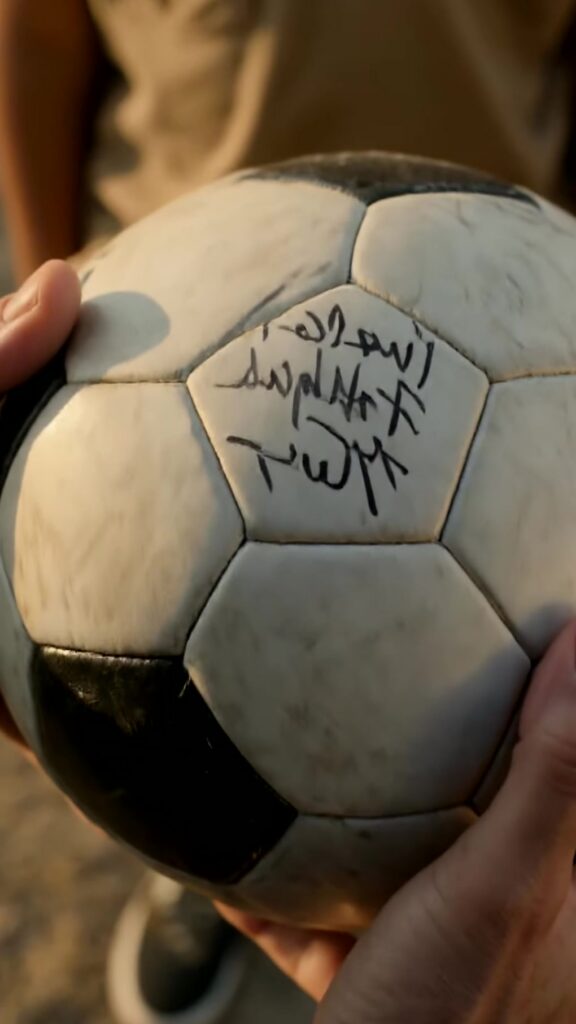
His thumb brushed something raised under the grime—letters, pressed into the leather. Adrian hesitated. A childish name, maybe. A phone number in case it got lost. People wrote those things on everything now.
But he didn’t toss it.
Something—some old habit he didn’t know he still had—made him turn it over in his hands until he found the writing, half-hidden along one seam. The letters were worn but legible. Not inked with marker. Burned in, as if someone had used heat to tattoo the message into the hide.
Adrian read it once and felt the park tilt.
It wasn’t a name. It wasn’t a phone number. It was a sentence he hadn’t seen in seventeen years, a sentence that should have existed only in a rotted notebook at the bottom of a river.
IF YOU SEE THIS, COME BACK.
His breath snagged. The courthouse noise dulled, the children’s cries blurred into distant static. Adrian stared at the words as if the leather might dissolve under his eyes and reveal something worse. His fingers tightened unconsciously, knuckles whitening. “No,” he whispered, and then, because the universe enjoyed cruelty, he added, “Not now.”
The boy watched him calmly. Not the curious stare of a child watching a grown-up get weird over a toy, but the patient attention of someone observing a reaction they’d predicted.
“You recognize it,” the boy said, voice carrying without effort. “Don’t you?”
Adrian’s throat worked, but no answer came. There was nothing to say that wouldn’t open the door he’d spent years barricading. His silence stretched, loud as a siren. The boy’s expression didn’t change; he let the silence speak for him.
“My mom said,” the boy went on, “if you ever saw it, you’d understand.”
Adrian’s eyes snapped up, anger flaring to cover fear. “Understand what?” he demanded. “What is this? Who are you? Where did you get this ball?”
For the first time, the boy shifted. He stepped closer across the grass, slow and deliberate. Up close he looked about nine, maybe ten—too thin at the wrists, hair cut in uneven lines like someone had done it themselves. His eyes were dark, reflecting the bright day without accepting any of it.
“I didn’t get it,” the boy said. “I brought it.”
“From where?” Adrian asked, sharper than he intended. His grip on the ball tightened, as if he could crush the message out of it.
The boy kept coming until he was within arm’s length. Adrian could see faint freckles on his nose, a small healed split on his bottom lip. Details that made him real, ordinary—details that made what was happening impossible.
Then the boy leaned in, very close, as if about to share a secret meant for only one ear.
He whispered a handful of words.
They were quiet, swallowed by the sounds of the park, but they hit Adrian like a blow to the sternum. Adrian stepped back instinctively, the air leaving his lungs in one stunned exhale. His heel caught on the edge of a path, and for a heartbeat he almost fell. The ball wobbled in his hand.
Because no one alive should have known that phrase.
Not the private password Adrian and Mara had made up as children, the ridiculous code they’d sworn would mean you can trust me when everything else felt unsafe. Not the words they’d murmured into each other’s hair in the old storm drain under Rivergate Bridge the night they’d made a promise to run away together, the night Adrian had told himself it was still a game.
He stared at the boy with a dawning horror that felt like grief waking up from anesthesia.
“Who are you?” Adrian asked again, but his voice had broken around the edges.
The boy took a step back, giving him space as if that was part of the ritual too. “My name’s Eli,” he said. “Mara was my mom.”
The name—Mara—opened a trapdoor in Adrian’s mind. He saw a girl with scraped knees and fierce eyes, a girl who’d dared him to climb fences and steal peaches and stop being afraid. He saw her standing under sodium lights years later, older but still impossibly bright, her mouth a thin line as she handed him a folded paper at the edge of a parking lot.
I can’t do this alone, Adrian.
He remembered refusing to unfold the paper in front of her. Remembered looking past her shoulder, already choosing a life that felt cleaner, safer. He remembered saying, in a voice he’d rehearsed in advance, “You should talk to someone else.”
He remembered the look on her face—a thing like a door closing softly.
And after that, nothing. He’d made sure of it. Changed numbers. Moved apartments. Built a career on the art of not looking back.
Adrian swallowed, the taste of metal flooding his mouth. “She—” His tongue stumbled over the sentence he didn’t want. “She’s dead?”
Eli’s expression tightened, not into grief but into something like resolve. “She’s gone,” he said. “But she told me where to find you. She told me about the ball. She told me what you’d do when you read it.”
Adrian looked down at the leather again. The burned words seemed to pulse. His hands trembled now, uncontrollable. “This can’t be,” he murmured. “That ball… we—”
“You left it with her,” Eli said, too plainly. “The night at the river. You said you’d come back with a flashlight and a plan. She waited. You didn’t.”
Adrian’s chest constricted. The park was too bright, too public for a confession this old. “I was a kid,” he tried. “I was scared. I thought—”
“She was scared too,” Eli replied, and there was no accusation in it, only fact. “She spent her whole life carrying what you didn’t carry.”
Adrian’s gaze found the boy’s face again. Now, in the curve of Eli’s eyebrows, in the set of his jaw, he could see Mara—her stubbornness, her refusal to bend. It made the years collapse into a single breath.
“Why are you here?” Adrian asked. The question sounded like a plea.
Eli lifted his chin. “Because she said if you ever saw that message, you’d understand what you were supposed to do.”
“And what am I supposed to do?” Adrian asked, voice barely audible.
Eli’s eyes didn’t flicker. “Come back,” he said. “Not to the park. Not to your car. Back to what you promised.”
Adrian’s laugh came out wrong, a cracked sound. “Promised? I promised a million stupid things when I was twelve.”
“She didn’t think it was stupid,” Eli said. “And neither did you. Not that night.”
Adrian looked away, blinking hard. Across the park, a mother called to her daughter. A dog barked. Somewhere, an ice cream truck played a song that sounded too cheerful to belong to this world. Adrian focused on these noises because if he didn’t, he would have to focus on the thing growing in his ribs—guilt, yes, but also fear. Fear that Mara’s story hadn’t ended neatly. Fear that by stepping back into it, he would lose the tidy life he’d stitched together out of legal briefs and controlled distance.
He looked down again and traced the burned letters with a shaking finger. The leather was warm from his hand, as if it were alive.
“She left you something,” Eli said quietly.
Adrian’s head lifted. “What?”
Eli reached into his pocket and pulled out a small, folded scrap of paper, creased so many times it looked like it might fall apart. He didn’t hand it over immediately. He held it between them like a test.
“She said you’d ask,” Eli continued. “She said you’d look like you’re about to run. And she said…” He paused, as if choosing the exact words. “She said if you take this and still walk away, then at least you’ll know you chose it with open eyes.”
Adrian stared at the paper. His pulse hammered behind his ears. “What is it?” he whispered.
“An address,” Eli said. “A storage unit. And a date.”
“A date for what?”
Eli’s fingers tightened on the paper, and for the first time the calm slipped, revealing something raw underneath. “For when everything she warned you about finally caught up,” he said. “For when it would be too late to pretend you didn’t know. She said you’d understand. She said you’d remember what you did in that storm drain. And she said you’d know why you have to go there now.”
Adrian’s legs felt unreliable. The sun seemed suddenly harsh, spotlighting him. “I don’t understand,” he said, but the lie tasted weak.
Eli extended the paper. “Then read it,” he said.
Adrian took it. The boy’s fingers brushed his, cool and dry, and the contact sent a tremor through Adrian’s whole arm. He unfolded the paper carefully, as if it might explode.
The address was on the other side of town, in an industrial strip by the river.
The date was tomorrow.
Adrian’s eyes blurred. He stared until the words swam back into focus. Tomorrow. As if Mara had planned the moment of impact. As if she’d known Adrian would only ever return if the timing cornered him.
He looked up, but Eli was already stepping away. Not running. Not retreating. Simply moving, certain Adrian would follow because the ball in his hand and the paper in his fingers were hooks sunk deep.
“Wait,” Adrian said hoarsely. “Eli—”
The boy stopped and turned. “You’re annoyed,” he said, almost gently, as if naming the first stage of something inevitable. “I get it. But it’s not about your day. It’s about what you left behind.”
Adrian opened his mouth, but no words came. The park felt like the edge of a cliff.
Eli nodded once toward the ball. “Keep it,” he said. “You’ll need it to remember you’re not allowed to lie to yourself anymore.”
Then he walked away through the sunlit chaos, a small figure swallowed by ordinary life. Adrian stood rooted, the scuffed leather heavy in his palm, the burned message biting into his skin.
Tomorrow, the paper promised. The river again. The storage unit. Whatever Mara had sealed away for him like a final argument he couldn’t object to.
Adrian watched until he couldn’t see the boy anymore. Only then did he realize his irritation had vanished completely, burned off by something older and darker.
He closed his hand around the ball as if it were a heart that still beat.
And for the first time in seventeen years, Adrian Kells turned—not toward his car, not toward the courthouse, but toward the river, as if the message on the leather had been written not just to summon him back, but to remind him that running had never erased what he’d done.
It had only postponed the moment he’d have to understand.