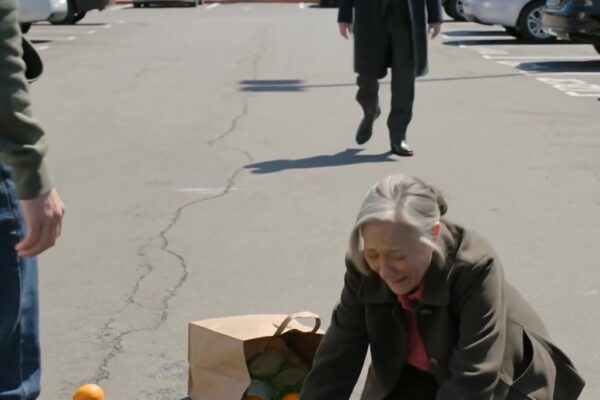
At first, it looked like an accident: a woman crouched at the lip of the shoulder where the asphalt bled into weeds, a bundle clutched to her chest, hair plastered to her cheeks as if she’d been running through rain. The road was empty in both directions, the kind of county two-lane that carried more wind than traffic. Yet she was positioned like a wreck had just happened—staring down the line of pavement, breathing in sharp, controlled pulls, waiting for someone to stop.
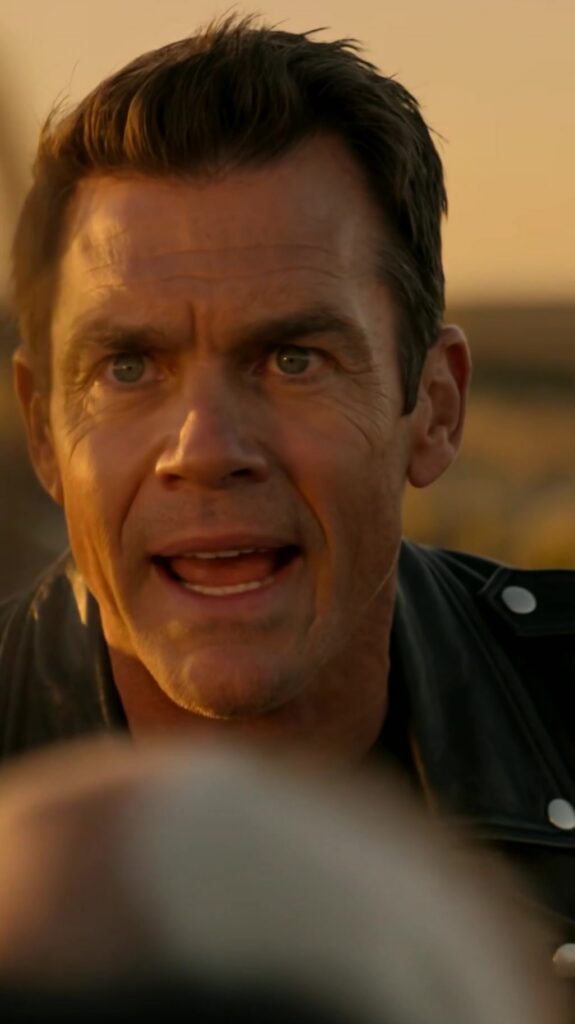
Three motorcycles came over the rise in a staggered formation, engines throaty and impatient. Their headlamps swept across the tall grass and caught her face. The lead rider—Kellan Ward, patched vest, scar at the hinge of his jaw—eased off the throttle first. Habit, he would’ve said later. A woman alone, a night too quiet, the way her arms tightened around what she held. He glanced for skid marks, shattered glass, anything that explained why she was there.
There was nothing. No twisted metal in the ditch, no broken reflector posts, no smell of hot coolant. Just the woman, and the infant swaddled against her like a secret. Kellan rolled to a stop, boots down, engine ticking. His two friends idled behind him, watching the darkness. “You hurt?” he asked, voice rough through his helmet as he flipped the visor up.
Her gaze slid past him to the road behind, then back. She didn’t look injured. She looked prepared. “Not yet,” she said.
The words landed wrong—like a door closing that should have opened. Kellan’s shoulders tightened. “Not yet isn’t an answer,” he said, and heard the edge in his own tone. It had been years since he’d used that edge on anyone who wasn’t wearing a gun.
She shifted, stepping off the gravel and toward the white line. Her boots were clean, which told him she hadn’t crawled from a wreck. Her face was pale under a smear of dirt, and her eyes held the steady, awful calm of someone counting down. “They’ll be here,” she said. “Soon.”
“Who will?” Kellan asked, though the part of him that still listened for danger had already begun to listen harder. The night carried far—he caught a distant hum, more vibration than sound, as if something heavy was riding the road toward them.
She tipped her chin to the baby. “People who believe that child belongs to them.”
Kellan let out a humorless breath. “And you’re saying it doesn’t?” He’d met plenty of drifters and saints and liars in the years he’d been riding. The way she spoke didn’t fit any of them. She wasn’t pleading. She wasn’t bargaining. She was reporting.
Her mouth tightened. “No,” she said, then softened the word as if the truth had edges. “He doesn’t belong to them.”
“Then whose is he?” Kellan asked. Behind him, one of his riders killed his engine, the sudden silence amplifying every insect chirp. The other rider glanced both ways down the road, hand near the holster at his hip.
The woman looked at Kellan like she was choosing where to cut. “Yours,” she said.
For a heartbeat the world held still, as if even the night didn’t know where to put that sentence. Kellan barked out a single laugh, short and cold, the sound men make when they’re cornered with a story too absurd to be dangerous. “That’s not funny,” he said.
“I didn’t tell it to entertain you,” she replied. She adjusted the baby’s blanket, and Kellan noticed how careful her hands were—no tremor, no panic. Just urgency contained. “You’ve spent years convincing yourself you left something behind and it stayed there. It didn’t.”
His laugh died. In its place came an old memory like a bruise pressed too hard: the back room of a bar that called itself a motel, the smell of bleach and cheap perfume; a woman he hadn’t planned to love; the decision he’d made at dawn when the club demanded a choice. He’d told himself that leaving was mercy. That she’d move on. That whatever might have happened after wasn’t his fault because he wasn’t there.
“That was a lifetime ago,” he said, voice low. “And the math doesn’t work.” He stared at the infant, searching for any detail that could unmake her claim. The baby couldn’t be more than a couple of weeks old. Kellan’s chest tightened with anger at the unfairness of it—at the way she’d put a loaded word in his mouth and dared him to swallow it.
“The math you know doesn’t,” she said. “There are other kinds.” She took a step closer. The child’s face turned toward the sound of Kellan’s voice, eyes cloudy with newborn confusion. A tiny hand slipped free of the blanket and reached, fingers opening and closing as if searching for something it had held before.
Kellan didn’t move until the baby’s hand brushed the air near him. Some instinct—something ancient, some reflex of protection he didn’t remember owning—pulled his gloved finger forward. The baby latched onto it with surprising strength, a fierce little grip that made Kellan’s breath catch. It wasn’t recognition, he told himself. Babies grabbed anything. It was physics, not fate. Yet the pull of that small hand felt like a hook sinking into a place he’d kept buried under miles of road.
He drew his hand back slowly. The baby fussed, a sound like a question. “What did you do?” Kellan asked the woman, as if she’d engineered the moment.
Her eyes flashed. “I didn’t do anything,” she said. “I carried him. I ran. I kept him alive long enough to put him in front of you. That’s all.”
The hum in the distance grew louder, resolving into multiple engines—cars, not bikes, moving too fast for a blind county road. Headlights began to flash through the trees like approaching storms. Kellan’s riders stiffened behind him. The woman didn’t flinch. She only tightened her hold and looked at Kellan as if she’d already watched him make this decision in another life.
“You need to tell me what’s going on,” Kellan said. He hated not knowing. He hated that his pulse had changed at the baby’s touch, like his body had been waiting for a command his mind refused to give.
She shook her head once. “If I explain it, you won’t be able to pretend you can walk away,” she said. “You’ll think you have options. You won’t.”
Headlights broke free of the trees and flooded the road, a line of dark vehicles closing the distance with predatory confidence. Kellan could see silhouettes in the windshields, the flash of chrome at the windows. Not lost tourists. Not locals. Men who moved like they had paperwork and guns and permission.
His rider on the right swore under his breath. “Ward—”
Kellan didn’t answer. He looked from the approaching cars to the woman and the infant, and felt something he hadn’t allowed himself in years: responsibility that wasn’t a slogan stitched to leather, but a living weight. He saw, suddenly, how an accident could be staged—how a person could be placed at the roadside like bait, how a lie could be shaped to look like the simplest story in the world. And he understood why the road was empty. It wasn’t chance. It was design.
The woman stepped toward him, pressing the baby into the circle of his arms before he could refuse. The bundle was warm, heavier than Kellan expected, and the infant’s breath tickled his wrist. “They aren’t here for me,” she said. “They’re here for him. For what he represents. For what you represent if you claim him.”
Kellan’s throat went dry. “And if I don’t?” he asked, though even as he spoke the baby quieted against him, as if the world had finally steadied.
“Then they take him,” she said. “And they keep taking until the truth disappears.”
The first car hit the shoulder, gravel spraying. Doors cracked open. Kellan shifted his stance, the baby shielded against his chest, and felt the old violence in his bones wake up—not for vengeance, not for pride, but for something he couldn’t name without admitting she was right. His hands, scarred and capable, tightened carefully around the swaddle.
He glanced at the woman, seeing now the exhaustion beneath her composure. “What’s your name?” he demanded, because names made people real and he needed something real to anchor this to.
“Mara,” she said. “I was there when you chose the road over the door I begged you to walk through.” Her voice didn’t accuse. It simply remembered.
The nearest car door swung wider. A man’s boots hit the ground. “Hand over the child!” someone shouted, amplified by anger and entitlement.
Kellan looked down at the infant—two weeks of fragile life wrapped in cloth, impossibly heavy with consequences. The baby’s fingers flexed against Kellan’s jacket, finding the seam, clinging. The road behind them stretched into darkness, the only exit not yet blocked. Kellan made his decision the way he’d made all the ones that mattered: fast, fully, and knowing what it would cost.
He turned to his riders. “Start the bikes,” he said. Then, to Mara, he added, “Get behind me.”
Her eyes closed for a fraction of a second, like a prayer answered too late. When she opened them, they were fierce. “Now you don’t get to call it an accident,” she said.
Kellan met the oncoming headlights with the baby in his arms and the past rising up like fire. “No,” he murmured. “Now I call it mine.”