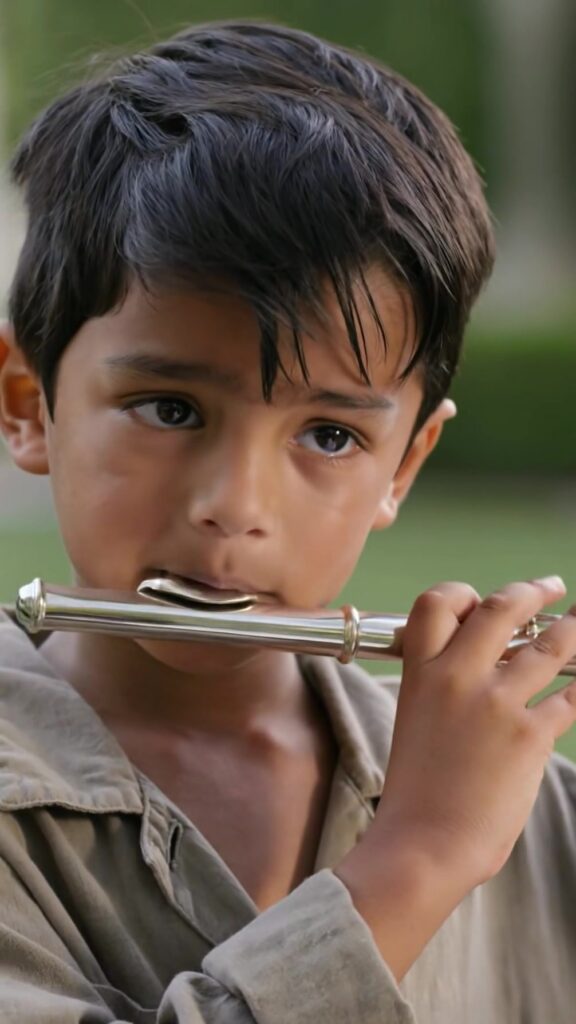
At first, no one noticed him because no one had trained themselves to notice boys like that.
The banquet hall was built to swallow small things. Its ceiling rose like a pale ocean, held up by columns dressed in gold leaf. The chandeliers scattered light across the long tables until every glass looked like it contained a private star. Men in tailored suits leaned into quiet, expensive laughter. Women in silk gowns moved like they had been rehearsed. Somewhere, an unseen quartet played perfect music—clean, obedient notes meant to be heard without being listened to.
So the boy with the flute stood at the edge of all of it and became part of the décor, no more remarkable than a coat rack. He was too thin for his jacket, too young for his solemnity. His shoes were scrubbed but old, their leather gone soft at the toes. He held the flute like it was both a weapon and a prayer.
He waited until the applause faded after a speech. Until the hall’s attention relaxed back into its own comfort. Then he stepped forward.
“Sir… please.” His voice did not carry far, but it was steady, as if he’d practiced saying those words in front of a mirror that never smiled back.
The man at the center table did not look up at first. He was the reason the banquet existed. Everyone in the room arranged themselves around him the way lesser planets arrange themselves around a sun. His cufflinks were small and understated, but his watch was loud with wealth. His hair, silvering at the temples, had never once been allowed to look messy.
When he finally glanced over, his eyes passed across the boy like light over stone. He gave a brief wave, the kind reserved for waiters and troubles that were not worth naming.
“Get him out.”
The request was not angry. That was what made it so efficient. Two men in dark suits shifted from the wall, their steps coordinated, their faces blank with practiced neutrality.
But the boy didn’t retreat. He didn’t even flinch as they approached. He held his ground, just beyond the reach of their hands, and in that small stubbornness, the room tilted.
“My mom is sick,” he said. “She can’t stand up anymore.”
One of the security men slowed, a flicker of hesitation crossing his mouth. Not sympathy—uncertainty. This was not in the program.
More heads turned. A ripple of attention moved through the hall. The quartet’s playing thinned, as if the musicians were listening through their bows. People weren’t watching openly, not yet. They watched the way polite society watches disasters: quietly, as if looking too directly might invite it to happen to them.
The man at the center table exhaled, long and controlled. The slightest irritation pinched the skin between his brows. Not at the boy’s words—at the inconvenience of being made a spectacle in his own room.
“You came to beg?” he asked. “There are offices for charity.”
The boy swallowed, and for a moment his composure trembled. Then it returned, tighter than before.
“Not charity,” he said. “Just… a minute.”
The man’s gaze dropped to the flute. It was nicked near the mouthpiece, its metal dulled as if it had been gripped too often by sweaty hands. It didn’t belong among crystal glasses and linen napkins.
“Play something,” the man said at last, as if granting entertainment could replace granting mercy. His tone made it a simple challenge, a quick way to end the discomfort. “Then you can go.”
The boy nodded. He did not smile in gratitude. He lifted the flute with care, lining it with his mouth as if he were aligning himself with something invisible. He took a breath.
The first notes came out soft and slightly uneven, a melody that wavered like a flame fighting drafts. It wasn’t the sweeping bravura expected in rooms like this. It sounded almost childish. Someone near the back gave a brief, dismissive cough.
Then—just when the melody began to find its footing—the boy stopped.
Too early.
Too intentional.
A silence opened in the hall, wide as a trapdoor. He lowered the flute and stepped closer to the center table. The security men made to intercept him, but the man raised two fingers, and they froze.
The boy reached into his inside pocket and drew out a folded piece of paper. He placed it gently on the tablecloth between a plate of untouched food and a vase of white lilies.
It looked absurdly small, that paper, against the expensive spread. It looked like something that had been held in trembling hands too many times.
The man picked it up as if it might be dirty. He unfolded it with the boredom of someone used to petitions, signatures, and accusations that never touch his real life.
His eyes moved across the page. Once. Twice.
And then his face changed.
Not in a dramatic way—no gasp, no widened eyes for the crowd. The change was worse because it was controlled. The color drained from his cheeks. His jaw hardened as if he’d bitten down on a memory. His fingers tightened on the paper so sharply that a faint crackle sounded in the hush.
“Where did you get this?” he asked, and his voice was no longer indulgent. It was thin, edged, the voice of a man who has seen a door he believed locked swing open.
The boy didn’t blink. He was very pale under the banquet lights, but his gaze held steady like iron held to a magnet.
“My mother said… you’d recognize your son.”
Silence did not merely fall; it pressed down. You could hear the distant clink of a glass being set down with too much care. You could hear someone inhale and not exhale.
The word son did something to the room. It bent every ear toward the table. The people who had been curious turned cautious. The people who had been cautious turned hungry.
The man stared at the boy as if he were calculating the cost of believing him.
“That’s not possible,” he said, but the sentence sounded like a wish rather than a fact.
The boy’s hands were shaking now, but he clasped the flute so tightly the metal must have bitten his skin. “She told me to come anyway,” he said. “She said you would pretend not to know. She said you’d have people who would push me away. She told me… to play the beginning only. So you’d remember.”
The man’s eyes flicked to the flute again, and something old and unwanted moved behind them. The melody the boy had played—those uneven first notes—were not random. They were a fragment, a specific fragment, the start of a tune almost no one in the world knew. A tune once practiced in a cramped apartment with peeling wallpaper, when the man had still had a different name.
He looked back down at the paper. Those few lines were written in a careful hand, the letters shaped with stubborn patience. They were not pleading. They were evidence. A date. A place. A promise. And a detail that would have meant nothing to anyone else—a small scar on the left thumb, a scar the man had gotten the night he broke a cheap glass while washing it, trying to impress a young woman who laughed at his clumsiness and kissed the cut like it was a secret.
He slid his thumb under the table without thinking and touched the scar that had always been there, hidden under polished cuffs and handshakes.
Across from him, the boy waited, his chin lifted the way people lift their faces when they expect to be struck.
“What do you want?” the man asked softly.
The boy swallowed again. “I want you to see her,” he said. “Before she can’t talk anymore. She’s been saving her breath for years. For this.” He hesitated, then added, “And… if you’re really—if you are—then I want you to look at me like I’m real.”
The man’s throat worked. He glanced around at the watching faces, the polished world that had accepted him on the condition that nothing messy ever reached the table. This, now, was messy. This was a stain that could spread.
He could have denied it. He could have laughed, called it fraud, signaled the security men, and watched the boy disappear through a side door. The hall would have returned to its music, and tomorrow the story would be only a rumor, softened by wealth into something harmless.
Instead, he stood.
Chairs shifted. Breath caught. The quartet, somewhere, had stopped entirely.
The man folded the paper with a care that felt like reverence and tucked it into his jacket as if it might burn through his skin. He looked down at the boy—really looked—and for the first time his gaze did not slide away.
“Where is she?” he asked.
The boy’s mouth trembled, and the tremble fought to become a sob. He held it back with the discipline of someone who has learned there is no room for weakness.
He gave an address. Not in a neighborhood the banquet guests would drive through. Not in a building with doormen. A place where elevators stalled and walls remembered every winter.
The man nodded once, as if making a decision that would split his life in two. He gestured sharply, and one of the security men stepped forward—not to grab the boy, but to escort him.
As they walked toward the exit, the boy kept his flute clutched to his chest. At the door, he turned back, just once. He looked at the sea of strangers, the glittering room that had swallowed him whole and then, suddenly, could not.
At first, no one noticed him.
Now no one could look away.
And in the wake of that impossible paper, the man followed—leaving behind the light, the speeches, the perfect music—walking toward a sickbed and a truth that had waited, patient and furious, for a child to carry it into the open.