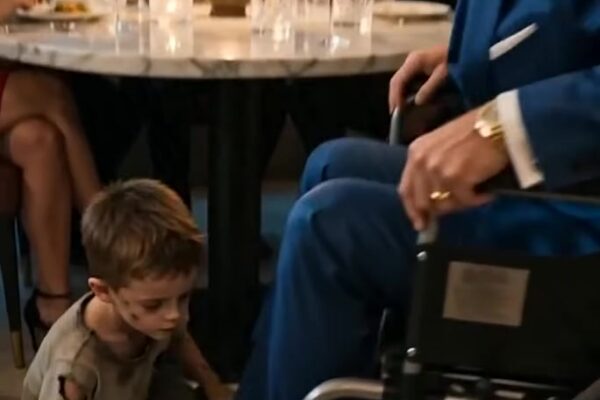
At first, the guests thought the boy was begging.
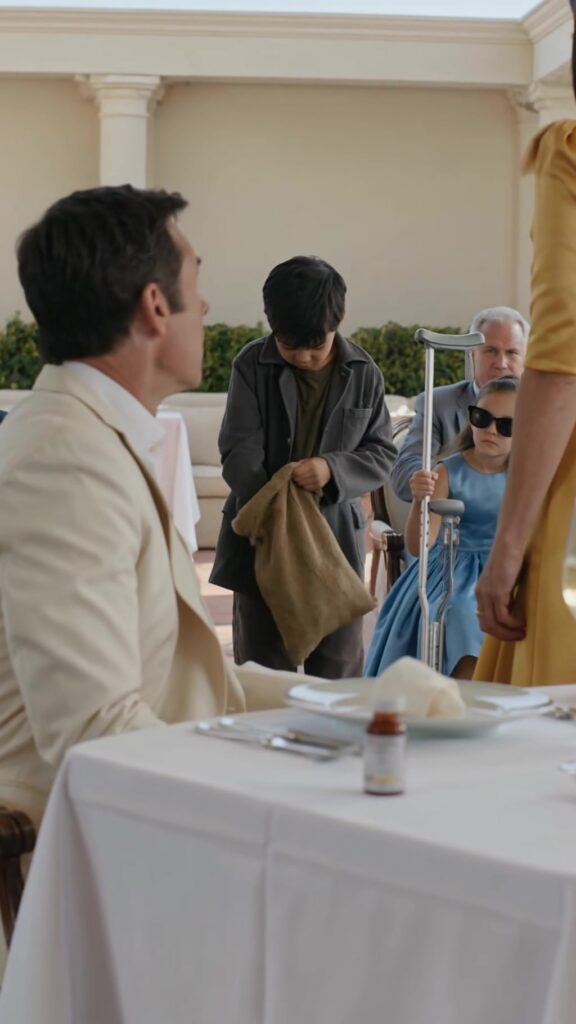
That was why no one reacted when he came up the terrace steps—thin as a reed, clothes hanging off him in wet, gray strips, soles blackened by the city. He dragged a sack that made a soft, metallic rattle as it bumped each stone tread. At a restaurant where the lanterns were the price of a month’s rent and the view was framed like a painting, a child like him belonged to the background—something for security to erase before it interrupted the linen and the laughter.
He didn’t look at the diners until he reached the top. Then he lifted his chin as if the whole terrace had been built for what he was about to say.
He pointed to the table at the center of the space, where the millionaire sat like a man who had paid to own the evening. He didn’t shout like a beggar, pleading for coins. He shouted like a witness calling a courtroom to order.
“Your daughter can see!”
The terrace changed shape. Conversation snapped off. Forks stopped midair. A waiter froze beside a bottle of wine, thumb still pressed to the cork as if the glass itself held its breath. A woman near the railing turned so quickly her chair scraped stone and left a white mark. Someone laughed once—reflexive, startled—then the sound died, ashamed of itself.
The father did not stand immediately. He stared at the boy as though the child’s words had reached into a locked room in his mind and turned a key he’d misplaced. Beside him, his daughter sat in a blue dress with dark sunglasses that hid whatever eyes were underneath. A small crutch lay across her lap, polished and expensive, the kind of object that made suffering presentable.
A few steps away, the wife in yellow halted where she’d been mid-step, her smile still half-worn like a mask that didn’t know it had been called a lie.
The boy lifted the dirty sack.
“She poisoned her food.”
This time the father moved. Slowly—too slowly, as if speed would make it real. He turned his head toward his wife. The look on his face was not anger first. It was recognition. Something old and private rose there, the expression of a man who had doubted his own doubts for too long.
The girl tilted her head.
Not vaguely. Not as a blind child might listen for footsteps. Exactly, as if she could see the boy’s bare toes on the stone.
Color left the wife’s cheeks. The yellow of her dress suddenly seemed too bright, a warning rather than a celebration.
The boy dropped the sack. He knelt, rummaged through the cans, and produced a tiny medicine bottle without a label. He held it up as if it were a relic.
The father snatched it, fingers crushing the plastic. His hand began to tremble the moment his eyes fixed on the cap—on the faint indentations where someone had pried it open before.
And in the silence that swallowed the terrace, the girl whispered, small and obedient, “Mommy gives it to me…”
A glass slipped from someone’s hand and shattered behind them. No one flinched. The crack of it felt like punctuation, not interruption.
The boy’s voice softened, which made it worse. “She told the nanny it works better in sweet juice.”
The father’s chair scraped as he stood. “Who are you?”
The boy didn’t answer the way children answered adults. He looked at the father’s face like he was measuring it against a memory. “You won’t know me,” he said. “But I know her.” His eyes flicked toward the woman in yellow. “I’ve seen what she does when people stop paying attention.”
The wife found her breath. “This is ridiculous,” she said brightly, too brightly. She reached for the father’s arm as if to guide him back into the safer world of manners. “He’s a thief. He’s trying to extort—”
“Don’t touch me,” the father said, and the words came out low, almost calm, which was more frightening than a shout.
She withdrew her hand slowly, as though the air itself might cut her. “Darling,” she whispered, and her eyes slid toward the surrounding guests. She was calculating—he could see it now—counting witnesses, counting versions of the story.
The boy stepped forward one pace. “Ask your daughter,” he said.
The father bent toward the girl. His voice shook despite his effort to steady it. “Is that true?”
The girl’s mouth tightened. For a moment she seemed to hesitate, as if permission were required even for truth. Then she lifted her sunglasses with one small hand.
Her eyes were open, wide, startlingly present. Not the unfocused gaze her father had taught himself to accept, not the milky blankness the doctors had blamed on fate. Her irises were dark and steady. They found his face immediately and held it.
“Daddy,” she said, as if saying it for the first time, “I can see you.”
Something broke in the father’s chest with no sound. His hand rose and hovered near her cheek, afraid that touch would shatter the moment. “Since when?”
The girl swallowed. “Since… since last winter. Mommy said we shouldn’t tell. She said it would go away if we talked about it.”
The wife laughed—a brittle sound that tried to turn the terrace back into a party. “Oh, sweetheart, you’re confused.” She leaned in, her voice honeyed. “You know you get confused when you’re tired.”
The girl flinched at that tone. The father saw it. He saw, finally, all the little flinches he had excused as shyness.
“Why?” he asked his wife. One word. Heavy as an entire life.
Her smile held for one heartbeat too long. Then it slipped. “Because you loved her more,” she hissed under her breath, and the venom of it surprised even her. “Because she belonged to your first wife. Because every time you looked at her you remembered the woman you couldn’t save.”
A stunned murmur moved through the terrace like wind through dry leaves. The wife’s eyes flashed toward the guests, furious at her own exposure, furious at their attention. “You think this is about money?” she snapped, loud enough now for everyone. “Do you have any idea what it’s like to live in a house where grief has a favorite?”
The father’s jaw clenched. He looked down at the bottle. He looked at his daughter’s bare wrist, where a faint bruise hid under a charm bracelet. He looked at the boy, and for the first time he saw that the child’s knuckles were scarred—not from work, but from doors slammed on him, from hands that had learned to push him away.
“Where did you get this?” the father asked.
The boy took a shaky breath. “From your kitchen trash,” he said. “I sleep near the service entrance some nights. The nanny cried when she threw it out. She didn’t know I was there.”
“The nanny,” the wife said quickly, seizing on a scapegoat. “Of course. The nanny is incompetent. The nanny—”
“She tried to stop it,” the boy cut in. His voice trembled now, anger and fear mixed together. “But she can’t. She’s afraid of you.” He pointed at the wife again, and there was something in the gesture that wasn’t childish at all. It was practiced. It was the same way someone points at a door they’ve watched for years, waiting for it to open.
The father straightened. The air around him felt suddenly colder. “Call my head of security,” he told the waiter who had not moved since the first shout. “And call my attorney. And the police.”
The wife’s eyes widened, and the terrace watched the moment her certainty cracked. “You can’t,” she said. “You’ll ruin us.”
“No,” the father said, and his voice sharpened, finally finding the anger underneath the grief. “You already ruined us.”
The girl reached out blindly out of habit, then corrected herself, and took her father’s hand with purpose. Her fingers were warm. Real. “Daddy,” she whispered, “don’t let her be mad at me.”
He looked down at her—at the eyes that saw him—and something in him steadied. “She doesn’t get to be mad at you,” he said. “She doesn’t get to decide what you are.”
Security arrived in a rush that came too late to prevent the truth, only to manage its aftermath. The manager hovered like a man trying to keep a ship from sinking by rearranging the chairs. Guests stood, whispering, phones hidden in palms, eyes drinking in the collapse of a beautiful lie.
As two guards approached the boy, the father lifted a hand. “Not him.” He stepped closer to the child and lowered his voice. “You saved her,” he said. “Why?”
The boy’s throat moved. He glanced at the wife, who was now rigid, her face set in a hard, bright hatred. “Because I know what it’s like,” he murmured. “When someone tells the world you can’t see what they’re doing.”
The father studied him, and his mind scrambled through staff lists, old news articles, the shape of a memory he’d never wanted to keep. “Have we met?” he asked, almost unwilling to speak the thought.
The boy’s mouth tightened. “Not really,” he said. “But my mother worked for her.” His eyes flicked to the woman in yellow. “Before she disappeared.”
The terrace seemed to tilt. The father felt the world narrow, the way it did before a fall. Somewhere, the police siren began to wail in the distance, growing louder as it climbed the hill toward them, toward the lanterns and the linen, toward the table where a child had been made invisible and then made herself seen.
The father squeezed his daughter’s hand. “We’re leaving,” he said. Not the terrace. Not the restaurant. A life. A lie. “And we’re not coming back.”
The wife opened her mouth to speak again—plead, threaten, charm—but her voice was lost under the first hard steps of officers on stone.
The boy stood very still as the world finally turned its full attention to him, not as a nuisance, not as an eyesore, but as the pivot point of an evening that would be remembered in whispers for years.
He had come up the terrace steps dragging a sack of cans, and at first the guests thought he was begging. Now everyone understood what he’d really brought with him.
Not hunger.
Evidence.