The yard behind the old feed store always looked like it had been scrubbed with sunlight. Even the weeds shined, brittle and proud, poking up through gravel that had been pounded flat by years of boots and tires. By noon the heat made the air wobble, and by two o’clock it was dusty enough that anything moving—anything at all—left a little ghost trail behind it.
That afternoon, the ghosts belonged to motorcycles.
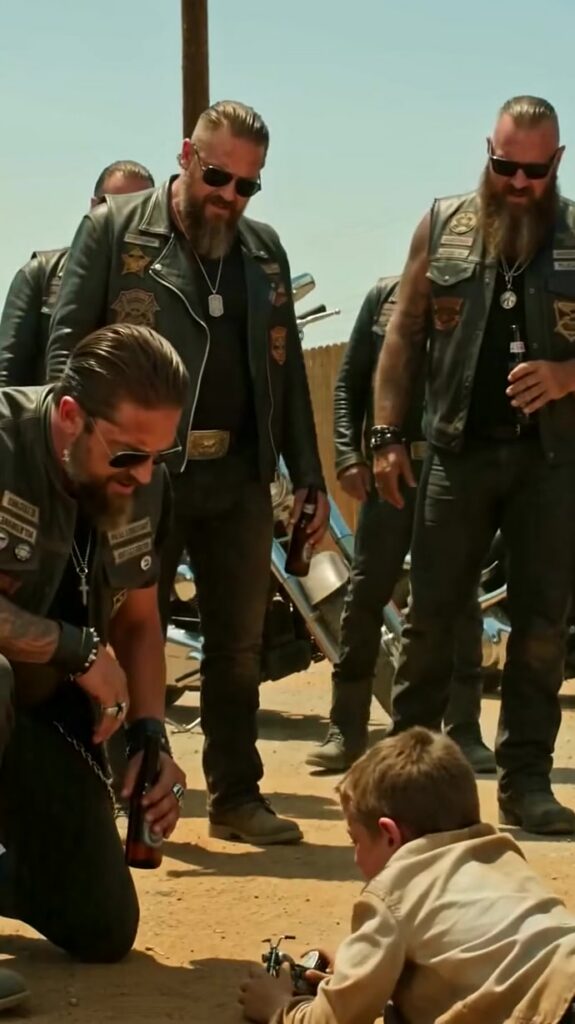
They rolled in loud, a pack of chrome and black paint and unbothered laughter. The kind of laughter that didn’t check who it was stepping on. Engines cracked, then settled into a steady growl that rattled the windows of the feed store and made the pigeons in the rafters shuffle nervously.
The riders parked in a crooked line like they owned the place. Most of them did, in their own heads. Helmets came off. Bandanas got tugged down. Someone slapped someone else on the shoulder and called him something rude but friendly. Somebody else said the dust tasted like money and spit.
Then a kid sprinted across the bright yard like he’d been fired out of a slingshot.
He was small—maybe seven, eight if you counted the seriousness in his eyes. His T-shirt clung to him with sweat, and his sneakers kicked up little bursts of gravel. In both hands he carried something that flashed in the sun, wrapped in a rag that didn’t quite hide its shape.
He didn’t look at the bikers as a group. He looked at the biggest one.
The leader stood slightly apart, as if the others were planets and he was the sun. Thick shoulders. A worn leather vest. A chain hanging from his belt like punctuation. His hair was pulled back, and his face was set in that permanent expression some men get when they’ve decided emotions are just another thing people try to sell you.
The kid aimed for him, breathing hard, rag bundle clutched tight.
He almost made it.
His toe caught on a ridge in the gravel—some old tire rut turned into a trap. The kid pitched forward. His hands shot out, but the bundle flew out of his grip like it was trying to escape. He hit the ground with a sound that made the laughing stop in midair.
The rag came loose.
Metal clanked against stone—sharp, clean, final. The tiny motorcycle, all silvery angles and careful curves, landed hard and skidded a few inches. Dust puffed around it like a little explosion, then settled as if holding its breath.
For a moment, even the idling engines seemed quieter.
The kid scrambled, elbows and knees scraping. He snatched the little bike to his chest like it was a living thing that could be hurt again. His face twisted, and then the crying hit him full force—big, raw sobs that didn’t belong in a yard full of grown men and machines.
“Please,” he choked, looking up at the leader with wet eyes. “Sir, please buy it.”
No one spoke. The other bikers watched, their amusement evaporating into the heat. Somebody shifted his boots. Somebody else cleared his throat and stopped, like he didn’t want to be the first sound.
One of the riders—a lanky guy with mirrored sunglasses and a grin that refused to die—finally broke the silence with a sharp, mocking laugh. “What is this, kid? Your little action figure ride?”
The kid squeezed the miniature motorcycle tighter. It was handmade, even the untrained eye could see it. Not some store-bought toy. The frame was built from thin metal strips, welded and smoothed. The tires were circles of layered steel, sanded into a rounded edge. The handlebars were delicate. The seat had a tiny indentation, like someone had pressed a thumb there on purpose to make it feel real.
In the sun it looked almost alive.
The boy shook his head so hard his tears flew. “It’s real,” he insisted, voice cracking. “My dad made it.”
The mocking biker crouched a little, still grinning but quieter now. “Your dad made that? Why’re you trying to sell it then?”
The kid’s shoulders trembled. He stared at the ground as if the gravel might tell him what to say. When he finally looked up, his eyes were so exhausted they seemed older than his face.
“My dad…” he whispered, and the words almost didn’t come. “He won’t wake up.”
The yard changed in that instant. The heat didn’t lessen, the dust didn’t disappear, but everything felt heavier. Even the motorcycles looked less like a party and more like a bunch of loud machines parked in front of somebody’s grief.
The leader took a step forward.
His boots made a crunching sound that echoed in the silence. He didn’t crouch, didn’t soften his posture. He held out his hand, palm up, like he was asking for something he deserved.
The kid hesitated. He glanced at the other bikers—faces less sharp now, some uncomfortable, some curious. Then he carefully placed the small motorcycle into the leader’s hand.
The leader’s fingers closed around it. Big hands around a tiny thing. He lifted it, turned it slightly, letting the sunlight catch the welds, the edges, the details. His eyes narrowed—not with suspicion, but with recognition. Like he was reading a signature.
There was a mark under the seat, scratched so lightly it was almost invisible: three little notches and a swirl. Not a logo. Not a brand. Something personal. Something that meant someone had made this with intention, with a private code.
The leader’s jaw tightened.
His expression shifted, slowly, as if it had to climb over something. It went from indifferent to alert, then to something that looked dangerously close to pain.
“Where did you get this?” he asked. His voice dropped lower, rougher, the teasing gone. It wasn’t a question for a kid anymore. It was the kind of question men ask when their past just walked into the room.
The boy wiped his nose with the back of his wrist, leaving a damp streak. “My dad gave it to me,” he said, voice small but steady now, like he’d rehearsed this part. “He said… you would know.”
The leader didn’t move for a beat. The tiny bike sat in his palm like a weight he hadn’t expected.
“He said you’d know,” the kid repeated, swallowing hard. “He said if… if he couldn’t wake up, I should find you. Here. In the yard where you all come.”
The leader’s eyes flicked to the feed store, then to the road beyond, like he could suddenly see a different version of this place layered on top of the present. His throat bobbed. He opened his mouth, but whatever he’d planned to say got stuck somewhere behind his teeth.
The other bikers watched him, confused. They’d seen him angry, they’d seen him bored. They had not seen him frozen.
“What’s your dad’s name?” the leader asked, and he sounded like he was bracing for impact.
The boy’s lips trembled again. “Eli,” he whispered. “Eli Marrow.”
The leader’s hand clenched, careful not to crush the miniature. His eyes shut for half a second—just a blink too long to be normal. When he opened them, the sunlight in the yard looked harsher, like someone had turned up the brightness on a screen.
“No,” he murmured, not to the boy, not to anyone. Just to the air. “It can’t be.”
The kid took a step closer, hope and fear mixed in his expression. “He said you’d help,” he said. “He said you’d understand the bike.”
The leader stared at the tiny motorcycle again, tracing the curve of the tank with his thumb. Then he looked down at the boy, really looked, as if seeing a face he didn’t expect to find connected to a name he thought belonged to a sealed chapter.
Behind them, one of the motorcycles popped softly as it cooled, the sound strangely loud in the stillness.
The leader swallowed, and when he spoke again, his voice had that low tension of a wire pulled too tight. “Where is he?”
The boy’s chin quivered. “At home,” he said. “On the couch. He’s just… there. And Mom’s not back yet. She went to get help but the phone—” He shook his head, tears threatening again. “He told me to come now.”
The leader didn’t hesitate. He tucked the tiny bike into the inside of his vest like it was something fragile and sacred. Then he turned sharply toward his own motorcycle.
“Axle,” he snapped at the biker with the mirrored sunglasses. “Get the truck. Now.”
Axle blinked. “What? Boss, it’s—”
“Now,” the leader repeated, and the word cracked like a whip.
Everyone moved.
And the boy, still dusty and scraped and shaking, found himself scooped up onto the leader’s bike as if it was the most natural thing in the world. The leader didn’t say anything reassuring. He just adjusted the boy’s position with one firm hand and then, very carefully, placed a helmet on the kid’s head.
“Hold on,” he said, quieter. “Don’t let go.”
The boy wrapped his arms around the leader’s waist like he’d been doing it his whole life.
The engines roared back to life, louder than before, but now there was no laughter riding on top of the sound. Only urgency. Only dust lifting into the air like a warning sign.
As they shot out of the bright sunny yard, the tiny handmade motorcycle pressed against the leader’s chest, and he rode like someone who’d just realized it was never a toy at all—just a message he’d been too stubborn to read until it came delivered in a child’s shaking hands.
Somewhere behind them, the yard went back to being just gravel and sunlight.
But for the leader, the past had started its engine again.