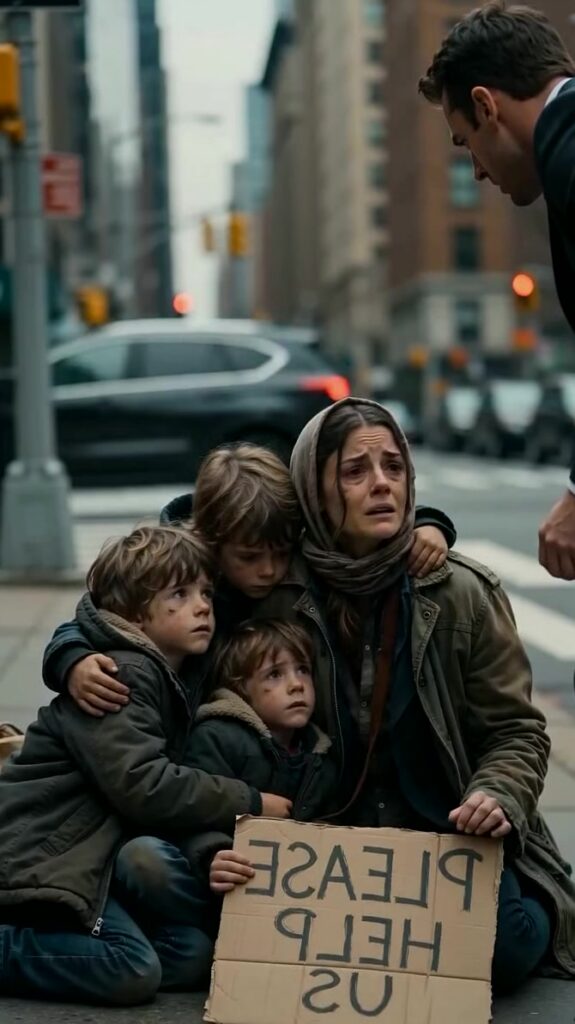
Emma had stopped feeling embarrassed a long time ago. The feeling had worn off the way a cheap shoe wears down—first the heel, then the sole, until you’re basically walking on the raw idea of rubber. Embarrassment was a luxury, like cappuccinos with foam art or coats that still had all their buttons. When you’re parked on a slab of icy sidewalk with three hungry kids pressed into you like little space heaters that don’t quite work, shame shrinks to something you can step over.
She kept her sign folded at the crease so it could fit in her tote when the security guard did his rounds. The cardboard was soft at the edges, darkened by melted snow and the oil of her hands. PLEASE HELP US, it said in thick marker. She’d written it in a hurry the first day, and by day five she hated how desperate the letters looked. But desperate was honest, and honest was all she had left.
Juno—six and sharp as a tack even when her stomach was empty—sat closest to the curb. She watched shoes the way other kids watched cartoons, cataloging brands like she could taste their price tags. Milo, four, clung to Emma’s sleeve with red knuckles and a quiet cough he tried to swallow. And Wren, two, had turned into a drowsy bundle against Emma’s shoulder, making tiny sighs like a kitten.
Every time someone slowed down, Emma straightened her back. Not to look proud. To look human. She’d learned that if you looked too broken, people got scared. If you looked too okay, people got suspicious. There was a narrow middle line: tired but trying.
“Anything helps,” she said when a woman in a clean puffer jacket glanced at them and then pretended she’d just remembered she needed to check her phone. Emma didn’t follow her with her eyes. Watching people not choose you was its own kind of bruise.
The city moved around them in blurs: the hiss of buses, the metallic smell of the subway grate nearby, the bite of wind that found every gap in her scarf. She counted coins by sound now. A penny was an insult. A quarter meant someone had at least reached into a pocket. A bill was a miracle.
And then, right in front of her sign, a pair of polished black shoes stopped. Not the kind with salt stains, not the kind that had ever met a puddle without an umbrella involved. The shoes were so shiny she could see a warped reflection of her cardboard.
Emma didn’t look up right away. That was a rule. Looking up too fast made you look hopeful, and hope was a magnet for disappointment.
“Please,” she said softly, the words she’d said all week, all month, like a prayer she didn’t believe in. “Anything helps.”
The man didn’t move. No coin clinked. No paper rustled.
He bent slightly instead, like he was trying to match his world to hers, and stared as if something impossible had walked out of the past and sat down on the concrete.
“Emma?” he said, barely louder than the wind.
Her whole body went rigid. That voice hit a place in her chest that had been bricked up for years, a room she pretended wasn’t there. The world narrowed to the sound of her own pulse.
She lifted her gaze slowly.
Dark suit. Clean shave. The expensive coat that fell perfectly at his knees. And eyes she had once watched in sunlight and candlelight and the glow of her phone at 2 a.m. The same eyes that had looked at her like she was the only person in the room—until they didn’t.
“Daniel,” she said, and it came out as a breath, not a name.
For one second, the street noise dimmed, like someone turned down the volume on reality. Daniel stared at her the way you stare at a stranger who somehow knows your childhood nickname. His gaze flicked from her face to the children pressed against her and back again. The confusion on his expression cracked and let something raw through.
“What are you doing here?” he asked. His voice wasn’t angry. It was almost hurt, like he’d tripped over a truth he didn’t want to see.
Emma’s throat tightened. She looked away instantly, because if she looked at him too long she might start talking. And if she started talking, she might tell him things she’d spent years swallowing whole.
“I didn’t expect to see you,” she said quietly.
Milo’s cough broke into the moment. He tried to cover his mouth with the edge of Emma’s coat. She pulled him closer, rubbing his back with her chapped hand. His little body felt too light. She hated that she could feel his ribs through the layers.
Daniel watched her hands like they were evidence. His expression changed in stages: confusion, then pain, then something heavier that settled behind his eyes.
Juno, who never missed anything, looked up at Daniel with open curiosity. “Mama,” she whispered, tugging Emma’s sleeve, “who’s that man?”
The question landed like a brick. Emma’s mouth opened and closed without sound. She’d practiced answers for social workers and shelter intake forms, but not for her daughter’s blunt, innocent curiosity.
Daniel went still. Not frozen like the air, but stunned—like a person who’s just heard their name called at a funeral. His gaze moved across the children deliberately now. Milo’s dark eyes. Juno’s eyebrows, the exact slope. Wren’s mouth when she sucked her thumb—an echo that made his face drain of color.
“Emma,” he said, and the word shook. “These children…”
Emma tightened her arm around Wren, protective and panicked at the same time, like she could hide them inside her coat. Her lips pressed together so hard they went numb.
Before Daniel could finish whatever question was forming, Juno leaned forward, studying him like she studied the menu boards in pizza shops. Then she asked, very plainly, “Are you the man Mommy cries about at night?”
There was a sharp silence, even with traffic roaring past. Emma felt heat rise in her face, not from embarrassment—she was past that—but from the sudden exposure of a secret she’d tried to keep gentle. She hadn’t thought the kids noticed her quiet, muffled sobs in the shelter bed. She’d been careful. She’d turned her face to the wall. She’d covered her mouth with her sleeve. Apparently, none of that mattered.
Daniel’s jaw tightened. He looked at Emma, and for the first time she saw him not as a memory but as a man standing in front of her, older, harder, still too polished for the real world. “Why would you cry about me?” he asked, and his voice wasn’t defensive. It was lost.
Emma let out a laugh that had no joy in it. “Because you were supposed to be there,” she said before she could stop herself. The words tasted like metal. “You were supposed to call. You were supposed to… do something.”
Daniel’s eyes flicked down, like the pavement had answers. “I tried,” he said, and immediately sounded like he didn’t believe his own sentence. “After… after you disappeared, I—”
“I didn’t disappear,” Emma cut in, sharper than she intended. Milo flinched, and she softened her voice. “I moved. I sent a letter to your office. It came back. I tried your number. It changed.” She swallowed hard. “And then I got tired of chasing someone who had already decided I wasn’t worth catching.”
Daniel’s face pinched, like he’d been punched somewhere tender. “My father—” he started.
Emma’s laugh came again, short and bitter. “Your father.” She’d known that name would show up, like a ghost with good timing. “He always had a way of making problems disappear, didn’t he? Including me.”
Daniel knelt without thinking, right there on the dirty sidewalk in his expensive coat. The motion was so out of place it made a couple walking by slow down and stare. He didn’t care. His gaze went to Juno. “What’s your name?” he asked gently.
Juno looked at Emma for permission. Emma’s chest felt too tight to breathe, but she nodded once.
“Juno,” Juno said. “I’m six. I can read chapter books.”
Daniel blinked, like the ordinary details were what made it real. “That’s… that’s great,” he managed. His eyes slid to Milo. “And you?”
“Milo,” Milo whispered, then coughed again, embarrassed by his own body.
Daniel’s hand hovered, uncertain, then he took off his gloves and offered one to Milo like it was a peace treaty. Milo stared at it, then took it with both hands.
Wren shifted against Emma’s shoulder, waking just enough to frown at the cold. Daniel looked at her and something broke open in his expression. “And her?”
Emma’s voice came out thin. “Wren.”
Daniel repeated it softly, as if saying it might anchor him. He swallowed, hard. “Emma,” he said again, and this time it wasn’t shock. It was a question wrapped in regret. “Are they… are they mine?”
Emma held his gaze for a long moment. She could lie. She could protect herself from the mess that would follow. But she was tired of surviving by pretending.
“Yes,” she said, simple and devastating. “All three.”
Daniel’s eyes filled fast, surprising and human. He looked away, pressing his fingers to his mouth like he could hold himself together. When he looked back, his face had changed. Not fixed—nothing fixes in a second—but decided.
“Okay,” he said, voice thick. “Okay. We’re not doing this out here.” He stood, pulled out his phone with hands that weren’t steady anymore, and looked down at Emma like she was someone he’d failed and was going to spend the rest of his life trying to make up for. “You’re coming with me. We’ll get warm. We’ll get food. Then… we’ll talk. All of it.”
Emma’s first instinct was to say no. Pride wasn’t the right word; it was more like self-defense. She’d built her life around not needing him. But the way Milo hugged the glove to his chest, the way Juno’s eyes flickered with cautious hope, the way Wren’s lips had gone bluish at the edges—those things made decisions for her.
She nodded, once. Not forgiveness. Not trust. Just motion, like taking the next step off a ledge.
Daniel held out his hand to help her up. Emma stared at it, at the clean lines and the familiar shape, and felt the strange collision of past and present like weather fronts meeting—storm brewing, air changing.
She took his hand anyway. Not because she’d stopped being careful, but because she’d stopped being embarrassed. And right now, survival—maybe something more—was bigger than everything else.