Ethan only took the cleaning job because he needed money for school. Not for some inspirational montage, not to “find himself,” not because he had a hidden passion for lemon-scented disinfectant. Just money. Tuition was due in three weeks, his financial aid had a mysterious “processing delay,” and the campus job board offered exactly one gig that paid cash: clean an old house in a back-alley pocket of town that everyone pretended didn’t exist.
The listing was weirdly vague. No address, just “ask for Mr. Lyle at the corner store.” When Ethan asked, Mr. Lyle slid him a key like he was handing over contraband.
“You don’t have to do it,” the man said, eyes flicking around the store. “Nobody else will.”
“I’m not scared of dust,” Ethan answered, because he hated how desperate he sounded if he admitted the truth: he was scared of being broke.
Mr. Lyle didn’t argue. He only scribbled directions on a receipt. “Alley behind the old theater. Third door. Don’t knock. She hates knocking.”
The alley felt like the city had forgotten it on purpose. No streetlight worked. Trash bins leaned like tired giants. The air held that damp, metallic smell of places where the sun gave up halfway. Ethan found the third door—warped wood, chipped paint, a brass knob turned the color of old pennies—and slid the key in.
The lock clicked like it hadn’t been used in years.
Inside, the house was quiet in a way that made his ears ring. Dust floated in beams of light that cut through half-broken shutters. The wallpaper, once floral, had faded into bruised pastels. The place didn’t look haunted so much as paused, like someone hit a remote control decades ago and forgot to press play again.
He set his backpack down and started with the basics: sweep, wipe, bag trash, repeat. The air tasted like paper and time. Every step on the floorboards sounded like a confession.
From somewhere deeper in the house came a soft cough. Then the faintest voice, scratchy but firm. “Kitchen’s off limits. Bedroom’s fine.”
Ethan followed the sound and found her.
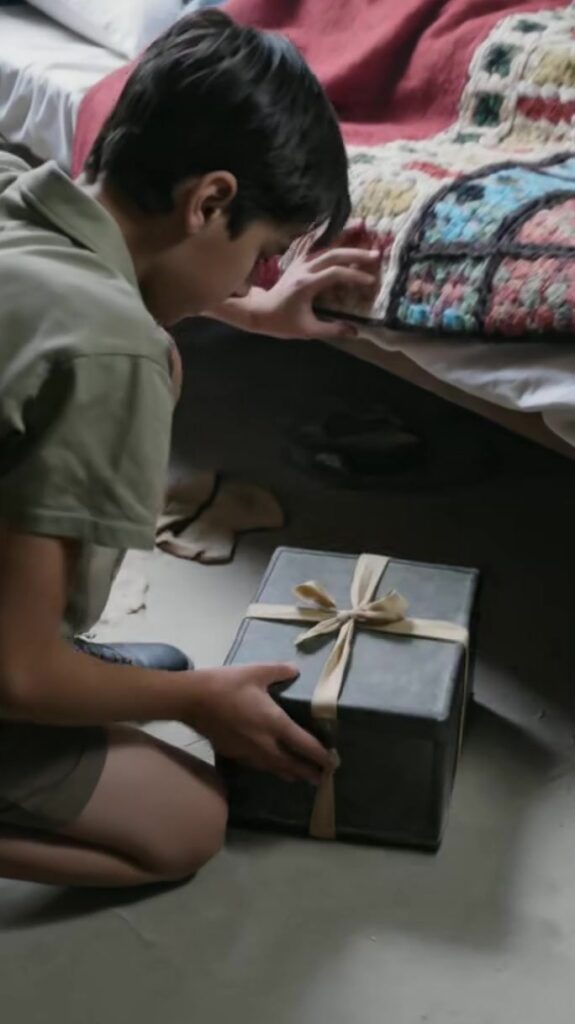
She lay in a narrow bed tucked against the wall, small under a bright quilt stitched from mismatched scraps of fabric. The colors were loud in the dim room—reds, yellows, blues—as if she’d tried to sew sunlight into something she could hold. Her face was lined like crumpled paper, but her eyes were sharp, watching him without blinking.
“I’m Ethan,” he said, keeping his tone light, like they were just two normal people in a normal house. “Mr. Lyle said you needed help cleaning.”
“Help,” she repeated, as if testing the word. “Fine. But don’t move the clock.”
Ethan glanced up. A rusted wall clock hung crookedly above a dresser. Its hands were stuck at 4:17.
“Sure,” he said. “Clock stays.”
He tried not to stare as he worked. The bedroom was a museum of things that should’ve been thrown away: stacks of newspapers tied with string, teacups with hairline cracks, a jewelry box with no jewelry, a suitcase that looked older than his grandfather. Nothing in the room was random. Everything was placed like it had a job.
After an hour, the old woman—she hadn’t offered her name—closed her eyes and drifted into sleep. Her breathing settled into a slow rhythm. Ethan kept sweeping, careful and quiet. He told himself he wasn’t the type to get pulled into neighborhood legends. He wasn’t the type to believe in strange old women who “waited for someone.” He believed in bills, deadlines, and the fact that ramen could get you through a week if you didn’t mind hating yourself a little.
He pushed the broom under the bed, trying to reach a stubborn line of dust. The bristles bumped something solid.
Clink.
Ethan froze with the broom halfway extended, like a kid caught snooping. The sound was too sharp to be a shoe or a book. He lowered to his knees and peered into the shadowy space under the bed.
His fingers brushed metal. He dragged out a small box, rectangular and dented at the corners. A faded ribbon—once blue, now almost gray—was looped around it in a neat bow. It didn’t look like trash. It looked like intention.
The moment the box cleared the edge of the bed, the old woman’s eyes snapped open.
Not groggy. Not confused. Alert, like she’d been waiting for a cue.
“Don’t,” she said, but the word didn’t sound like a warning. It sounded like a plea she’d practiced until it fit in her mouth.
Ethan’s throat tightened. “I’m sorry. It was under—”
“I heard it,” she whispered. “That sound. I knew one day I’d hear it again.”
Her gaze was locked on the box as if it were alive. Ethan’s hands started to shake, and he hated that, hated how his body reacted before his brain could figure out why.
“Do you want me to put it back?” he asked.
The woman swallowed. Her chin trembled. “Open it. If you’re the one who found it, you should open it.”
Ethan hesitated, then slowly untied the ribbon. The knot loosened easily, like it had been tied by someone who expected it to be undone. He lifted the lid just enough to see inside.
Letters. Dozens. Maybe more. Envelopes stacked and bundled, the paper edges yellowed. A photograph lay on top: a little kid in a striped shirt, squinting at the camera like the sun was too bright to trust. Beneath the photo were certificates—school awards, attendance slips, congratulatory notices—still crisp, still sealed in plastic sleeves as if they’d been preserved against disaster.
And on the top certificate, in bold black print, was a last name Ethan recognized so instantly it made his vision blur.
His own.
The broom slipped out of his hand and hit the floor with a soft thud. Ethan didn’t even register the sound. His mouth opened, but nothing came out. He stared at the name again, like it might rearrange itself into something less impossible.
“That’s…” He tried to swallow, but his throat refused. “That’s my dad’s last name.”
The woman sat up slowly, as if the movement cost her years. Tears had already collected in the corners of her eyes, shining but not falling. “It was mine first,” she said.
Ethan looked at her properly then. The shape of her cheekbones. The curve of her nose. Something in the way her eyebrows angled when she focused. He’d seen that exact expression in the mirror when he crammed for exams.
“Who are you?” he asked, though his voice had turned into a whisper without his permission.
She pressed a hand to her chest like it was holding everything together. “My name is Mara,” she said. “Mara Caldwell. And I’ve been waiting for someone from my family to come back for forty years.”
Ethan’s heart thudded hard enough to hurt. “Caldwell,” he repeated. His father had been Ethan Caldwell. His father who never talked about his childhood. His father who’d died two years ago, leaving behind a toolbox, a stack of unpaid hospital bills, and exactly one photo of himself as a teenager with the face cut out of everyone else around him.
“My dad never said he had family here,” Ethan managed.
“He left,” Mara said, voice cracking on the word. “One night. He was seventeen. He promised he’d come back when he was steady. He promised he’d write. And he did, at first.” She nodded at the box. “Those are his letters. I never opened most of them.”
Ethan blinked. “Why not?”
She gave a shaky laugh that wasn’t funny. “Because if I opened them and he said he wasn’t coming… then it would be true. Sealed letters can still be hope.”
Ethan stared at the envelopes like they might bite. “He… he’s gone,” he said softly. “He died.”
Mara didn’t flinch. Like she’d already had the argument with herself a thousand times. “I know,” she said. “Mr. Lyle told me. Two years ago. I didn’t believe him. Not at first.” She reached toward the box, her fingers hovering above the photo. “Then you showed up. Same eyes. Same stubborn jaw. Same last name walking back into my house like a debt finally being paid.”
Ethan’s chest felt packed with cotton. “You hired me?” he asked.
Mara’s lips pressed together. “I asked Mr. Lyle to find someone. Any Caldwell. He checked the records. He told me you were in town. College.” Her gaze softened. “You needed money. That part… I didn’t plan. I’m sorry.”
Ethan sank back on his heels, overwhelmed by how quickly life could turn into something else. “So you’re my…” He couldn’t finish the sentence. Grandmother? Great-aunt? The word felt too big for his mouth.
“I’m your grandmother,” Mara said quietly. “Your father’s mother.”
Ethan’s eyes burned. He hated that he was about to cry in a dusty bedroom in a stranger’s house that suddenly wasn’t a stranger’s house anymore. “He never mentioned you,” he said, a little sharper than he meant.
Mara nodded like she’d earned that accusation. “I was hard to live with,” she admitted. “I kept everything. I kept rules. I kept waiting. Your father wanted air. I gave him walls.”
Ethan looked around at the stacked newspapers, the tied bundles, the frozen clock. “Why the clock?” he asked, desperate for something simple.
Mara’s eyes flicked up to 4:17. “That’s when he left,” she said. “I set it to that time the next morning. I thought if the house stayed in that moment, maybe he’d walk back through the door and nothing would have changed.”
The honesty hit Ethan harder than any ghost story. He reached into the box and picked up one of the unopened letters. The envelope was addressed in his father’s handwriting, slanted and careful. “Can I… can I read them?” he asked.
Mara’s tears finally spilled, tracing clean lines down her cheeks. “That’s why I kept them,” she said. “Not for me. For someone who could finish what I couldn’t.”
Ethan sat on the floor beside the bed, the metal box between them like a shared heartbeat. Outside, the alley stayed quiet, and the neighborhood kept its rumors. Inside, in a room that smelled like dust and time, Ethan opened the first letter and realized he wasn’t just cleaning a house.
He was sweeping his way into a family he didn’t know he’d lost.