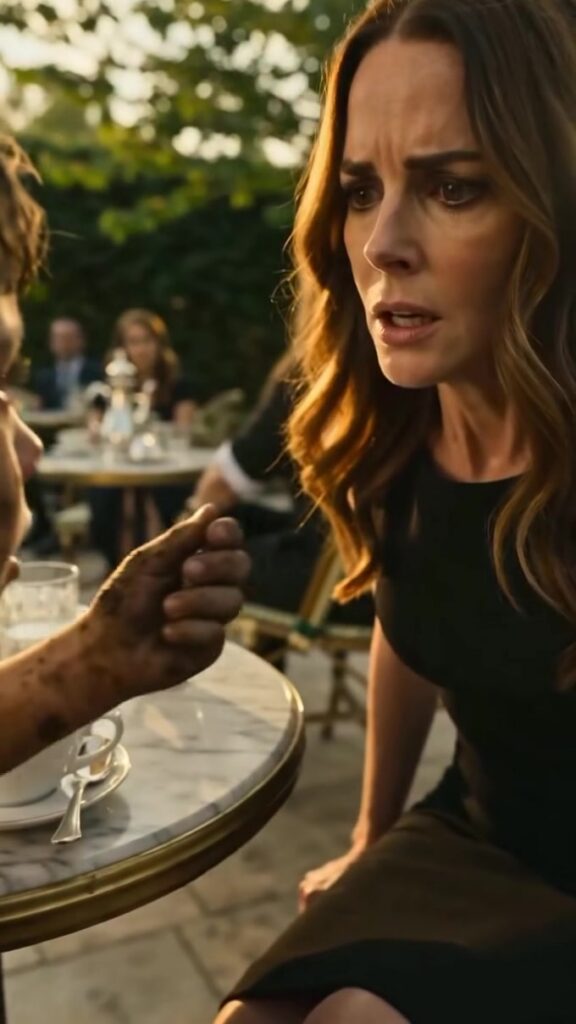
Every evening, she sat at the same café table by the window, where the light turned honey-colored just before it died. It was a small ritual in a city that loved rituals—people who ordered the same pastry, walked the same route, wore the same expressions. Hers was the cleanest. A black dress with a high collar. A single ring she never removed. A white cup that arrived without her asking, the coffee pale as bone. She sat with her spine straight and her mouth composed, as if the world might tilt if she relaxed.
The staff knew not to fuss. The other patrons learned not to stare too long. Her elegance had a chill to it—like the glass of a museum display. She liked it that way. Distance made things manageable. Distance meant no one reached past the polished surface and found what she’d buried underneath.
Routine meant control. Control meant the past stayed where she had pressed it down, under layers of time and money and carefully curated silence.
That evening, the café was full. Plates clinked, laughter rose and fell, and the golden light softened everything so even fatigue looked beautiful. She had opened a book she didn’t plan to read—something with thin pages and thick prestige—when she sensed motion beside her chair, something quick and low, like a cat passing under a table.
A hand touched her hair.
It wasn’t rough. It didn’t snatch or tug. It brushed a lock behind her ear with a tenderness so intimate her body reacted before her mind caught up. She recoiled hard enough to make the cup tremble.
“Hey—don’t touch me.”
The words landed sharper than she intended. Conversations nearby snapped off. A spoon hung midair. Even the espresso machine seemed to hold its breath.
The boy who had dared reach for her withdrew his hand as if burned. He was filthy—dust in the seams of his clothes, hair clumped with street grit, knees raw and scabbed. Thin enough that his ribs seemed to argue with his shirt. But his eyes were what stopped her. They weren’t hungry in the usual way. They were fixed on her face as if he was searching for something he’d seen in a photograph and was afraid he’d found wrong.
“She has the same hair,” he whispered, not to her but to himself.
Her fingers tightened around the edge of the table. “What are you talking about?”
The boy swallowed. His throat bobbed. Tears welled, but he blinked them back with stubborn force, as though crying would ruin the mission that had carried him here. “My mom said I’d find you here.”
Her breath turned thin. The word mom should have been ordinary. In her chest it struck like a hammer. A sound from far below the floorboards.
“Your mom?” she repeated, though she already hated the direction this was going. Her mind, trained for contracts and boardrooms and controlled narratives, began to assemble possibilities: a scam, a con, a cruel coincidence engineered by someone who had learned her habits.
The boy opened his fist. His palm was grimy, but what lay on it caught the café’s warm light and threw it back like a warning.
An ornate hair clip, jeweled and delicate, curved like a crescent. Tiny stones—some opal, some ruby—set in a pattern that mimicked a wreath. Near the edge, one stone was missing, leaving a tiny dark socket like an eye that had been plucked out.
The woman’s face drained of color so quickly it felt like the world had siphoned the blood from her veins.
She knew that clip.
Not just as an object, but as a chapter. She remembered the weight of it when it pinned her hair up on a night that had smelled of rain and perfume. She remembered the hands that had fastened it—fingers with chipped nail polish, laughing at nothing. She remembered the argument that followed, sharp words said at a train platform, a suitcase too small for an entire life. She remembered running, because running had been easier than staying and admitting she was afraid.
“That’s impossible,” she managed, though her voice didn’t sound like hers.
A tear escaped the boy’s control and slid down his cheek, carving a clean line through the grime. “She said you’d say that.”
The café’s background noise seeped back in—murmurs, an uneasy cough, the soft scrape of a chair as someone pretended to move casually while watching. The woman stood so fast her own chair shrieked against the stone floor. Her book fell closed with a slap. She didn’t pick it up.
“Where is she?”
The boy didn’t answer. His gaze shifted past her shoulder, past the marble tables and the neat rows of pastries, toward the edge of the outdoor walkway where a trimmed hedge separated the café’s terrace from the street. He turned his head slowly, as if afraid the motion would break something fragile.
She followed his line of sight, and the world narrowed.
There, half in shadow and half in the last wash of daylight, stood a woman in a beige suit. Not young. Not old. The kind of face time had refined without softening. Her hair was pulled back tightly, a few silver strands catching the light. She held herself very still, hands folded in front of her like someone waiting outside a courtroom for a verdict.
The elegant woman’s heart did something irrational, a lurch that was almost pain.
Because she knew that face too.
She had tried to bury it. She had done everything you could do to bury a person without a grave—changed circles, changed names, changed cities, changed the story she told herself whenever the memory threatened to rise. She had convinced herself that the past was a locked room and she held the only key.
But the past had walked back into the light, wearing a beige suit and carrying a boy with her eyes.
The woman at the hedge took a single step forward. The café’s chatter dimmed again, as if everyone had unconsciously sensed that something important had arrived. The boy beside the table clutched the hair clip so tightly his knuckles paled beneath the dirt.
The elegant woman couldn’t move. Her heels might as well have been nailed to the stone. Her mouth opened and no sound came. She felt every year she had built between herself and this moment crumble like stale bread.
The woman in beige stopped just short of the terrace. Her gaze held steady, neither pleading nor accusing, but heavy with a kind of exhaustion that made anger look childish. When she finally spoke, her voice was low, carrying only because the silence made space for it.
“You still sit in the same place,” she said.
The elegant woman’s throat burned. “You… you shouldn’t be here.”
“I know,” the other woman replied. “But we ran out of ways not to be.”
The boy shifted closer to the elegant woman, not trusting the distance between them. “Mom,” he whispered, and it was the first time the word sounded like a rope thrown across deep water.
The elegant woman’s eyes flicked down to him again. His hair was dark, but in the warm light it revealed a copper sheen. She saw it suddenly: her own reflection in the curve of his brow, the shape of his mouth when he tried not to cry. A map of her that existed without her permission.
“What is this?” she asked, though she knew what the answer might cost her. “Why would you bring him here?”
The woman in beige took another step. The hedge no longer separated them; only a few feet of air did, charged and trembling. “Because he asked,” she said. “Because he found the clip and wouldn’t let it go. Because I told him the truth, and the truth made him hungry for you in a way I couldn’t feed.”
The elegant woman’s hands curled at her sides. “The truth,” she repeated, as if the word itself were foreign. She had lived so long on edited versions of events that an uncut sentence felt obscene.
“You left,” the woman in beige said softly. “You left, and you never looked back. I told myself you were dead a hundred times, because it was easier than believing you chose not to know.”
The elegant woman flinched, as if struck. “I had reasons.”
“So did I.” The other woman’s eyes flicked to the boy. “But my reasons didn’t get to erase a person.”
Behind them, someone’s phone buzzed and then quickly went silent. A waiter hovered near the door, torn between concern and curiosity. The city, indifferent, rolled on beyond the hedge—cars, footsteps, a distant siren. The world had not stopped for their reckoning, yet it felt as if everything had tightened around this small square of terrace.
The elegant woman looked at the jeweled clip again. She remembered the night she had thrown it into a suitcase in a fit of spite, then taken it out because it had been a gift and she couldn’t bear to discard it. She remembered setting it down on a table, meaning to come back, meaning to apologize, meaning to do a hundred things she never did. She remembered telling herself, later, that if she didn’t know, she couldn’t be guilty.
But the boy stood there, and knowledge had found her anyway.
“What do you want?” she asked the woman in beige, though her voice had broken into something rougher than elegance.
The woman in beige held her gaze. “I want you to see him,” she said. “I want you to hear his name from your own mouth, not from mine. And then—” Her lips tightened, a tremor of fear betraying her control. “Then I want you to decide what kind of person you are, now that you can’t pretend you’re not involved.”
The boy extended the clip toward the elegant woman, offering it like evidence. “She said it belongs to you,” he whispered.
The elegant woman’s fingers hovered above it. The metal gleamed in the evening light, beautiful and cruel. She realized, with a clarity that made her dizzy, that control had never been the same as safety. Routine had only been a wall. And walls, eventually, invite someone to knock.
She took the clip. The cool weight settled into her palm, and with it came every memory she had tried to crush into silence. The café watched, breath held, as the woman in black lowered herself back into her chair—no longer poised, no longer untouchable, but still upright, still there.
“Sit,” she said to the boy, and the command sounded more like a plea. Her eyes lifted to the woman in beige. “Both of you. Before I lose my nerve.”
The woman in beige hesitated only a moment, then guided the boy to the empty chair opposite. She did not sit immediately. She stood as if waiting for permission, as if the years between them were an authority neither dared challenge.
The elegant woman looked up at her and, for the first time that evening, allowed the past to breathe.
“Tell me everything,” she said. “From the beginning. And don’t spare me. I can’t afford pretty stories anymore.”
The sun slipped lower, turning the windows into sheets of amber. Somewhere deep in the café, a machine hissed, and the sound was like a long-held breath finally released.