The park had a way of pretending nothing terrible had ever happened. The oaks held their leaves like green lanterns, the pond reflected the sky as if it had no memory, and the path—Daniel’s path—curved obediently through all of it, smooth and familiar beneath the wheelchair’s tires.
Every Sunday, Daniel pushed his daughter Emma through the same quiet park path.
He told himself the routine was medicine. That repetition was a kind of prayer. If he could keep the world steady for her, maybe her body would remember how to be steady too. He kept his hands on the handles and his eyes on the horizon, as though looking down might reveal the hole he’d been walking around since his wife died.
Emma sat small and pale, her chin tucked into the collar of her coat. A soft knit cap hid a head that used to carry messy braids and barrettes shaped like stars. Now, no hair showed, and her eyelashes seemed too heavy for her to lift. She did not wave at dogs or laugh at squirrels anymore. She rode through the park like a ghost being escorted.
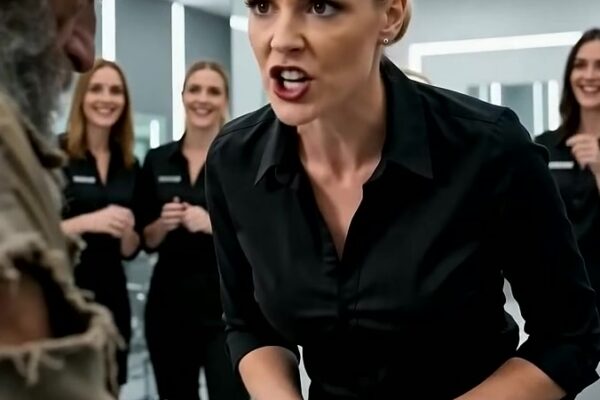
Vanessa walked alongside, perfectly paced, her arm occasionally brushing Daniel’s as if to reassure him they were a single unit. She always wore the same calm expression, the same practiced sympathy for strangers who glanced at the chair and then looked away too quickly.
“We’re taking it day by day,” she would say when someone asked. Her voice carried just enough tremble to sound honest. “The treatments are… hard.”
Daniel had learned to let her talk. After the funeral, he had lost language for anything except logistics—bills, locks, empty rooms. Vanessa had arrived with lists and certainty. She had taken the appointment calls, managed the medications, set alarms for doses. When Daniel asked questions, her answers came swiftly, coated in compassion and medical terms that made him feel ignorant for doubting.
He didn’t doubt. Not really. Doubting felt like pushing a finger into a wound just to see if it still bled. He believed because belief was lighter than suspicion, and he was already carrying too much.
That Sunday, the air had the thin bite of early autumn. Leaves skittered over the pavement like nervous hands. Daniel’s fingers tightened on the grips when he saw someone step off the grass and into their path.
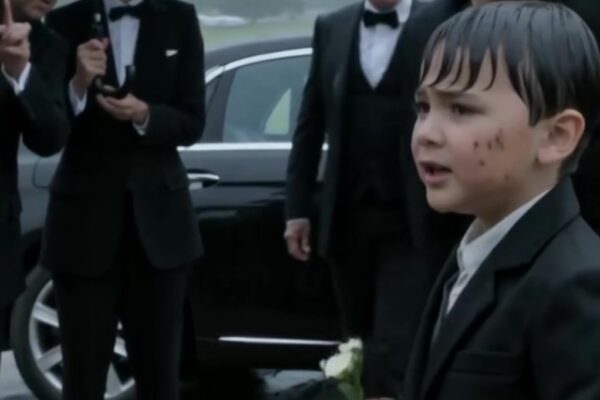
A boy—maybe sixteen, maybe younger—stood squarely in front of the wheelchair. He wore a dark hoodie and jeans too big for him, and his hands shook as if he’d run all the way there. But his eyes were steady, fixed on Daniel with a strange, fierce clarity.
“Move,” Daniel snapped before he could help himself. Anger rose fast in him these days, a flare to hide the fear underneath.
The boy didn’t move. His throat bobbed as he swallowed, and he spoke in a voice that cracked but didn’t break. “Your daughter isn’t sick.”
For a moment the park seemed to hush. The breeze paused. The pond stopped glittering. Daniel felt the words land against his chest like a thrown stone.
Vanessa went stiff beside him. Daniel’s jaw clenched. Emma’s eyes dropped to her lap, as if she’d been waiting for the ground to open.
“What did you say?” Daniel asked, quieter now, because the boy’s certainty unsettled him in a way rudeness never could.
The boy lifted a trembling hand and pointed—not at Emma, but at Vanessa. “It’s her. She did it.”
Vanessa’s breath caught. “Excuse me?” she said, but her voice had lost its rehearsed softness. It was too sharp, too quick.
Daniel’s mind searched for a reasonable explanation, found none, and settled on disbelief as a shield. “You don’t know what you’re talking about.”
“I do,” the boy insisted. His cheeks were pale, as if courage had drained him. “My mom used to clean your house. Before she got sick. She took me with her sometimes when she couldn’t afford a sitter.” He swallowed again, hard. “I saw things.”
Vanessa took half a step back, and Daniel noticed it the way you notice a floorboard shifting under your foot. “This is insane,” she said. “Daniel, don’t listen—”
“What did you see?” Daniel asked, and he hated how the words came out hungry.
The boy’s gaze flicked to Emma, softening for the first time. “I was in the hallway,” he said, “waiting. And I heard crying. Not like sick crying. Like scared crying. I looked in the bathroom and…” His voice faltered. He blinked rapidly, as if the memory stung. “Vanessa had scissors. Emma was sitting on the closed toilet lid, shaking. She kept saying she didn’t want to. Vanessa kept saying it was necessary.”
Daniel’s skin prickled. He turned slowly toward Vanessa, as though sudden movement might shatter something fragile and unseen. “Is that true?” he asked.
Vanessa’s eyes shone instantly with tears, too fast, too perfect. “No,” she said. “Daniel, I would never—”
She reached for his arm, but he flinched without thinking. The flinch surprised them both.
Then Emma moved.
It was small—just a lift of her hand from her lap—but it pulled all attention to her like a magnet. Her fingers were clenched into a fist so tight her knuckles looked white. Daniel leaned closer, his heart pounding loud enough to drown out the distant chatter of the park.
“Em?” he whispered, using the nickname he hadn’t dared to use lately because it felt like calling for someone who wasn’t there.
Emma’s lips parted. No sound came at first. Her eyes glistened as if tears had been waiting behind them for weeks, held back by a dam of fear. With trembling effort, she opened her fist.
Three small blue pills sat in her palm.
Daniel stared. He knew their color, though he couldn’t have named them. He’d seen them in a weekly organizer. He’d watched Vanessa place them beside a glass of juice. He’d thanked her for being so careful.
Emma’s voice emerged thin as thread. “She makes me take them,” she whispered. “Before you come home.”
The boy exhaled like he’d been holding his breath for years. “She told my mom they were vitamins,” he said quickly, desperate to be heard now that the door had cracked. “But my mom saw the bottle once. She looked it up. She said it wasn’t for kids.”
Daniel’s mouth went dry. He looked at Vanessa. For the first time, he saw not a savior but a stranger wearing a familiar face.
Vanessa’s tears spilled over. “Daniel,” she pleaded, “I’m trying to help her. You don’t understand what grief does to a child—”
“Stop,” Daniel said, and his voice was low, dangerous in its steadiness. He took the pills gently from Emma’s palm as though they were fragile evidence. “What are these?”
Vanessa’s gaze darted to the boy, then to the path behind them, calculating. “It’s complicated,” she whispered. “She panics. She gets… hysterical. This keeps her calm.”
“My legs,” Emma breathed, as if the confession itself hurt. “They go fuzzy. I can’t feel them. And she says that means the medicine is working. That I have to stay in the chair.”
Daniel felt something in him break—not a clean snap, but a slow tearing, like fabric that had been stretched too far. He remembered Emma stumbling once in the kitchen and Vanessa’s quick hands on her shoulders, forcing her gently but firmly back into the chair. He remembered Vanessa insisting on keeping the house quiet, the curtains drawn, the visits limited. He remembered how Emma’s world had shrunk to what Vanessa allowed.
He looked down at his daughter and saw what he hadn’t wanted to see: not illness, but obedience. A child trained to disappear.
“Why didn’t you tell me?” he asked, and the question sounded like an apology and an accusation at once.
Emma’s eyes finally met his. They were wide and terrified, full of the kind of fear that didn’t belong in a park on a Sunday. “Because she said…” Emma’s voice faltered. She glanced at Vanessa the way prey glances at a shadow. “She said if I told you the truth, you would hate me. And she said you’d send me away… like Mom left.”
The words struck Daniel so hard he nearly staggered. Vanessa’s face changed—just for an instant, the mask slipping to reveal something cold and cornered underneath. Then she forced her expression back into sorrow.
Daniel straightened, his hands tightening on the wheelchair handles until his fingers ached. The park was still pretending at peace, but the air around them had turned sharp with consequences.
“Vanessa,” he said, and her name sounded unfamiliar on his tongue. “Step away from her.”
Vanessa shook her head, tears still shining. “Daniel, please. You’re confused. You’re grieving. You need me.”
He looked at Emma, at the pills, at the boy who had risked being called a liar. Something steadier than grief rose in him—protective, furious, clear.
“No,” Daniel said. “She needs me. And I’m done being blind.”
Vanessa’s gaze flicked toward the exit of the park, and Daniel saw the decision forming behind her eyes, swift and desperate. He pulled the wheelchair back a fraction, positioning Emma behind him as if his body could become a wall.
The boy took a cautious step closer. “Call someone,” he said urgently. “Don’t let her take her.”
Daniel’s hand went to his pocket for his phone, but his fingers shook so badly he fumbled it. Vanessa watched, breathing fast now, her composure cracking like thin ice.
And as Daniel finally got the phone in his grip, Emma whispered something else—so softly he almost missed it.
“Dad,” she said, voice breaking, “she told me you wouldn’t believe me. She said you’d choose her.”
Daniel’s throat burned. He opened his mouth to answer, to promise, to undo months of silence with one sentence—
But Vanessa turned and ran.