Every year, when the leaves turned brown and the wind started to taste like winter, Daniel and Claire Mercer came back to the same grave. They arrived with the same careful timing, as if grief were an appointment neither of them could reschedule. Daniel carried chrysanthemums wrapped in paper that had gone soft from his sweating palms. Claire brought a tin of biscuits she never opened—an offering made more to memory than to earth.
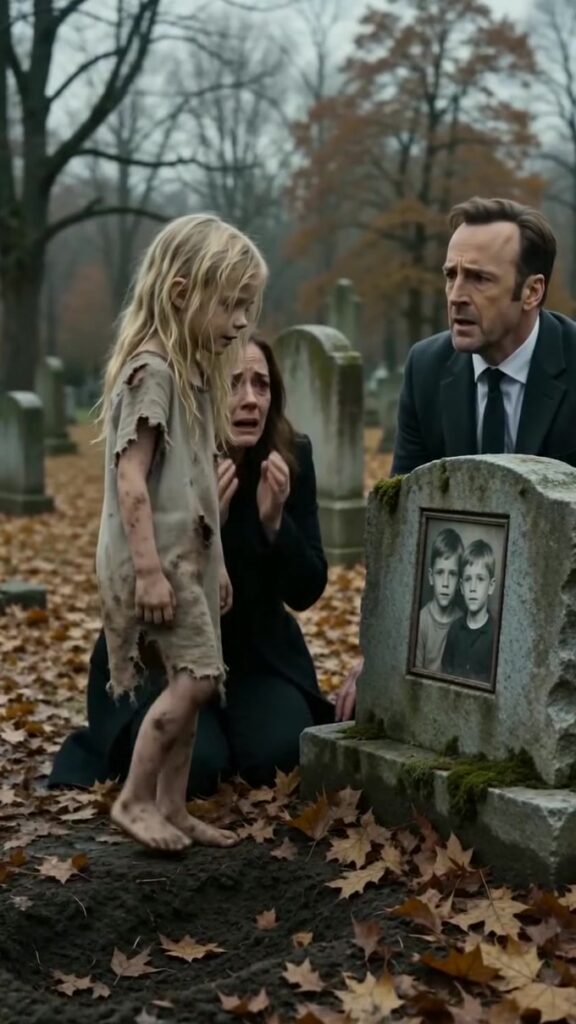
The cemetery sat on the edge of town where the streetlamps thinned out and the darkness looked older. Their boys’ marker stood under two skeletal maples at the far end, the stone mottled and pale, a portrait sealed beneath glass: Evan and Luke, cheeks round with summer, eyes bright with a trust the world had not kept.
Claire sank down first, her knees finding the damp ground as if it had been carved for her. She pressed her forehead to the stone and made the small sounds that came when crying had worn itself out and returned as something rawer. Daniel knelt beside her, his hand braced on her shoulder, his face fixed into the hard stillness he’d learned in the years after the fire—years of investigators, condolences, and waking at 3 a.m. with the taste of smoke that wasn’t there.
“I’m sorry,” Claire whispered to the headstone, the words lost in wind. “I’m so sorry.”
Daniel didn’t speak. His apologies had all been used up the first year. Since then, he came because the calendar demanded it, because leaving them alone in the ground felt like another abandonment, because somewhere in the quiet he could still hear Luke’s whistle and Evan’s laugh as if the sound had soaked into the soil.
A dry leaf skittered across the granite. Another followed, and another, until the air seemed full of small restless bodies. Then, from the far side of the stone, a voice interrupted the wind—thin, steady, too young to belong among the graves.
“They aren’t here.”
Claire froze mid-sob. Daniel’s hand tightened on her shoulder so hard she flinched. He leaned forward and peered around the headstone.
A girl stood there barefoot on the cold grass. Blond hair, tangled and unbrushed, lifted and fell like seaweed in a tide. A gray smock hung off her thin frame, torn at the hem and streaked with dirt. Her eyes were startlingly calm, the color of rainwater.
Daniel swallowed. “What did you say?”
The girl pointed at the photograph embedded in the stone. “The small one cries when it’s dark. The big one tells him to hush, because it makes her mad.” Her voice didn’t tremble. It carried the certainty of a child repeating rules.
Claire’s hands slid away from her face. The pallor that came over her skin looked like someone had blown out a candle inside her. She stared at the girl as if she were seeing a ghost with mud on its feet.
“Who… who told you that?” Claire asked, her words scraping.
The girl’s brows drew together, puzzled that the answer wasn’t obvious. “He did.” She tapped the glass over Luke’s face. “He said his mother used to sing. Not loud. Just enough to cover the bad noises.”
Claire made a sound like a swallowed scream. Daniel felt the blood drain from his fingers.
The lullaby had been hers. She’d invented it on an exhausted night when Luke wouldn’t stop shaking after thunder. No one knew it. Not the priest. Not the firefighters. Not the neighbors who’d brought casseroles and pity.
“Listen,” Daniel said, forcing his voice to stay level, “what’s your name?”
The girl’s gaze slipped away, then returned. “Mara.” She hesitated, like the name was borrowed. “They told me to find you when the trees went bare again. When the air bit.”
“Where are they?” Claire whispered.
Mara’s mouth tightened. “At Saint Agnes House. On the east side. Behind the river road.”
Daniel had heard of Saint Agnes the way people heard of a storm in a neighboring county—vaguely, with distant unease. A charity, an orphanage, a place run by a woman who attended city meetings and smiled too brightly. It took children no one wanted and gave the town a story it could feel good about.
“Our sons died,” Daniel said, the statement tasting like rust. “We identified them.”
Mara shook her head, slow and deliberate. “There are rocks beneath this ground. Heavy ones. That’s what she said you would bury, because people need something to visit.”
Claire’s fingers dug into Daniel’s sleeve. “No,” she breathed. “No, no—”
Daniel felt the world tilt, that sickening moment when a life’s foundation shifts. He gripped the stone with both hands as if it could anchor him.
Mara reached into the sagging pocket of her smock. She pulled out a small silver whistle on a broken chain. The metal was dull with age, but the crescent-shaped scratch across its side was unmistakable.
Claire’s eyes went wide, then filled so fast the tears spilled without blinking. “Luke’s,” she choked.
Daniel took it as though it were fragile glass. His thumb found the scratch, the place where Luke had dropped it down the porch steps and cried until Daniel promised it was still special. They’d never recovered it after the fire. Daniel had told himself it melted. He had told himself a thousand lies because truth had been unbearable.
“Where did you get this?” Daniel asked.
Mara’s composure finally cracked; her lower lip trembled. “He pushed it through a hole in the wall. In the locked room. He said if I ever got out, I had to give it to you before she moved them.”
“Moved them,” Daniel repeated, his voice turning rough. “Where?”
Mara glanced toward the cemetery entrance, as if the headstones might be listening. “I don’t know. She talks on the phone. She says names are dangerous. She says children are like paperwork—you can file them anywhere.” Mara rubbed her wrist, and Daniel saw the faint purple band of a bruise shaped like fingers.
Claire rose abruptly, unsteady but determined. “Take us to them,” she said, and in her voice Daniel heard a mother clawing her way out of a grave. “Now.”
Mara didn’t answer. Her eyes were fixed beyond them, past the leaning angels and the iron fence. The wind rose, and with it came the low rumble of an engine.
A black sedan had stopped at the cemetery gate, too polished for this place. A tall woman stepped out, dressed in a dark coat that looked expensive even in the dull light. Her hair was pinned back neatly. From this distance Daniel could still see the sharpness of her posture, the way she held herself as if the world existed to be managed.
The woman’s gaze found them. It did not wander. It landed, and it stayed.
Mara’s breath hitched. “That’s her,” she whispered.
Daniel slid the whistle into his pocket and stood, placing himself between the woman and the child without thinking. Claire moved to his side, her hand gripping his as if she could steady herself by force. The woman began walking toward them through the rows, her heels striking stone paths with measured patience.
Daniel’s mind raced through options—run, fight, call the police—and found each one tangled in the same horrible question: if this was true, how many people had helped hide it? How long had their sons been alive somewhere, calling for them in a locked room, while Daniel and Claire knelt at a monument built over stones?
The woman stopped a few yards away and smiled, a practiced curve that didn’t reach her eyes. “Mara,” she said gently, as if calling a pet back to heel. “There you are. You know you’re not allowed to wander.”
Mara pressed closer to Daniel, trembling now. Claire’s voice came out ragged. “Who are you?”
“A caretaker,” the woman replied, her gaze flicking to the photograph in the stone. “And you must be the Mercers. I’ve heard your tragedy. Such devotion, coming here every year.”
Daniel felt something in him harden into a point. “Where are my sons?”
The woman’s smile held. “You’re grieving,” she said softly. “Grief invents stories. Little girls invent them too.”
Daniel took a step forward. “She has Luke’s whistle,” he said. “The one we never found.”
For the first time, the woman’s expression changed—just a flicker, like a shadow passing behind a curtain. Then it was gone. “Trinkets circulate,” she said. “Firemen keep souvenirs. Children steal.”
Claire’s nails bit into Daniel’s hand. “If you touch her,” Claire whispered, voice shaking with a fury so old it had become sacred, “I will tear you apart.”
The wind lifted a spiral of leaves between them. The woman’s eyes narrowed slightly, assessing. Behind her, the black car waited like an open mouth.
Daniel looked down at Mara, at the bruises and the dirt and the terrible bravery of her coming here. He realized she hadn’t come for attention. She’d come because two boys—his boys—had asked her to, because hope had been smuggled through a hole in a wall and carried on bare feet across a city.
Daniel drew in a breath that burned. “Mara,” he said quietly, “when we run, you run with us.” He raised his voice then, letting it ring across the graves. “And if you’re thinking of stopping us,” he told the woman, “remember: this is a cemetery. People will hear a scream.”
The woman’s smile thinned. Claire leaned close to Daniel and whispered the lullaby under her breath—not to soothe herself, but like a vow spoken over a blade.
As the first cold drops of rain began to fall, Daniel made a choice he hadn’t known he was capable of. He stopped being a man who visited a grave. He became, again, a father trying to get his children back from the dark.
And the woman in the dark coat took one slow step closer, as if she’d been waiting all year for this moment too.