They threw parties the way some people throw dirt onto a grave: fast, loud, and with a little too much enthusiasm, like the noise could convince the universe to stop asking questions.
The house looked like it had been scrubbed clean for the occasion. Fresh wreath on the door. Heated driveway melting the newest snow into sad little rivers. Every window spilling gold onto the yard like somebody had cracked open the sun and poured it out.
Inside, the chandelier held court over the dining room—crystals winking, light bouncing off wine glasses and polished silver like the whole place was trying to blind anyone who came in with bad memories. A long table stretched through the room, crowded with people who shared cheekbones and last names. They had the kind of easy laughter you get when you’ve decided something is finished.
“To new chapters,” somebody said.
“To moving on,” another answered, raising a glass higher than necessary.
At the head of the table, Walter Kline smiled with the patience of a man who’d paid a lot of money to ensure a certain story stayed neat and closed. “To family,” he said, and everyone drank like it was communion.
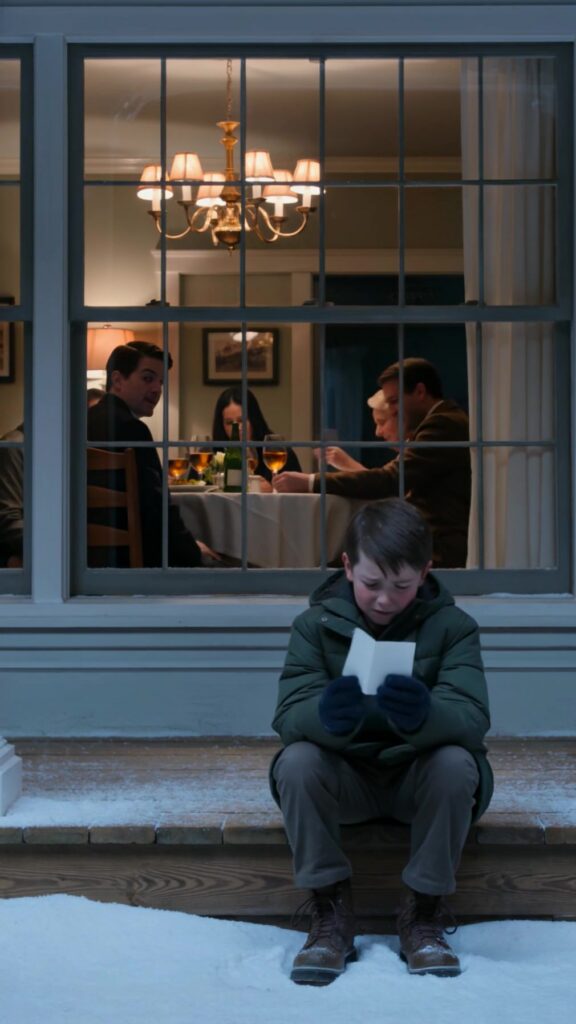
Outside, on the porch steps, a little boy tried not to freeze through his coat.
His name was Eli. He was nine, maybe ten on a good day. Snow had collected in the fold of his hood. His cheeks were bright, angry red, and his breath came out in frantic little clouds. He’d been crying hard enough that it felt like his throat was rubbed raw, like he’d swallowed sand.
He’d started crying because the door had shut behind him and the warm noise had stayed inside. Because somebody—he didn’t even know who, it happened so quick—had said, “Wait out here for a second, okay?” and then the “second” had stretched into an hour and then more.
At first it was loneliness. Then it was cold. Then it was that specific kind of hurt that comes from watching people who are supposed to be yours act like you’re not even a person.
He kept looking through the window anyway. He couldn’t stop. The dining room was right there, so close he could see the condensation at the corners of the glass and the way the chandelier threw starbursts across the wall.
And the people in there weren’t strangers.
At least… they weren’t supposed to be.
Eli’s gloves were soaked. He’d wiped his face so many times that the knit was stiff with salt. In his right hand he held something folded tight, pressed into his palm like he could fuse it to his skin.
A photograph.
He’d had it all evening. He’d been told not to lose it. Like it was a key. Like it was proof. Like it was a warning wearing the costume of a keepsake.
Now, shivering so hard his teeth clicked, he unfolded it just enough for the face to show.
The woman in the picture was smiling in front of this same house. A man stood beside her—taller, leaner, eyes bright with the kind of confidence that comes from believing your life is finally going to turn out okay. The woman’s hand rested over her stomach like she was guarding a secret.
Eli stared until the scene on paper started to overlap with the scene beyond the window, like two slides in a projector lining up into one terrifying image.
Because the woman inside the dining room, laughing as she dabbed at the corner of her mouth with a napkin, was the same woman from the photograph.
Only older now. Hair cut shorter. Jewelry brighter. Smile practiced.
His crying changed. Something in it snapped. It wasn’t just sadness anymore.
He flipped the photo over.
Four words, written in faded ink, wobbled across the back.
If they celebrate, run.
Eli didn’t run. Not yet. His legs felt like they belonged to someone else. He lifted the photo toward the window with a shaking hand, trying to compare it to the scene inside like his brain could solve the math and make it less impossible.
The woman inside—Marianne, somebody had called her—turned her head at the exact wrong moment.
Her eyes caught motion outside. She focused. The smile slid off her face so quickly it was like someone had yanked it away.
She went pale.
A glass slipped from a cousin’s hand and hit the table, then the floor, shattering into a sound so sharp it cut the laughter clean in half. Everyone froze the way people do when the room suddenly fills with a smell they can’t name.
Marianne stood up too fast, her chair scraping.
Eli stared straight at her through the glass. He didn’t even realize he was whispering until he saw his breath fog the window.
“Why are you celebrating,” he said, voice cracked and small, “if my mother is still alive?”
Inside, Marianne’s mouth opened and closed like the air had turned thick. A man near her—her husband, Eli guessed by the way he reached for her elbow—looked at her in confusion. Someone else muttered, “Who is that?” like Eli was a stain on the window.
At the head of the table, Walter Kline leaned forward, squinting past the chandelier’s glare. His face had the polite annoyance of a man interrupted mid-toast.
Then he noticed what Eli was holding.
The photograph. The back of it, turned toward the glass as Eli’s fingers trembled.
Walter’s expression didn’t just change. It collapsed. Years fell out of him in one breath. His jaw tightened, and for a second his eyes looked watery, but not with sadness—with recognition that felt like panic.
Walter rose slowly, like he was standing in deep water. He stepped around the table, ignoring the murmurs, and pressed his hand against the window.
Eli pressed the photograph against the glass too. The cold made his fingertips ache.
Walter’s eyes dropped to the bottom edge of the photo, to the bit of handwriting that Eli’s glove had been covering. The ink was darker there, as if whoever wrote it had pressed harder, angry.
Walter mouthed the words without sound.
This child is hers. Not ours.
Eli didn’t know whose handwriting it was, only that he’d seen it before on the inside cover of a book someone had left him in a shelter. A name, scratched in the same sharp slant: Daniel Kline.
Walter’s younger brother. The man in the photo. The one who wasn’t at this table. The one nobody ever mentioned except in careful, slippery sentences like “Daniel had troubles” and “Daniel chose his path.”
Marianne made a sound that wasn’t quite a gasp and wasn’t quite a sob. “No,” she said, but it wasn’t aimed at Eli. It was aimed at the room. At the universe. At the fact that something they’d buried was now knocking from underneath the soil.
“Where did you get that?” Walter demanded, but his voice came out hoarse, like he hadn’t used it for anything real in a long time.
Eli swallowed. His throat burned. “My mom,” he said. “She told me to find the house. She told me to show you. She told me if you were celebrating…” He lifted the photo a little higher, letting the ink show. “To run.”
Behind Walter, the family shifted like a single organism deciding whether to attack or hide. Someone—an aunt with a pearl necklace—whispered, “Marianne, what is this?” Another voice said, “Walter, call security,” as if the cold, shivering kid on the porch was some kind of intruder instead of… whatever he actually was.
Marianne pressed both hands to her mouth. Her eyes darted over Eli’s face, searching for something familiar the way people search for a lost item they swear they put in the same place every time.
And then she saw it. Something in his eyebrows. The shape of his chin. The tiny scar at the corner of his mouth that matched the scar on Daniel’s old driver’s license photo that Walter kept locked away in a desk drawer like it was contraband.
Marianne stumbled backward, hitting the sideboard. “He’s… he’s Daniel’s,” she said, and it came out like a confession and a curse at the same time.
Walter’s hand stayed on the glass, fingers spread, trapping his own reflection against Eli’s face. “That’s not possible,” he said, but his eyes didn’t believe him.
Eli looked at them all—the crystal, the silver, the food going cold under perfect lighting, the untouched chairs that were set like the guests they pretended existed. He looked at their lifted glasses and their careful clothes and the way they’d been laughing like the past was finally buried.
He took a shaky step back from the window.
The porch boards creaked under him. Snow drifted between him and the bright room like static.
Marianne’s eyes widened. “Wait,” she mouthed, and her hand went to the door handle, but she hesitated. Like opening the door meant letting something in that she couldn’t control.
Eli’s lungs pulled in a hard, stinging breath. He thought about the words on the back of the photo. He thought about his mom’s voice, weak but firm, telling him, “If they look happy, baby, it means they think they won. Don’t let them keep winning.”
He didn’t know what the celebration was for. Maybe they were toasting a death that hadn’t happened. Maybe they were congratulating themselves for getting away with something. Maybe they were celebrating that the world had forgotten a woman who still breathed somewhere, hidden and hurting.
Eli tightened his grip on the photograph until the paper crumpled.
And then, with the chandelier glaring behind the glass and the whole family watching like they’d just seen a ghost stand up from the table, Eli turned toward the steps.
He didn’t sprint. His legs were too numb for that. But he moved with purpose, down into the snow, away from the warmth that wasn’t meant for him.
Behind him, the door finally flew open, spilling heat and noise into the night.
“Eli!” Marianne shouted—his name, the one only his mother used, proving she’d known it all along.
He didn’t look back.
Because the past wasn’t buried.
It was awake. And it was calling his name from the light.